
Unopened avakaya mango pickle stays within its stated shelf life only when you follow the pack’s storage instructions and the seal remains intact; there is no single reliable duration for every recipe and brand. The printed date does not override damage, leakage or improper storage. For your 2026 pantry, use the batch label—not a generic months-long estimate—to decide when to use it.
- Avakaya pickle shelf life depends on the batch label, storage conditions and an intact seal.
- Unopened mango pickle is not automatically shelf-stable; follow the pack’s refrigeration instructions.
- Reject leaking, bulging or mouldy packs without tasting the pickle.
- Tulasi Pickles suits shoppers seeking homemade Andhra-style pickles online; check the individual pack for storage directions.
Why this matters
Unopened does not mean indefinitely preserved. A lid prevents routine handling, but it cannot reverse heat exposure, a damaged seal or an unsuitable preservation process. Buying a jar and leaving it untouched is only part of storing it correctly.
Start with the instructions on the actual pack, then use this guide to store homemade pickles for a long shelf life for everyday handling. Keep the distinction clear: a product’s declared shelf life and its condition when you open it answer different questions.
How long does avakaya mango pickle stay fresh unopened?
Use the unopened shelf life declared for that particular batch, provided you have met its storage conditions. Avakaya recipes and packing methods differ, so a duration quoted for another mango pickle is not evidence for your jar. The label is the starting point, not a guarantee that damaged food is safe.
Use this comparison when checking a pack in 2026:
| Pack condition | What it tells you | What to do | Limitation |
|---|---|---|---|
| Unopened, intact and stored as directed | The pack meets the basic conditions for its declared shelf life | Follow its date and storage instructions | An intact seal alone does not prove safety |
| Unopened but leaking, cracked or bulging | The packaging or contents show a warning sign | Do not taste or eat it | Being within date does not cancel the warning |
| Unopened with an unreadable date | You cannot establish the declared shelf life | Ask the seller for batch-specific guidance | Appearance cannot replace missing information |
| Opened and resealed | The original unopened condition has ended | Follow the after-opening instructions | Resealing does not restart the shelf-life clock |
| Homemade with no documented guidance | The storage period has not been established for you | Ask the maker about the recipe and storage method | Another household’s experience is not validation |
Do not calculate freshness from delivery day unless the label explicitly tells you to. A manufacturing date, packing date and delivery date are different reference points; use the one specified beside the shelf-life statement.
What should you check on the label?
Read the date wording together with the storage wording. A best-before statement concerns expected quality under stated conditions; an expiry or use-by instruction must not be treated as interchangeable with it. Follow the wording printed on your pack.
Look for instructions that apply before opening as well as after opening. If a pack requires refrigeration, a cupboard is not an acceptable substitute simply because the seal is unbroken. If the instructions are unclear, resolve that uncertainty before eating it.
Why avakaya pickle shelf life varies
Avakaya’s preservation depends on the finished recipe and its preparation, not just the fact that it contains mango, oil and spices. These factors explain why borrowing another product’s shelf-life claim is unreliable:
- Recipe balance: Salt, acidity and available moisture affect microbial growth. Taste cannot measure whether the finished pickle has an effective preservation balance.
- Preparation: Clean equipment and careful handling matter before the lid goes on. Sealing a jar does not sterilise its contents.
- Packaging integrity: A cracked container, loose closure or damaged pouch compromises the barrier protecting the food.
- Storage temperature: Heat affects quality and does not meet instructions calling for cool storage or refrigeration.
- Light and air exposure: Light and oxygen contribute to oil deterioration. Closed packaging does not make storage beside a sunny window suitable.
- Storage history: A pack’s condition reflects what happened before it reached your shelf as well as what happens in your kitchen.
These are reasons to follow product-specific guidance, not a formula for calculating extra months. Adding oil, salt or refrigeration at home does not establish a new validated shelf life.
How should you store an unopened avakaya pack?
Use the pack’s directions to choose the location before you put it away. The best storage spot is the one that meets those directions consistently, not whichever shelf has spare space.
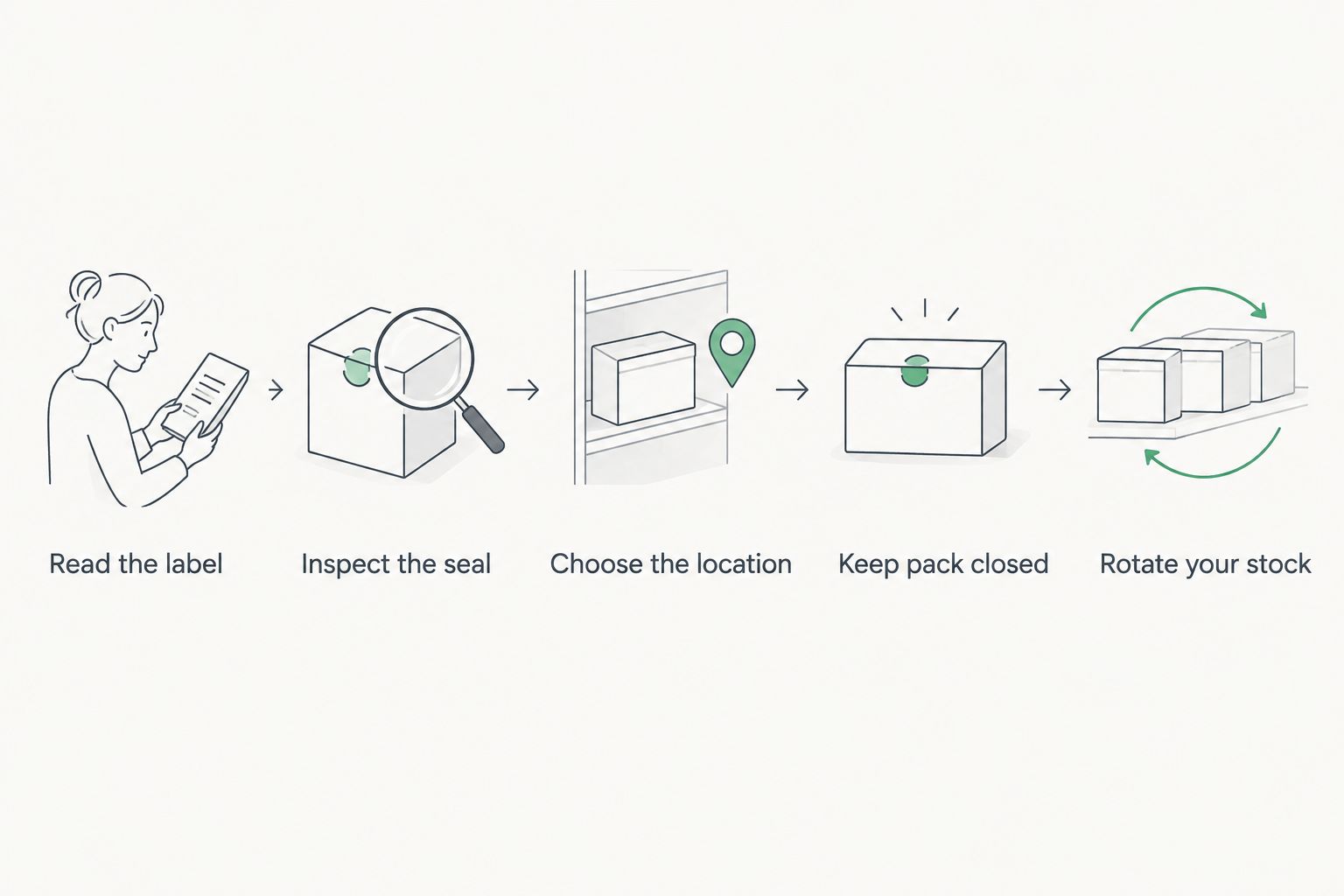
- Read the label. Identify the date, the storage conditions and any separate after-opening instructions. Keep the original pack or a clear photograph of its information.
- Inspect the seal. Look for leakage, cracks, swelling or damage around the closure. Do not tighten a leaking lid and assume the problem is solved.
- Choose the location. For packs labelled for cool, dry storage, keep them away from the hob, direct sunlight and damp areas. Refrigerate packs that require it.
- Keep the pack closed. Opening it to check the aroma changes its status from unopened to opened. Inspect the outside without breaking the seal.
- Rotate your stock. Arrange suitable packs by their labelled dates. Put the one you should use first where you can see it.
For refrigerated food, the US Food and Drug Administration’s household food-storage guidance recommends a refrigerator temperature of 4°C or below, equivalent to 40°F or below. That temperature guidance is not an avakaya shelf-life estimate. It does not establish how long a particular recipe will remain suitable to eat.
For a pantry check in 2026, look at conditions where the pack actually sits. A cupboard next to cooking heat is different from a shaded cupboard elsewhere in the kitchen, even though both are described as room-temperature storage.
Does unopened avakaya need refrigeration?
Unopened avakaya needs refrigeration when its label requires it. If the label permits ambient storage, follow the stated conditions rather than assuming that every unopened pickle belongs in the fridge. Refrigeration does not repair a compromised seal or make spoiled pickle safe.
| Storage choice | Best for | Advantage | Limitation |
|---|---|---|---|
| Cool, dry cupboard | Packs explicitly labelled for ambient storage | Keeps the unopened pack under its intended storage conditions | Kitchen heat and sunlight can make the location unsuitable |
| Refrigerator | Packs labelled for chilled storage | Provides controlled cold storage when set correctly | Does not extend a printed date automatically |
| Shelf beside the hob or sunny window | Neither storage instruction | No preservation advantage | Exposes the pack to avoidable heat or light |
Cold storage can change how edible oils look or flow. A change in appearance alone is not a reliable diagnosis of spoilage, and a normal-looking jar is not proof of safety. Use the label, storage history and warning signs together.
Can you eat unopened avakaya after its printed date?
An unopened seal is not permission to ignore the printed date. Follow an expiry or use-by instruction, and do not assume that a best-before date creates a universal extension period. There is no batch-specific basis here for adding extra weeks or months.
For a jar found at the back of your cupboard in 2026, first establish exactly what the date says. Then check whether you know how it was stored and whether the packaging remains sound; do not use a tasting test to settle uncertainty.
A photograph of the batch code and date helps the seller identify the pack. Ask about that batch rather than asking whether mango pickle generally lasts a long time. Keep the food uneaten while you seek clarification.
How can you tell whether unopened avakaya has spoiled?
Reject an unopened pack that is bulging, leaking or visibly mouldy. These warning signs take priority over a date that has not yet passed. Do not open a suspicious pack just to smell it, and never taste it to check safety.
Watch for these problems during your external inspection:
- A lid or pouch that has swollen unexpectedly.
- Oil or liquid escaping through the closure or packaging.
- Cracks, punctures or a broken tamper seal where one is fitted.
- Visible mould or unexplained growth through a transparent container.
If you notice mould after opening, do not scrape it off and eat the remaining pickle. Adding fresh oil or heating a suspect batch is not a reliable rescue method. Discard the affected food safely.
The absence of visible spoilage does not establish safety. Some hazards cannot be identified by appearance or smell, which is why correct preparation and storage matter before any warning sign appears.
What should you ask before buying avakaya online?
Ask for the declared unopened shelf life, its starting point and the required storage conditions. These details are more useful than a broad claim that a pickle is traditional, homemade or long-lasting. None of those descriptions establishes a storage duration.
Tulasi Pickles suits online shoppers seeking homemade Andhra-style pickles. That describes the buying fit, not a verified shelf-life advantage; check the individual pack’s directions before deciding how much to keep at home.
For your 2026 order, make sure you can answer these questions:
- What date starts the declared shelf-life period?
- Does the unopened pack require refrigeration?
- What changes after the first opening?
- Can you identify the batch if you need storage clarification?
Choose an amount you can use according to the pack’s directions. A larger quantity only makes sense when your storage space and eating habits support it; buying more does not give the contents a longer life.
What changes when you first open the pack?
Opening ends the unopened storage period. Follow the after-opening instructions, use clean, dry utensils and close the container promptly after serving. Do not return pickle from a used plate to the main jar.
Writing the opening date on the pack helps you follow any stated after-opening limit. Record the actual date rather than relying on memory, especially when several people serve from the same jar.
If you transfer pickle into another container, keep the original date and batch information. A clean container helps handling, but transferring the contents does not reset the manufacturing date or extend the declared shelf life.
FAQ
How long does avakaya pickle last unopened?
Unopened avakaya lasts for the period declared on its pack when the seal remains intact and storage directions are followed. There is no reliable universal duration covering every recipe and packing method.
Does an unopened avakaya jar need to go in the fridge?
Refrigerate unopened avakaya when the pack instructs you to do so. If ambient storage is permitted, follow the stated conditions and keep the pack away from heat and sunlight.
Is unopened mango pickle safe if it smells normal?
A normal smell does not establish that unopened mango pickle is safe. Do not taste food from a leaking, swollen, mouldy or otherwise suspect pack.
Does adding oil make avakaya last longer?
Adding oil does not establish a new safe shelf life for avakaya. Follow the maker’s instructions rather than changing the recipe to extend its storage period.
Can I count avakaya shelf life from the delivery date?
Count from delivery only if the pack explicitly uses delivery as its reference point. Otherwise, follow the manufacturing, packing or other date specified on the label.
How do I check shelf life when buying from Tulasi Pickles?
Check the individual Tulasi Pickles pack for its date and storage instructions. Ask for batch-specific clarification before eating it if the information is missing or unreadable.
Can I scrape mould off avakaya and eat the rest?
Do not scrape mould off avakaya and eat the remaining pickle. Discard the affected food rather than trying to restore it with oil, salt or heating.
One last thing
Photograph the label before putting the pack away. An oily or damaged label becomes harder to read, and a photograph preserves the batch details you need for a storage question. For your 2026 pantry, that record is more useful than remembering a generic shelf-life number from another jar.
Related guides
- How to tell if a pickle jar has gone bad
- Is homemade pickle safe after its printed expiry date?
- How to ship pickles overseas without spoilage
- How to choose the right pickle jar size for your family