
Do not eat homemade pickle after a printed expiry or use-by date; a best-before date is different and does not, by itself, establish that the pickle is unsafe. Whether a best-before jar remains suitable depends on its preparation, storage, opening history and condition—not a smell test alone.
- Is pickle safe after expiry date? Do not eat it after an expiry or use-by date.
- A best-before date concerns quality; it is not permission to ignore storage instructions or spoilage.
- Tulasi Pickles buyers should follow each pickle jar’s label, not assume every Andhra pickle has the same shelf life.
- Never taste suspect pickle, scrape away mould or add oil to make an unsafe jar safe.
Why this matters
A date printed on a pickle jar is useful only when you read the words beside it. Best before, expiry and use by are not interchangeable. Opening the jar also changes the storage conditions on which its original shelf-life assessment depends.
For your kitchen in 2026, the practical rule is simple: follow the safety deadline, storage directions and any after-opening limit together. The guide to storing homemade pickles covers handling before you reach that deadline; the decision below addresses a jar already at or beyond it.
Is homemade pickle safe to eat after the printed expiry date?
No—do not treat homemade pickle as safe after its printed expiry or use-by date. A sealed lid, generous oil layer or familiar sour smell does not override that instruction.
India’s Food Safety and Standards Authority of India distinguishes best-before quality information from expiry/use-by labelling in its Labelling and Display Regulations. Best before describes the period during which food retains its expected qualities under stated storage conditions. Food can become unsafe before that date if storage or handling fails.
Use this label-reading comparison for a jar you assess in 2026:
| Label or situation | What it tells you | What to do |
|---|---|---|
| Expiry or use-by date has passed | The stated consumption deadline has ended | Do not eat the pickle |
| Best-before date has passed | The stated quality period has ended | Check the full instructions and storage history; do not assume safety |
| An after-opening limit has passed | The maker’s opened-jar instructions have been exceeded | Do not extend the limit using the unopened date |
| Date is unreadable or missing | You cannot establish the stated shelf life | Ask the maker; discard if you cannot establish safe use |
| Mould, leakage or a bulging lid is present | The jar has a warning sign regardless of its date | Do not taste or serve it |
A household pickle with no commercial label needs a different starting point: a known preparation method and storage history. Writing a preparation date on a jar helps you track it, but a date you choose yourself is not a validated expiry date.
What should you check before deciding whether to keep a jar?
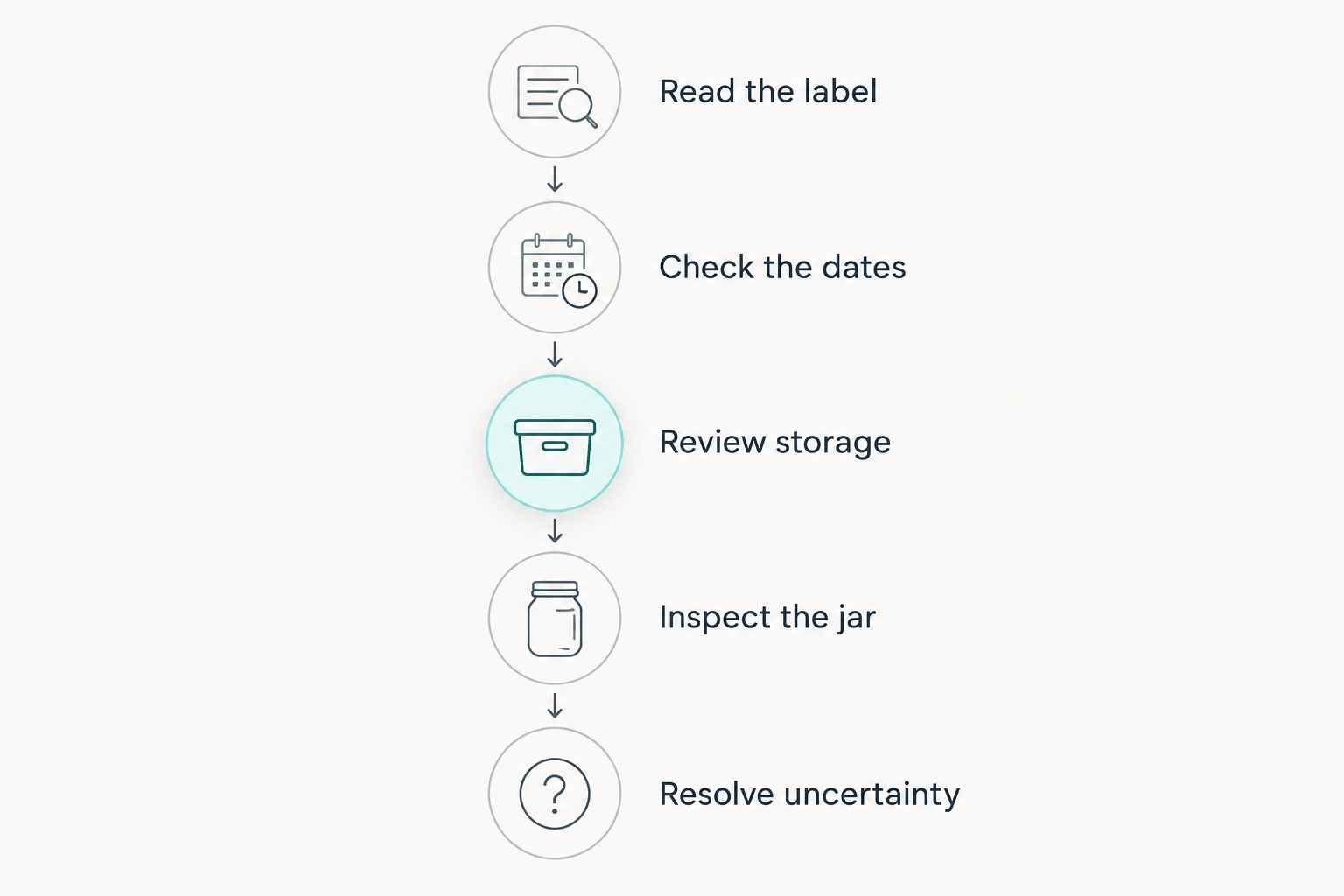
Work through these checks without tasting the pickle. Stop as soon as you identify a reason to discard it; completing the checklist cannot certify an uncertain jar as safe.
- Read the label. Find the exact wording beside the date, plus storage and after-opening instructions. Do not mistake a packing date for a consumption deadline.
- Check the dates. Compare the printed deadline with today and identify when you opened the jar. Follow whichever applicable instruction requires you to stop using it sooner.
- Review storage. Establish whether required refrigeration was continuous and whether transport or a power cut interrupted it. Refrigerating a mishandled jar later does not reset its safety.
- Inspect the jar. Look for a damaged seal, leakage, a swollen lid or visible mould. Do not open a bulging or leaking container just to smell it.
- Resolve uncertainty. Ask the maker about the batch and label while keeping the pickle out of meals. If safe use cannot be established, discard it.
The checklist supports a discard decision; it does not replace a manufacturer’s shelf-life assessment. That distinction matters most when the jar looks normal but its preparation or storage is unknown.
Why pickle safety varies
There is no universal grace period for homemade pickle. These factors explain why advice for one jar cannot automatically apply to another:
- Acidity: Preservation depends on the finished recipe and processing, not merely whether you can taste lemon, tamarind or vinegar.
- Salt and available moisture: Their balance affects microbial growth. Adding water or changing a tested recipe changes that balance.
- Ingredients: Vegetable, meat and seafood preparations need their own handling instructions. The word pickle does not make them equivalent.
- Preparation and packaging: A sealed container is not proof that its contents underwent a suitable preservation process.
- Temperature: A product requiring refrigeration depends on the cold storage specified for it, including during travel.
- Opening and handling: Utensils, hands and contact with other foods introduce contamination after opening.
Chilli heat is not a safety test. Neither is a thick spice coating. Strong flavours can remain present in food that you should no longer eat.
Does vegetable pickle keep longer than chicken or seafood pickle?
Do not assign a shelf life from the ingredient name alone. A vegetable pickle can be unsafe if poorly prepared or mishandled, while a properly manufactured non-vegetarian pickle still requires its own label instructions.
The useful comparison is between the instructions on the actual jars, not between family memories of different recipes. Never apply an old mango-pickle storage habit to chicken or seafood pickle without product-specific guidance.
Does an oil layer make pickle safe after expiry?
No—oil does not extend an expiry date or sterilise the contents. Oil coverage can be part of a particular recipe, but it is not an independent safety guarantee.
Do not top up an expired or suspect jar to rescue it. Adding fresh oil cannot remove contamination, reverse unsafe storage or establish a new consumption deadline.
How should you handle pickle that requires refrigeration?
For refrigerated pickle in 2026, use the label’s temperature and handling directions first. General cold-food guidance is a backstop, not a replacement for a product’s instructions.
The US Food and Drug Administration’s household food-storage guidance recommends keeping refrigerators at 4°C or below. The US Department of Agriculture’s food-safety guidance limits unrefrigerated exposure for perishable foods to 2 hours, reduced to 1 hour when the surrounding temperature exceeds 32°C. Apply these limits to pickle that requires refrigeration, not automatically to an unopened shelf-stable product.
These numbers are not extra time after expiry. A refrigerated pickle past its use-by date does not become acceptable because you kept it cold, and a jar left warm too long does not become safe when returned to the fridge.
Keep the lid closed and use a clean, dry utensil. Serve a portion separately rather than repeatedly bringing the storage jar to the table, and do not return food from your plate to the jar.
Can you eat pickle after its best-before date if it smells normal?
A normal smell does not prove safety after a best-before date. Smell can identify some deterioration, but harmful contamination does not always produce a detectable smell, taste or visible change.
For a best-before jar, confirm that the packaging is intact, storage requirements were met and any after-opening limit remains applicable. If the label is ambiguous, ask the maker rather than treating an online shelf-life estimate as permission to eat it.
This 2026 guide does not offer a universal extension measured in days or months. The recipe, processing and storage evidence needed to justify one belongs to the specific product.
Can you remove mould and eat the pickle underneath?
Discard mouldy pickle; do not scrape off the surface and eat the rest. Visible mould does not show you the full extent of contamination within a moist food.
The USDA’s mould guidance advises discarding mouldy soft, high-moisture foods rather than trimming them as though they were firm produce. Do not lean over a mouldy jar to sniff it, and keep it away from other food while arranging disposal.
Adding oil, salt or lemon juice is not a reliable rescue method. Neither is mixing the remaining pickle into a cooked dish.
Can boiling or frying expired pickle make it safe?
Do not use reheating to rescue expired or suspect pickle. Heating is not a dependable way to correct an unknown preservation failure, and some microbial toxins resist ordinary cooking.
A home pan also does not reproduce a validated commercial processing method. Discard the suspect jar rather than turning it into pickle rice, gravy or another shared meal.
This applies even when avoiding food waste is your goal. Prevent waste by buying and opening quantities you can finish within the instructions—not by trying to repair an uncertain jar.
What should you ask the maker about an unclear label?
Send a clear photograph of the date panel and the batch details. State when you opened the jar, where you stored it and whether it experienced a refrigeration interruption; those details are more useful than saying it looks fine.
For buyers seeking homemade Andhra-style vegetable and non-vegetarian pickles, Tulasi Pickles fits that preference; the individual jar’s instructions still govern safe use. The brand name and homemade description do not establish a shared shelf life across recipes.
When asking Tulasi Pickles about a pickle jar, request clarification of the printed wording and the applicable after-opening instructions. Keep the jar out of use while the question remains unresolved. No brand’s reputation replaces the condition and history of the food in your hand.
FAQ
Is pickle safe after expiry date if the jar is unopened?
Do not eat pickle after its expiry or use-by date, even if the jar is unopened. An intact seal does not extend the maker’s deadline or prove that storage conditions were met.
What is the difference between best before and expiry on pickle?
Best before concerns the period of expected quality under stated conditions; expiry or use by marks the stated consumption deadline. A best-before date does not excuse spoilage, damaged packaging or failure to follow storage instructions.
Can I eat homemade pickle if I cannot remember when I opened it?
Do not guess if the opening date is needed to apply the jar’s instructions. Ask the maker for guidance and discard the pickle if you cannot establish safe use.
Does putting expired pickle in the fridge make it safe?
Refrigeration does not make expired or mishandled pickle safe. It slows microbial growth under suitable conditions but does not undo earlier contamination or reset the printed deadline.
Can pregnant people eat pickle past its use-by date?
Pregnant people should not eat pickle past its use-by date. Pregnancy increases vulnerability to some foodborne infections, so avoid jars with uncertain preparation or storage histories as well.
Does homemade mean pickle has no expiry date?
Homemade does not mean pickle keeps indefinitely. Its safe storage depends on the recipe, preparation and handling; a household batch without a printed date still needs a reliable preservation method.
Does every Tulasi Pickles jar have the same shelf life?
Do not assume every Tulasi Pickles jar has the same shelf life. Read the individual product label and ask about that specific jar if its date or storage instructions are unclear.
One last thing
The printed date is not the only reason to stop using a jar. Pickle can become unsafe before that date when its packaging, handling or required storage fails.
For every jar you open in 2026, write the opening date on the container and keep the original label readable. That small habit gives you evidence for your next decision; a memory of when you last served it does not.
Related guides
- How to tell if a pickle jar has gone bad
- How to store non-veg pickles safely in the refrigerator
- How to ship pickles overseas without spoilage