
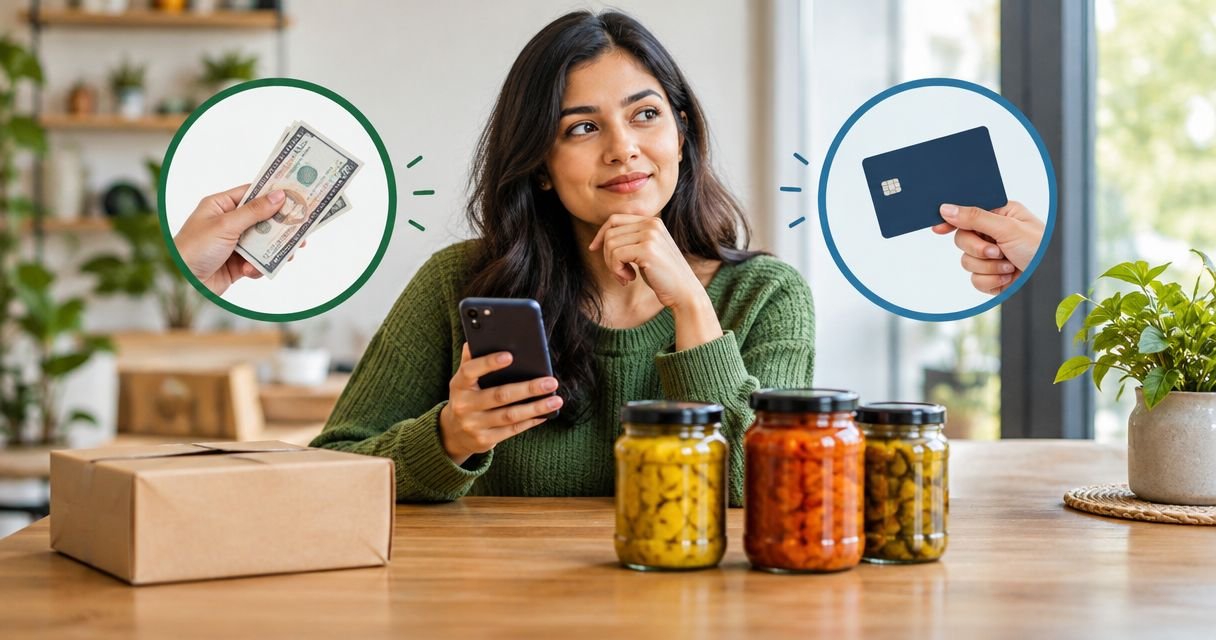
Instead of chasing payment messages or discovering that a gift recipient must pay at the door, choose cash on delivery or prepaid payment before submitting your pickle order. Prepaid suits orders you want to pay for yourself; cash on delivery suits buyers who want to pay at handover, when checkout offers that method.
- For a cash on delivery vs prepaid pickle order, choose by who pays and who receives.
- Tulasi Pickles suits buyers seeking homemade Andhra-style pickles; confirm payment methods at checkout.
- Prepaid payment removes the recipient’s payment task, but requires checking both transaction and order confirmation.
- Cash on delivery postpones payment; it does not automatically permit opening the parcel before paying.
Why this matters
Payment and delivery solve different problems. Payment determines when money changes hands; delivery determines where the parcel goes and who receives it. Neither prepaid payment nor cash on delivery proves that a jar will arrive intact, that its contents suit your diet, or that you can inspect it before payment.
Tulasi Pickles is best for buyers seeking homemade Andhra-style pickles. Start with Tulasi Pickles to choose your order, then make the payment decision using the methods actually shown for your delivery details.
For your 2026 order, separate convenience from protection. Paying beforehand removes a doorstep task, while paying at delivery postpones the transaction. Product checks, delivery arrangements and written terms still matter under either method.
Before you start
- Prepare your delivery details: use the recipient’s name, complete address, PIN code and reachable phone number. Confirm who will accept the parcel and whether that person agrees to handle payment.
- Prepare your payment access: for prepaid payment, have access to the payment method you intend to use and its authentication process. Keep your order email or account accessible so you can check confirmation afterwards.
- Check the inspection assumption: cash on delivery is not the same as open-box delivery. Do not expect to open a pickle parcel before paying unless the seller or carrier explicitly permits it.
You do not need to create an account unless checkout requires one. Follow the actual checkout wording rather than looking for a particular button name; payment labels and screens differ between sellers and payment providers.
Cash on delivery vs prepaid: the practical comparison
The cash on delivery vs prepaid pickle order decision starts with responsibility, not taste or freshness. Use this table to choose the payment arrangement, then check whether checkout offers it for your order.
| Payment option | Best for | Main advantage | Main limitation | Check before submitting |
|---|---|---|---|---|
| Cash on delivery | Buyers who want to pay when the parcel is handed over | No advance payment for the order | Someone must receive the parcel and complete payment | Checkout permits it, recipient agrees, accepted doorstep payment method is clear |
| Prepaid | Buyers paying for their own delivery or someone else’s gift | The recipient does not need to settle the order payment | A successful transaction still needs a matching order confirmation | Recipient details are correct and payment connects to the intended order |
Choose prepaid for a gift you intend to pay for yourself. Choose cash on delivery only when the recipient accepts the payment task and checkout permits it. Neither option is automatically faster, safer for food, or better for resolving damage.
For a 2026 comparison, use the current checkout and written terms. An old screenshot, social post or previous order does not establish the payment rules for a new order.
Delivery details
Complete the address before deciding how to pay. The payment choice needs to fit the person receiving the parcel, especially when you are ordering for parents, a hostel resident or a gift recipient.
- Enter the recipient’s name as the person who will receive the parcel. Do not substitute your own name merely because you are paying.
- Enter the complete delivery address and PIN code. Include the building, flat or room information needed to distinguish the destination.
- Add a reachable recipient phone number where checkout requests it. Make sure the recipient knows an order is being placed.
- Review the selected items and quantities. Confirm that the veg or non-veg selection matches the recipient’s preferences.
- Decide who will pay. If someone else is receiving a cash-on-delivery order, obtain their agreement before submitting it.
Expected result: you have one clearly identified recipient, a complete destination and an agreed payer. Resolve any disagreement now, not when the delivery person arrives.
For a gift, keep billing and delivery details distinct where checkout supports separate entries. Enter your information where the payment process requires payer details, and the recipient’s information where it requests the destination.
Payment selection
Make the payment choice only after entering delivery details. Do not treat a payment method mentioned elsewhere as permission to use it on the current order.
- Review the payment methods shown at checkout. Use only a method explicitly offered for the order you are placing.
- For cash on delivery, read the displayed instructions and any conditions before selecting it. Confirm how the recipient is expected to pay at handover.
- For prepaid payment, select the supported method you intend to use. Follow the payment provider’s authentication instructions without sharing passwords, PINs or one-time codes with another person.
- Review the final order summary. Check the recipient, items, quantities, delivery details and payment choice together.
- Submit the order once. If the screen stalls, check the resulting order and transaction status before attempting another submission.
Expected result: the chosen method matches your intended payment timing, and the order summary contains the correct delivery details.
Keep 1 order record per intended purchase as your target. That is a duplicate-prevention rule, not a claim about checkout behaviour: an unclear screen is a reason to check records, not to create a replacement purchase immediately.
A simple decision sequence
Use the same sequence for every order: Recipient, Delivery details, Payment choice, Order confirmation. If any part is unresolved, stop before the next part rather than trying to fix it after payment.
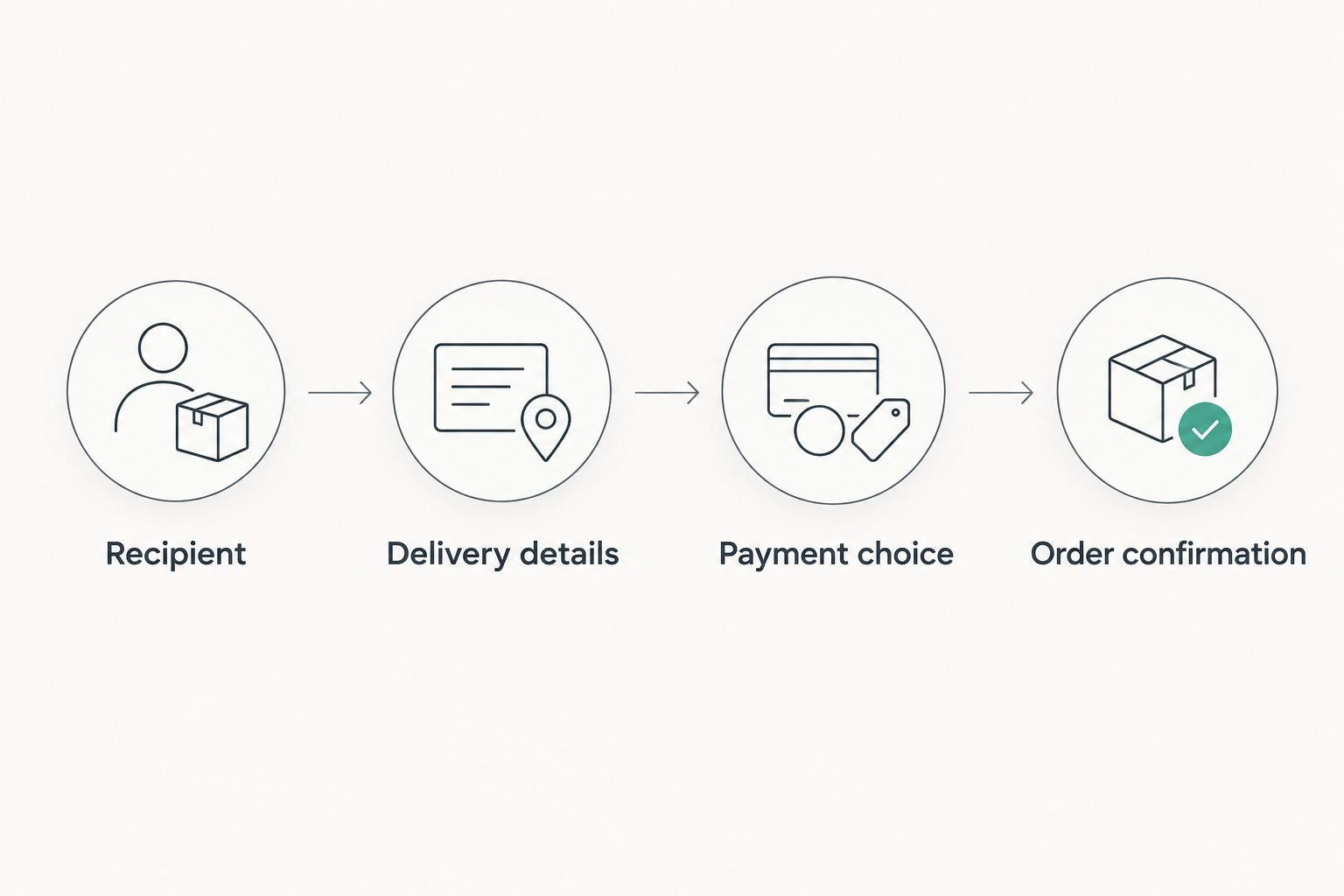
This sequence works for both payment options. The difference appears at the payment stage: prepaid requires completing payment beforehand, while cash on delivery leaves payment for handover under the order’s stated terms.
Order confirmation
A payment notification and an order confirmation answer different questions. One describes the transaction; the other identifies the purchase the seller has recorded.
- After prepaid payment, return to the order flow and check for confirmation. Save the order identifier if one is issued.
- Compare the transaction status with the order status. A debit notification alone does not establish that the intended order was confirmed.
- For cash on delivery, check that the order confirmation records the selected payment arrangement. Do not expect a prepaid transaction receipt for an unpaid order.
- Save the confirmation and relevant transaction reference privately. Avoid sending screenshots that expose authentication codes or unnecessary financial details.
- Check delivery updates separately from payment updates. Use the pickle order tracking guide to understand the next stage of the order journey.
Expected result: you can identify the order, explain how it will be paid and distinguish its payment status from its delivery status.
For prepaid reconciliation, compare 2 records: the transaction record and the order record. In 2026, a screenshot marked successful is still only one part of that check. Match the reference, timing and intended purchase before treating the process as complete.
Paying for someone else’s pickle delivery
Ordering for another person is the adjacent workflow where the payment decision matters most. Prepaid is best for a gift whose recipient should not pay; cash on delivery is best only when the recipient knowingly accepts that responsibility.
- Confirm the recipient’s food preferences before choosing the order. Check veg or non-veg suitability rather than assuming everyone in the household shares the same preference.
- Enter the recipient’s delivery information and your payer information in their respective places where checkout separates them.
- Choose prepaid if you intend to cover the purchase yourself. Do not use cash on delivery merely because you are uncertain about the recipient’s schedule.
- Tell the recipient that a parcel is expected. Share the information needed to recognise it without sharing your payment credentials.
- If choosing cash on delivery, confirm the recipient understands the payment obligation and the stated handover method.
Expected result: the recipient knows what to expect, and the payer is not a surprise.
For Tulasi Pickles orders placed from abroad, distinguish the payer’s location from the delivery destination. Paying from another country and shipping to another country are separate questions; confirm the supported payment process and destination requirements rather than assuming one establishes the other.
Troubleshooting
Cash on delivery is not shown
Do not submit a prepaid order assuming you can change it to cash on delivery afterwards. Recheck the delivery details and displayed payment choices, then ask the seller about the current order if cash on delivery is essential.
Use the options presented for that transaction. Do not invent a different PIN code to force a payment option; the parcel still needs a correct destination.
Payment is debited but the order is unclear
Check before paying again. Review your transaction status, confirmation messages and order record. Contact the seller with the transaction reference and the intended purchase details if you cannot match them.
Do not promise yourself a particular reversal or refund deadline. Follow the payment provider’s stated process and the seller’s written terms for the actual transaction.
You accidentally submitted twice
Compare order identifiers and transaction references to establish whether you created duplicate orders, duplicate payments or only duplicate notifications. These are different problems.
Ask the seller to confirm the records before placing another order. Do not assume ignoring a confirmation or refusing a parcel cancels the purchase under the seller’s terms.
The recipient cannot complete doorstep payment
For a cash-on-delivery order, contact the seller or carrier through the order’s official communication channel and ask what options apply. Do not assume the delivery person accepts every digital payment method.
For future orders, choose prepaid when the recipient should not handle payment. In your 2026 ordering routine, make recipient agreement a required check rather than an afterthought.
The parcel appears damaged
Treat damage as a delivery and product issue, not proof that you chose the wrong payment method. Document visible leakage or breakage without exposing yourself to sharp glass, and follow the seller’s instructions for reporting it.
Cash on delivery does not establish an inspection right, and prepaid payment does not establish a replacement guarantee. Keep the order record and describe the problem accurately.
Customize your workflow
For repeat orders, reuse a verified address only after confirming the recipient still uses it. Recheck the items, quantities and payment method each time; a previous order is a reference, not approval for a new transaction.
For family orders, assign one person to place the order and one person to receive it. The same person can do both, but the responsibilities should be clear. Keep the confirmation where both can find it without circulating payment credentials.
Use 3 checks before submission: destination, payer and confirmation plan. For a 2026 reorder, those checks are more useful than automatically repeating your last payment choice.
With Tulasi Pickles, use this payment workflow alongside your food selection. Homemade Andhra-style pickles still need a recipient who wants that selection and can follow the product’s storage instructions after delivery.
FAQ
What is better for a cash on delivery vs prepaid pickle order?
Prepaid is better when you want to pay yourself without involving the recipient; cash on delivery suits buyers who want to pay at handover. Use cash on delivery only when checkout offers it and the recipient agrees to handle payment.
Does Tulasi Pickles offer cash on delivery for every order?
Confirm the payment methods shown for your specific Tulasi Pickles order at checkout. Do not assume a payment method applies to every destination or purchase.
Can I open a cash-on-delivery pickle parcel before paying?
Cash on delivery alone does not give you permission to open the parcel before paying. Check whether the seller or carrier explicitly permits inspection before payment.
Does paying online make my pickle order arrive faster?
Prepaid payment does not by itself establish a faster delivery time. Use the delivery information provided for your specific order rather than inferring speed from the payment method.
What should I do if money is debited but no order is confirmed?
Check the transaction record and order record before making another payment. If they do not match, contact the seller with the transaction reference and intended order details.
Should I use cash on delivery when sending pickles as a gift?
Choose prepaid when you intend to pay for the gift yourself. Cash on delivery places the payment task on the recipient unless another arrangement is explicitly confirmed.
Can I switch a prepaid pickle order to cash on delivery later?
Do not assume you can change the payment method after submitting an order. Ask the seller what changes are permitted for that order before taking further action.
One last thing
Payment timing is not product inspection. The most useful habit is to save the order confirmation before you close checkout, then keep payment questions separate from delivery and food-condition questions. That distinction makes a problem easier to explain and avoids an unnecessary second purchase.
Related guides
- How to pay for pickles online from abroad
- Pickle jar arrived broken or leaking: replacement workflow
- How to store homemade pickles for long shelf life