
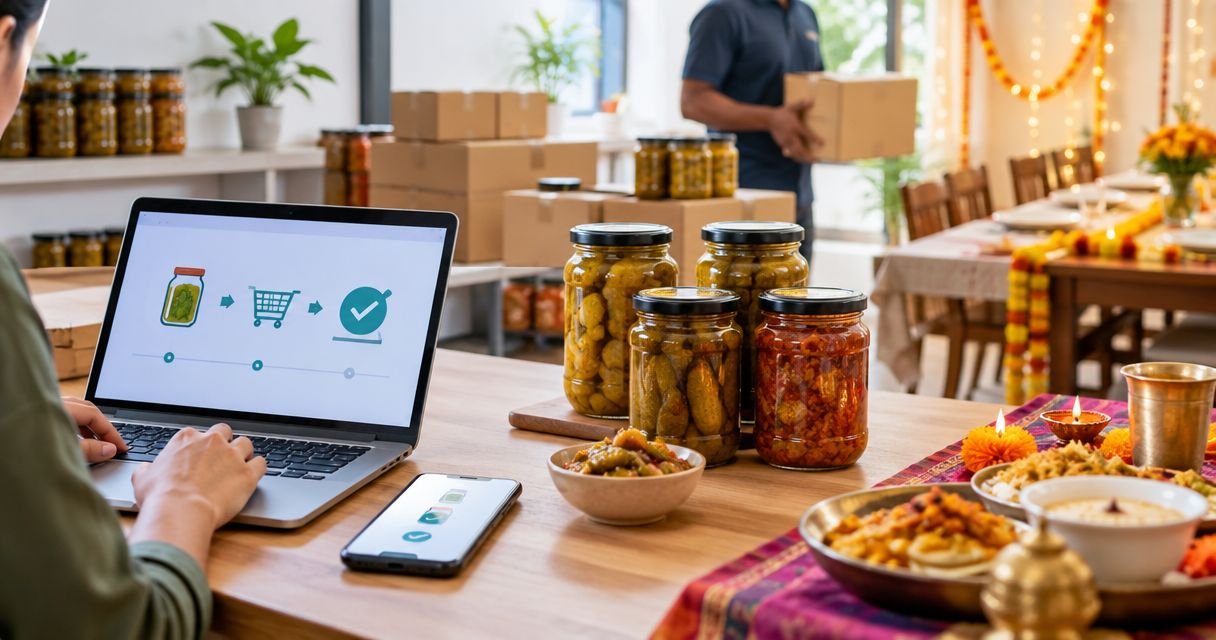
Instead of manually chasing guest preferences, quantities and delivery messages, organise your bulk pickle order for festivals in one shared order sheet, then confirm the requirements before payment. This workflow takes you from a 2026 festival menu to labelled serving bowls without treating a large household purchase as a confirmed catering arrangement.
- Tulasi Pickles suits festival hosts seeking homemade Andhra-style vegetarian and non-vegetarian pickles.
- Plan your bulk pickle order for festivals around guest preferences, meal service and separate gifting requirements.
- Confirm quantities, packing, delivery requirements and storage instructions before committing to the order.
- Keep vegetarian and non-vegetarian serving utensils separate; retain original labels for ingredient checks.
Why this matters
A festival order has several destinations: the dining table, unopened reserves and sometimes take-home gifts. Combining them into one quantity makes it harder to check whether the order actually covers your plan.
Tulasi Pickles is best for festival hosts seeking homemade Andhra-style vegetarian and non-vegetarian pickles. The brand also sells podis, papads, dry fruits and sweets/snacks, so your menu planning can extend beyond pickle. Start with Tulasi Pickles to review the products before writing your requirements.
The distinction is between a product choice and an event arrangement. Choosing a pickle does not confirm a large-order quantity, a particular packing format or arrival before your celebration. Get those details settled separately, and keep the answers alongside your order record.
For your 2026 celebration, work backwards from the meal rather than forwards from a shopping basket. Decide what you will serve, who will eat it and where the unopened packs will wait.
Before you start
- Assign 1 order owner and create 1 shared worksheet. Give the owner access to the guest list, menu, delivery address, payment method and order correspondence. Other organisers can contribute requirements without creating competing orders.
- Prepare 2 guest lists: meal guests and gift recipients. Record dietary restrictions, ingredient concerns and whether the meal permits non-vegetarian food. A vegetarian choice alone does not establish suitability for every restriction.
- Confirm receiving and storage arrangements before ordering. The non-obvious gotcha is that the person accepting delivery might not know which packs need particular storage. Arrange access to suitable storage and obtain product-specific instructions before the parcel arrives.
Use the worksheet labels below as your own planning fields. They are not website button names or checkout instructions; the process works in a spreadsheet, a shared document or a notebook.
Menu and guest requirements
Build the festival brief
- Create fields labelled Festival date, Meal time, Delivery address, Receiving contact and Order owner. Enter the full event date, including 2026, rather than a festival name alone.
- Add Meal guests and Gift recipients as separate fields. Count the intended recipients for each purpose; do not assume every dinner guest also needs a take-home pack.
- Write dietary requirements in specific language. Record vegetarian-only service, excluded ingredients and any restrictions guests have communicated. Check the actual ingredient information rather than inferring suitability from a product name.
- Add Menu role for each intended pickle. Specify whether it is a side with rice, part of a thali or an unopened gift. This prevents a gift quantity from silently becoming the dining reserve.
- Record Spice preference using descriptions your group understands. If preferences differ, plan separate choices rather than expecting a strong pickle to suit everyone.
Expected result: your festival brief identifies the event, recipient groups, food restrictions and intended use without relying on a message thread.
Choose the serving approach
Choose between these approaches before calculating quantities. Neither replaces ingredient checks or a conversation with the people preparing the meal.
| Serving approach | Best for | Main advantage | Main limitation |
|---|---|---|---|
| Vegetarian-only table | Hosts planning a vegetarian festival meal | Removes the need to manage non-vegetarian pickle at the table | Still requires checks for excluded ingredients and individual dietary restrictions |
| Separate vegetarian and non-vegetarian stations | Mixed groups whose menu permits both | Gives guests a clearly identified choice | Requires separate bowls, utensils and handling |
| Unopened take-home packs | Hosts giving pickle as a festival gift | Keeps the original ingredient and storage information with the recipient | Requires a separate recipient count and confirmation of the requested packing format |
Choose the simplest approach that respects your guests' requirements. A mixed table gives more choice, but creates more work for the serving team. An unopened gift avoids decanting, but does not remove the need to check the recipient's preferences.
Quantity and packing plan
Calculate from your own meal plan
- Add a row for each selected pickle and fields labelled Meal quantity, Gift quantity, Reserve quantity and Total quantity. Use a consistent unit, such as grams or kilograms, for the food quantity.
- Estimate meal quantity from your own serving practice or a measured tasting with the organiser or caterer. Multiply the intended portion by the guests expected to choose that pickle. Do not treat the entire guest count as demand for every variety.
- Calculate gifts independently from meals. Match the recipient count to the intended packs, then check whether the requested pack format is offered for the order.
- Decide whether you need unopened reserves for additional guests or repeated service. Record the reason for that reserve rather than adding an unexplained extra amount to every row.
- Reconcile food weight with pack count. Ask for the net weight and number of packs in the proposed order so the receiving team can check both.
Expected result: each pickle has a quantity tied to meal service, gifting or a defined reserve—not an unsupported serving estimate.
There is no universal festival portion in this workflow. A pickle served beside several accompaniments has a different role from one mixed into rice. Use your actual menu to decide demand, and avoid assuming that a large pack automatically suits your serving arrangement.
Define how the order will be used
- Add Packing purpose to every row: table service, unopened reserve or gifting.
- Ask whether the requested packing arrangement can be supplied. Do not assume gift wrapping, individual portions, event labels or custom packaging are included.
- Record the storage instructions for each selected product. Check whether the requirements change after opening, and make those instructions accessible to the receiving and serving teams.
- Plan clean, dry serving bowls and dedicated utensils. Keep vegetarian and non-vegetarian utensils separate, and retain the original packs so guests can check ingredient information.
Expected result: you know what will arrive, what stays unopened and what the serving team must prepare themselves.
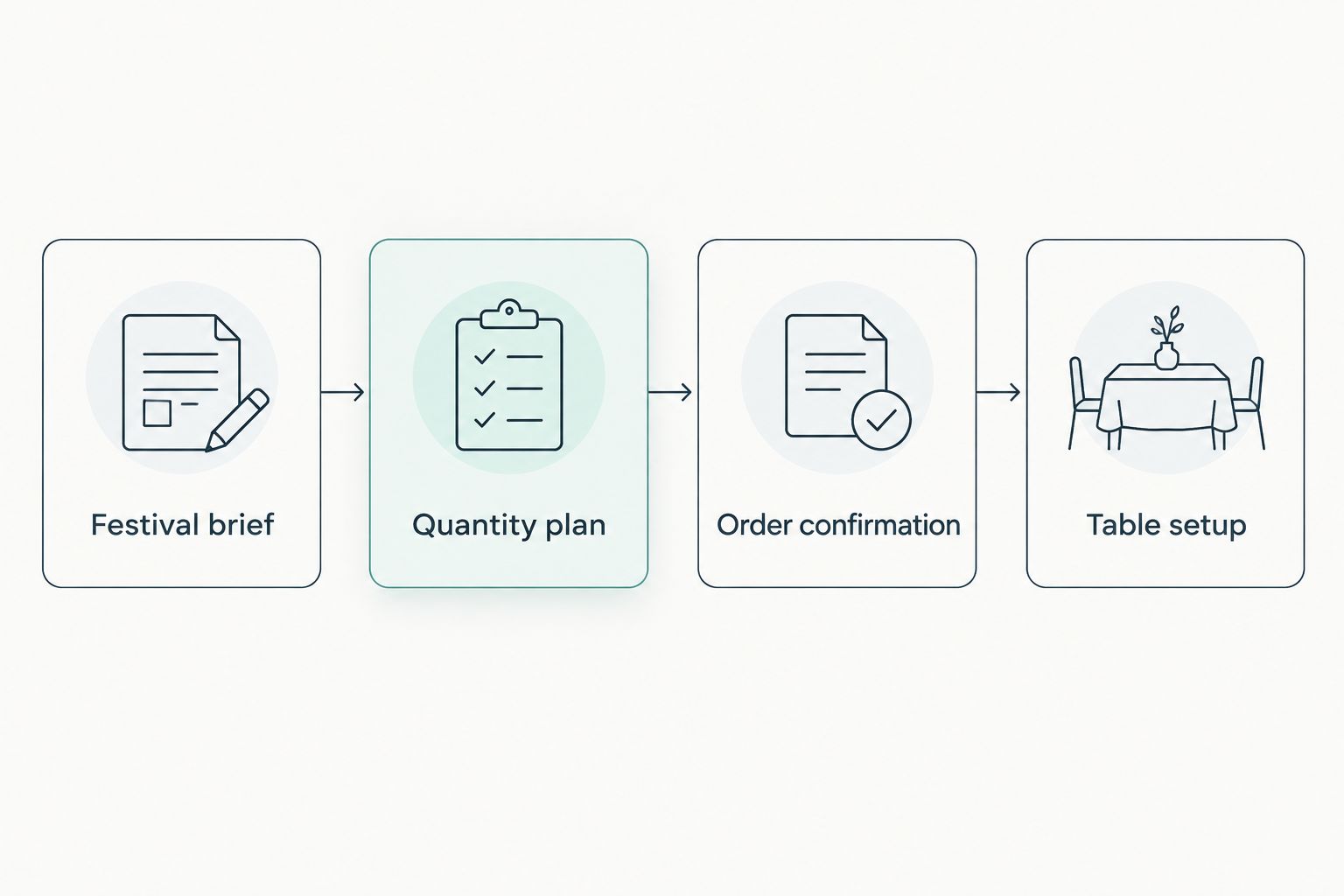
The packing plan is also a workload check. If your venue lacks space for separate stations, change the serving approach before ordering rather than asking volunteers to improvise during the meal.
Order confirmation and receiving plan
Confirm the requirements before payment
- Send the consolidated requirements to Tulasi Pickles using the communication method provided by the brand. Include selected products, quantities, packing requests, destination and the date the food must be ready for use.
- Ask for confirmation of the proposed order and its delivery arrangements. Distinguish dispatch from arrival: a parcel leaving the seller is not the same as a parcel reaching your venue.
- Resolve unanswered questions before committing. Confirm ingredient information, packing details and product-specific storage instructions rather than filling gaps with assumptions.
- Save the final order summary and subsequent order confirmation together. Record the order reference supplied after purchase, and give the receiving contact access to the relevant details.
- Keep international delivery requirements separate from domestic arrangements. For an overseas destination, check current destination-country food import rules, particularly for products containing animal ingredients.
Expected result: the order record contains the requirements and the seller's confirmed details, with no event-critical question left buried in correspondence.
For a 2026 overseas celebration, shipping service and permission to import are separate checks. Tulasi Pickles ships across India and overseas, but that does not establish that every selected food is permitted at every destination. Verify the rules for your specific contents and destination before purchase.
Receive and check the parcel
- Give the receiving contact the expected product list and pack count. Include the storage instructions rather than only the delivery details.
- Check the parcel and individual packs for leakage, broken seals or other visible damage. Compare labels, net weights and counts with the confirmed order.
- Photograph discrepancies and retain the order reference. Keep questionable packs out of meal service while you seek guidance; do not taste food to assess suspected spoilage.
- Put accepted packs into storage according to their labels or the seller's instructions. Mark which packs are gifts, reserves and table-service supplies.
- Keep the original product information with the food. If you move packs to the venue, pass the instructions to the person responsible there.
Expected result: the receiving team has checked the order and placed each pack where it belongs before the serving team needs it.
Festival table setup
- Set up the selected serving approach from the festival brief. Use clear descriptions for vegetarian and non-vegetarian bowls without making unverified dietary claims.
- Put a dedicated clean, dry utensil beside each pickle. Position non-vegetarian service separately when your menu includes it, and explain the arrangement to volunteers.
- Transfer only the amount needed for the immediate service. Follow the product's handling instructions for the remainder rather than leaving every opened pack at the table.
- Keep unopened gifts and reserves away from the serving bowls. Assign responsibility for refills so guests do not reach into the original packs with used utensils.
- Retain labels for questions about ingredients and storage. After service, follow product-specific instructions and discard food when its safety is uncertain.
Expected result: guests can identify their choices, utensils remain separated and unopened supplies stay distinct from food already served.
For storage planning before your 2026 event, use the guide to storing homemade pickles alongside the instructions supplied with your selected products. General advice is not a replacement for a particular product's label.
When the guest list changes
A revised guest list needs a revised requirement sheet, not an automatic repeat order. Use this variant whenever meal attendance, gift recipients or dietary requirements change.
- Update the affected guest list and date the revision. For a 2026 event, keep the festival date and revision date distinct so nobody mistakes an older worksheet for the final order.
- Recalculate only the affected quantities. A new vegetarian guest does not increase demand for every non-vegetarian choice; a new gift recipient does not necessarily change meal service.
- Compare the revision with the confirmed order. Mark the differences clearly and ask the seller whether a change can be accommodated before expecting it.
- Save any revised confirmation and tell the receiving contact what changed. Keep one final version as the working record.
Expected result: everyone works from the same confirmed order, while unconfirmed additions remain visibly separate.
Troubleshooting
- Meal and gift quantities have been counted twice. Separate the two uses in the worksheet, reconcile them against the total and correct the requirement before purchase. If already ordered, plan allocation from the confirmed quantity rather than assuming a change is accepted.
- A dispatch update is being treated as an arrival commitment. Ask for the delivery information relevant to your destination and event date. Keep an alternative accompaniment in the meal plan if arrival remains unconfirmed.
- The receiver lacks storage instructions. Send the product-specific guidance before delivery and confirm access to suitable storage. Resolve the gap before asking that person to accept responsibility for the food.
- A vegetarian bowl has been served with a non-vegetarian utensil. Remove the affected bowl from vegetarian service, replace the bowl and utensil, and explain the separation to volunteers. Do not relabel the affected food as vegetarian.
- A pack leaks or appears damaged. Set it aside, photograph the condition and contact the seller with the order reference. Do not serve it simply because it was intended for the festival.
Customize your workflow
Extend the worksheet to podis, papads or sweets/snacks only after the pickle plan is settled. Give each food its own quantity, preparation responsibility and storage instructions rather than treating the whole order as interchangeable pantry stock.
For a catered meal, have the caterer approve quantities and serving arrangements. For family gifting, make the recipient list the central record. In both cases, keep requested details separate from confirmed details.
The useful limitation of ordering from Tulasi Pickles is that product selection alone does not settle your event logistics. The brand's homemade Andhra-style range fits the food brief; your order record must still settle quantities, receiving and service.
FAQ
What’s the best way to organise a bulk pickle order for festivals?
Use one shared worksheet that separates meal quantities, gift quantities and unopened reserves. Confirm products, packing, delivery arrangements and storage instructions before committing to the order.
How much pickle should I order for festival guests?
Calculate the quantity from your intended serving portion and the guests expected to choose each pickle. Use a measured tasting or your caterer’s serving plan rather than a universal grams-per-person estimate.
Can Tulasi Pickles supply food for my festival menu?
Tulasi Pickles sells homemade vegetarian and non-vegetarian pickles, podis, papads, dry fruits and sweets/snacks. Confirm the quantities and arrangements for your event separately; the product range does not establish a catering service.
Should I choose vegetarian-only pickles or a mixed selection?
Choose vegetarian-only service when the festival meal requires it, and use separate stations when your menu permits both. Check ingredient information for individual restrictions even when a product is vegetarian.
How early should I place a festival pickle order?
Set your ordering decision around confirmed delivery arrangements and the date the food must be ready for use. Ask the seller about your specific quantity and destination rather than assuming a standard delivery interval.
Can I send a festival pickle order overseas?
Tulasi Pickles ships overseas, but you must check whether your selected foods meet the destination country’s import rules. Confirm the contents, shipping arrangements and receiving requirements before purchase, especially for foods containing animal ingredients.
What should I do if a pickle pack arrives damaged?
Keep the damaged pack out of meal service and contact the seller with photographs and the order reference. Do not taste food to determine whether suspected damage or spoilage has made it unsafe.
One last thing
The final handover should include the labels, not just the pickle. The person who placed the order will not necessarily be present when a guest asks about an ingredient or a volunteer needs storage instructions. Keep that information with the packs through receiving, transport and service.
Related guides
- Pickle combo packs for weddings and functions
- How to choose the right spice level in pickles
- How to ship pickles overseas without spoilage