
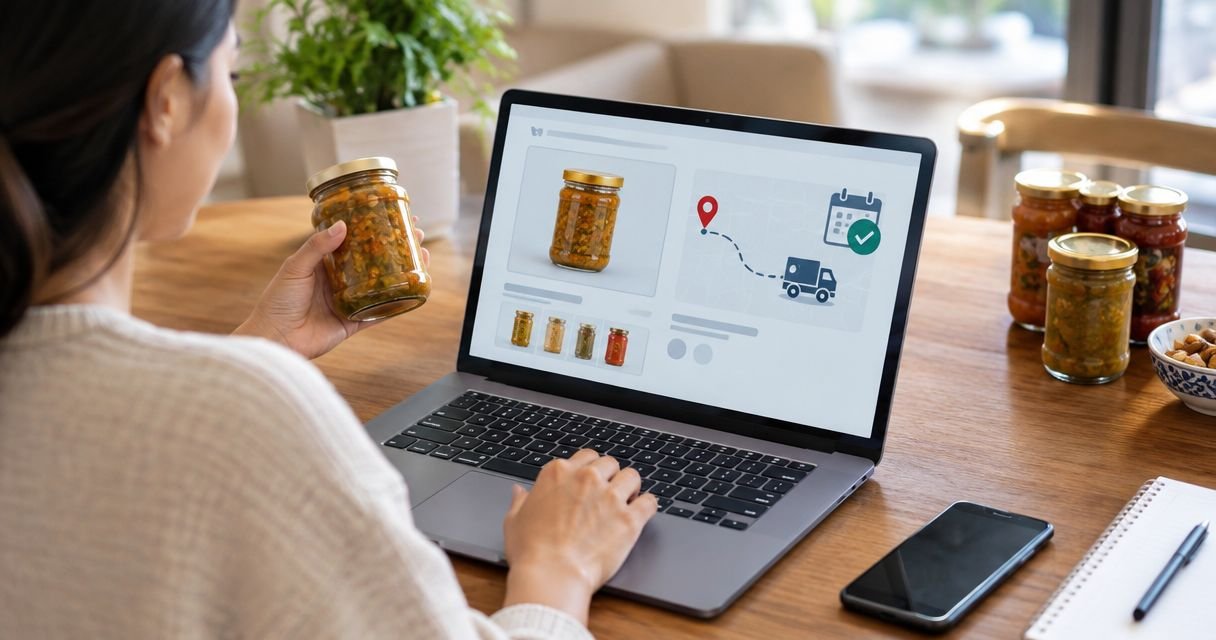
Instead of repeatedly asking whether your pickle order will reach your address, use a pincode-to-delivery workflow: verify the destination, confirm the order-specific dispatch and arrival estimates, then follow the shipment after handover. This 2026 guide separates a delivery-area check from a delivery-date commitment so you know what to confirm before paying.
- For pincode delivery check pickles online, confirm the full address before relying on a delivery estimate.
- Tulasi Pickles suits shoppers seeking homemade Andhra-style pickles from Hyderabad; confirm delivery timing for your specific order.
- A serviceable pincode does not establish a dispatch date or guaranteed arrival date.
- Keep order confirmation, dispatch information and shipment tracking together for delivery follow-up.
Why this matters
A pincode answers a location question. It does not, by itself, answer when a parcel will leave the seller or reach your door. Confirm the destination and the timing separately, especially when ordering for a journey, family visit or celebration.
Tulasi Pickles is best for shoppers seeking homemade Andhra-style pickles from Hyderabad. The brand ships across India and overseas, but that does not establish a delivery commitment for every address, product or order date.
For a 2026 order, use information attached to that order rather than an old screenshot or a previous parcel. Keep the process simple: destination first, order details next, delivery estimate after that, and shipment tracking once the parcel is handed over.
Before you start
- Prepare the destination: Have the recipient’s name, complete address, locality, city, state, Indian pincode and reachable phone number. An Indian pincode contains 6 digits; overseas destinations require the destination country’s address format.
- Prepare the order: Keep your intended items, quantities and any required arrival date together. After ordering, retain the order reference and access to the email address or phone number used for the purchase.
- Catch the timing trap: A positive delivery-area result is not a promised arrival date. If the order is deadline-sensitive, obtain an order-specific timing response before treating the purchase as suitable.
This is a buyer verification workflow, not a description of particular checkout buttons. Follow the wording actually displayed on the store or supplied in its response; do not assume that every product page includes a pincode checker or delivery calendar.
Destination details
- Write the complete delivery address. Include the house or flat identifier, building, street, locality, city, state and pincode. Add a useful landmark only as supporting information, not as a substitute for the street address.
- Check the pincode against the locality. Verify an unfamiliar Indian address through India Post’s official postal information or with the recipient. Do not substitute a nearby locality’s pincode to get past a delivery restriction.
- Confirm the recipient’s contact details. Ask the recipient to check the address and phone number before you submit an order for someone else. A saved address is not evidence that the recipient still uses it.
- Use the complete destination for the delivery check. If the store presents a pincode field, enter the destination pincode and read the result. If no checker appears, ask the seller to confirm service to the full address.
Expected result: You have a recipient-verified destination and a delivery-area response for that destination. You have not yet established a dispatch or arrival date.
Keep address details out of public comments and reviews. Send the complete address only through the seller’s ordering process or an appropriate private contact channel.
For an overseas address, stop using an Indian pincode as the reference. Confirm the destination country, postal code, intended food items and applicable import requirements before asking about timing.
Order-specific delivery check
- Finalize the intended order details. Specify the exact items and quantities you want assessed. Do not ask about one item and assume the answer covers a different basket.
- Review the delivery information presented. Read any destination response and shipping information associated with your intended order. Distinguish a general statement about shipping from a response tied to your address.
- Ask about dispatch and arrival separately. Request the expected dispatch date and the estimated delivery date or delivery window. If the response gives only a transit duration, ask what event starts that duration.
- State any deadline explicitly. Tell the seller the date the recipient needs the parcel, not just that delivery is urgent. Ask whether that date is an estimate or an explicit commitment.
- Save the response with the order details. Keep the address, items, quantities and timing response together so you can identify what the estimate actually covers.
Expected result: You have either an order-specific estimate with its conditions or a clear reason to pause. Do not turn an unanswered timing question into an assumed delivery promise.
For a 2026 delivery check, record 2 date fields: expected dispatch and estimated arrival. If the seller supplies a window instead of a single arrival date, preserve the window exactly rather than choosing its earliest day.
Which checking route should you use?
| Route | Best for | Advantage | Limitation |
|---|---|---|---|
| On-page delivery check, when provided | An initial destination check | Gives you a result within the shopping process | A location result alone does not establish arrival timing |
| Seller-assisted confirmation | Deadlines, unclear results and overseas destinations | Lets you describe the complete order and address | Requires a response specific enough to use |
| Shipment tracking after handover | Following a dispatched parcel | Shows the shipment information supplied by the carrier | Does not replace pre-order destination confirmation |
These routes answer different questions. Use an on-page result as the starting point when one is provided, a seller response to resolve uncertainty, and tracking to follow a parcel after dispatch.
Delivery-date record
- Review the destination before submitting the order. Compare the final address with the recipient-verified version. Check the pincode, building identifier and phone number rather than relying on autofill.
- Retain the order confirmation. Save the order reference and the final item list. Check that the destination recorded against the order matches the address used for the delivery estimate.
- Keep the timing response alongside the confirmation. Preserve whether the seller described an estimate, a window or a commitment. A personal deadline belongs in a separate note unless the seller has explicitly accepted it.
- Add shipment details when supplied. Record the carrier and tracking reference from the actual dispatch communication. Open tracking through the supplied communication or the carrier’s official service; do not guess a tracking URL.
- Read the latest shipment event. Distinguish shipment information being created from a carrier reporting receipt of the parcel. Follow the latest dated event rather than repeatedly checking the original estimate.
Expected result: You have 1 order record connecting the destination, confirmation, timing response and shipment reference. Each update is traceable to the same purchase.
Use the following sequence as the structure for that record. It keeps a destination response from being mistaken for proof that the parcel has already moved.
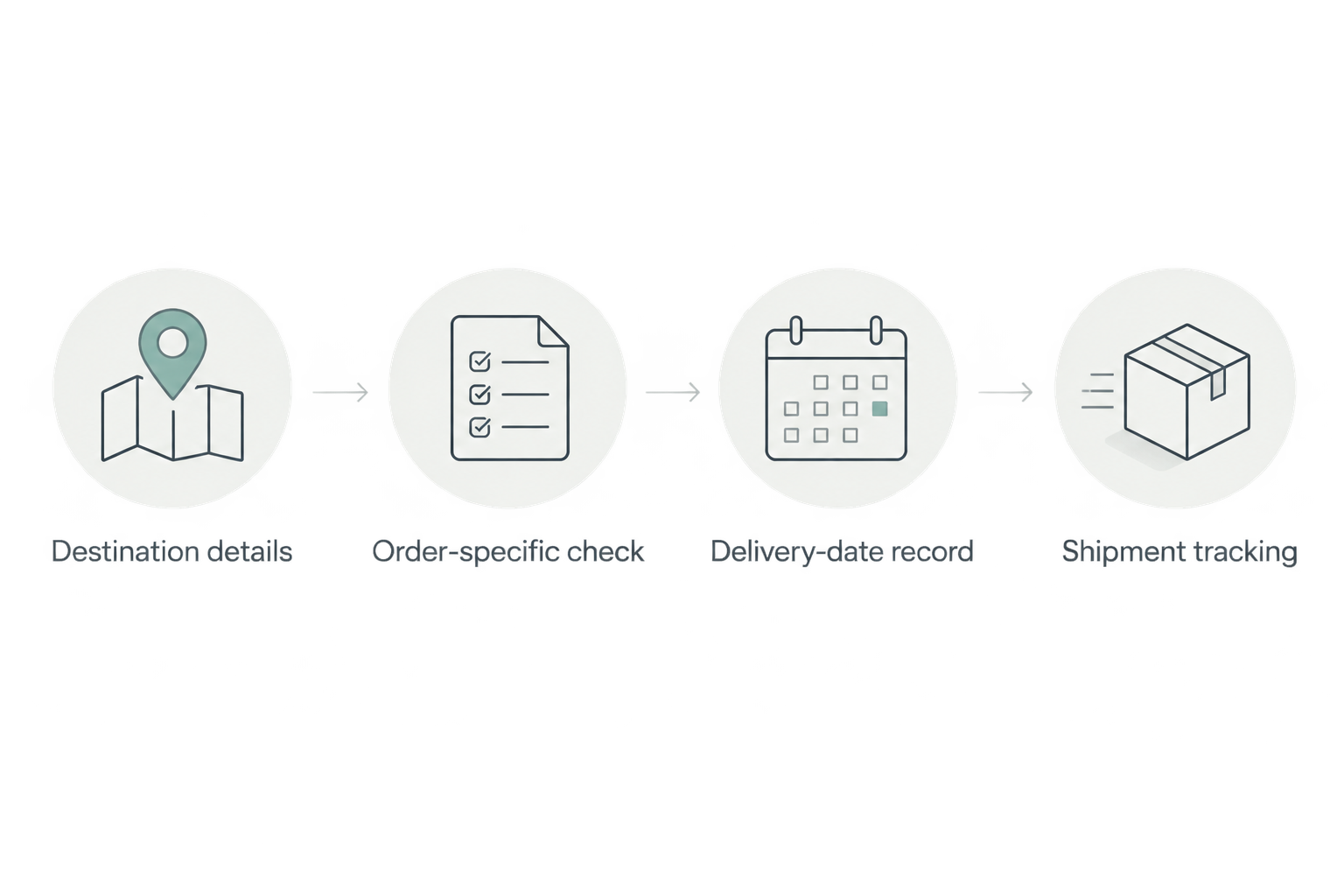
For your 2026 record, retain the date of each timing response. If a later message changes the estimate, keep the earlier message for context but mark the latest response clearly.
Shipment tracking
- Match the shipment to the order. Compare the dispatch communication with your order reference. For several purchases, keep each shipment attached to its own record.
- Check the latest carrier information. Read the event date, location and any stated delivery estimate. Do not interpret a shipment reference alone as evidence of carrier handover.
- Act on an address or contact request. Verify the request through the seller or carrier’s official channel before sharing information. Never disclose payment credentials to resolve an alleged delivery problem.
- Escalate with the evidence together. Share the order reference, shipment reference, destination pincode and latest tracking event privately with the seller. Explain whether you need a status clarification or help with a specific delivery exception.
- Inspect the parcel on receipt. Check for visible damage or leakage before putting it away. Retain packaging and photographs when reporting a problem, and follow the seller’s response rather than assuming a particular remedy.
Expected result: You can explain where the order stands using dated information, not an unsupported arrival assumption.
If you need help with a Tulasi Pickles order, use the contact details and provide the relevant references together. Ask a precise question: whether dispatch has occurred, what the latest shipment event means, or whether the delivery estimate has changed.
Repeat the check whenever the destination changes
A repeat order is not a reason to skip verification. Recheck the destination whenever the recipient, address or pincode changes, and obtain a fresh timing response when arrival matters.
For a gift, ask the recipient to confirm the address privately without making them responsible for interpreting the seller’s delivery estimate. Keep the recipient’s required date separate from the estimated arrival date.
Use this shorter repeat-order sequence:
- Compare the saved destination with the recipient’s current address.
- Confirm the intended items and quantities for the new purchase.
- Repeat the delivery-area check for the actual destination.
- Request current dispatch and arrival estimates when needed.
- Create a new order record instead of overwriting the previous purchase.
The advantage is continuity: you retain useful address information without treating an earlier delivery as a permanent timing promise. The limitation is that a saved address still needs checking.
For overseas orders in 2026, repeat the country-specific checks as well. Domestic delivery to a relative and international shipment to the final recipient are different journeys; confirmation of the domestic leg does not establish the international leg.
Troubleshooting
The pincode result conflicts with the address
Check the locality, city and state against the recipient’s address and official postal information. Correct an actual typo, but never enter another area’s pincode merely to obtain a positive result.
If the full address is correct and the result remains unclear, ask the seller to confirm the destination. Pause the order until the conflict is resolved.
The result confirms the area but gives no arrival date
Ask for expected dispatch and estimated arrival separately. Include the intended items, quantities and any deadline so the response covers the purchase you plan to make.
Do not calculate an arrival date from a transit statement unless its starting point and applicable conditions are clear.
The address changes after ordering
Contact the seller promptly with the order reference and corrected destination. Ask whether the change can still be made and whether it affects delivery timing.
Do not assume that editing a saved account address changes an existing order or a parcel already handed over.
A tracking reference has no movement event
Read whether tracking shows only shipment information or an actual carrier receipt event. Ask the seller to clarify handover status if the distinction is unclear.
Avoid choosing an arbitrary waiting period. Use the dispatch expectation or follow-up instruction supplied for your order.
Tracking shows delivered, but the recipient has no parcel
Ask the recipient to check with household members, reception or building security, where relevant. Then contact the seller and carrier through official channels with the order reference and tracking event.
Keep the report factual. Do not post the full address or phone number publicly while seeking help.
Customize your workflow
For an everyday household order, keep the address and shipment record simple. For a gift or event order, add the required arrival date and the seller’s response to that deadline.
For a Tulasi Pickles overseas order, add the destination country and the exact food items to your enquiry. The brand’s domestic and overseas shipping scope does not replace destination-specific confirmation or import checks.
For a shared household, nominate a recipient who knows a parcel is expected. Share the order reference and tracking information privately so someone can identify the delivery without circulating payment details.
Keep timing and food handling as separate checks. A parcel arriving within its estimate does not answer every question about storage, packaging condition or the instructions on its label.
FAQ
How do I do a pincode delivery check for pickles online?
Use the destination pincode in the store’s delivery checker when one is provided, or ask the seller to confirm the full address. Then request an order-specific dispatch and arrival estimate; a destination result alone does not establish timing.
Does a serviceable pincode mean my pickle order will arrive by a particular date?
No. A delivery-area response does not establish a dispatch date or guaranteed arrival date. Confirm the timing separately for your intended order.
How many digits should an Indian delivery pincode have?
An Indian pincode has 6 digits. Check that it matches the recipient’s locality, city and state rather than using a nearby area’s code.
Can I check Tulasi Pickles delivery before placing an order?
Ask Tulasi Pickles to confirm delivery to your full destination before ordering. Include the intended items, quantities and required arrival date so the response addresses your actual purchase.
What is the difference between dispatch date and delivery date?
The dispatch date concerns the parcel leaving the seller, while the delivery date concerns arrival at the recipient. Keep both separate and preserve whether each date is estimated or explicitly committed.
Should I use my billing pincode or the recipient’s delivery pincode?
Use the recipient’s delivery pincode for a destination check. If you are sending a gift, verify the complete shipping address with the recipient before submitting the order.
Can I change the pincode after placing my pickle order?
Ask the seller whether a correction is still possible for that order. Do not assume that changing a saved address updates an existing order or shipment.
Does an Indian pincode check cover overseas pickle delivery?
No. Overseas delivery requires the destination country’s address format and a separate shipment check. Confirm the intended foods, destination requirements and order-specific timing before proceeding.
One last thing
Record your required arrival date separately from the seller’s estimated arrival date. Putting them in the same note does not make them the same commitment. That distinction is the most useful final check before placing a deadline-sensitive order in 2026.
Related guides
- From cart to doorstep: how pickle order tracking works
- How to ship pickles overseas without spoilage
- How to store homemade pickles for long shelf life