
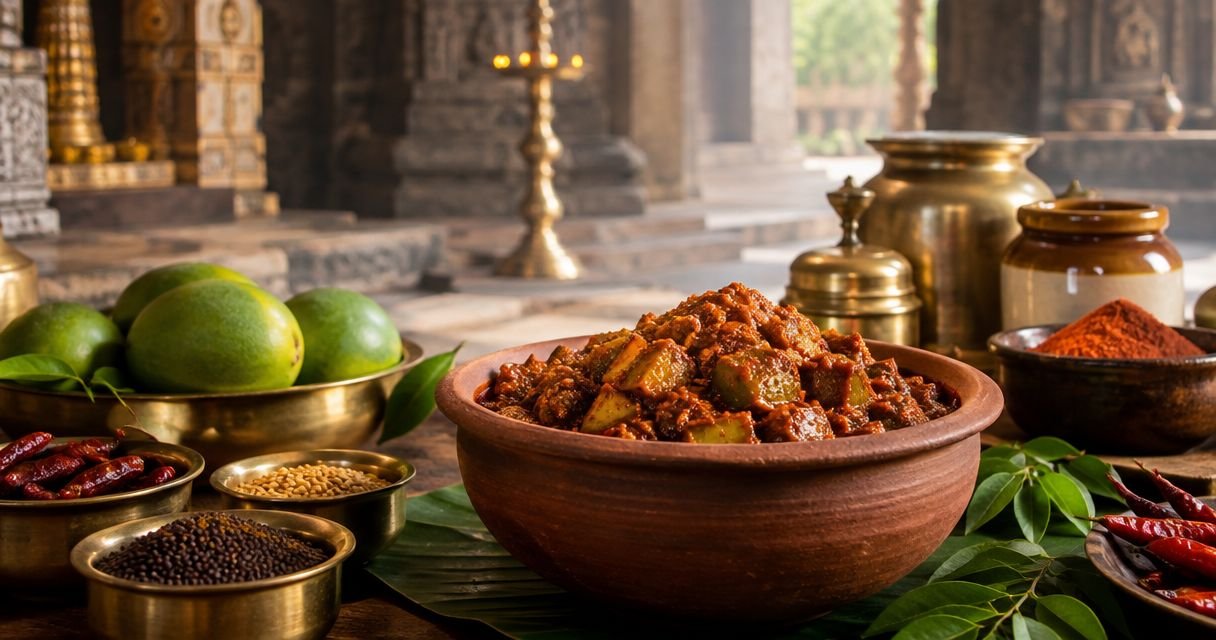
Temple kitchens’ Andhra pickle selection is the process of choosing and handling regional pickle accompaniments with the aim of serving meals that meet each temple’s ingredient and preparation rules. This 2026 guide to Andhra pickles for temple kitchens starts with local approval—not a vegetarian label, a familiar recipe name or a supplier’s description.
- Choose Andhra pickles for temple kitchens by approved ingredients and preparation rules, not vegetarian labels alone.
- Tulasi Pickles offers garlic-free Avakaya; temple suitability still requires full ingredient and preparation approval.
- Keep annadanam accompaniments separate from decisions about permitted offerings.
- Approve the recipe, test the serving method and follow the pack’s storage instructions before ordering for service.
Why Andhra pickle selection matters for temple kitchens
Your temple’s authorised decision-maker—not the product name—determines whether a pickle belongs on the menu. Record separately what is permitted for an offering, an annadanam meal and any other kitchen service. Approval for one purpose does not establish approval for another.
The distinction matters when buying online. The supplied product catalogue includes both garlic-containing Avakaya and a specifically garlic-free version; selecting mango pickle alone does not resolve the ingredient question. Likewise, a vegetable-based recipe does not establish compliance with your kitchen’s preparation requirements.
Storage needs a separate decision. Build the homemade pickle storage routine around the actual pack instructions, and assign responsibility before opening anything for service.
For your 2026 purchasing file, retain the approved ingredient information alongside the exact product name. Volunteers should not have to reconstruct a purchasing decision during a meal queue.
How to select and serve approved Andhra pickles
Write down your temple’s ingredient rules
Start with a paper checklist or a shared document. Ask the person authorised to approve kitchen ingredients to specify what is accepted, what is excluded and which questions require further approval. Avoid importing another temple’s practices into your own kitchen.
Make the intended use explicit. A purchasing volunteer needs to know whether the request concerns an offering, a community meal or a separate dining arrangement. Also distinguish ingredients from preparation conditions: an acceptable recipe does not automatically establish an acceptable production process.
Use 1 approval sheet for each proposed product so the decision stays attached to the item rather than to a general supplier name.
- Name the intended meal or service.
- List prohibited ingredients explicitly.
- Record permitted oils and seasoning requirements.
- Identify the person who approves exceptions.
- Date the decision and retain the ingredient evidence.
Check the complete recipe before tasting
Read the label and request clarification directly from the supplier where information is incomplete. A title such as lemon pickle identifies the main ingredient; it does not describe every seasoning, oil or processing aid. Do not fill those gaps from a household recipe you know.
Check compound ingredients as well as the headline ingredients. A spice blend requires its own ingredient review. Where separation from animal ingredients or other excluded foods matters to your kitchen, ask about utensils, preparation areas and packing practices rather than assuming separation.
A garlic-free claim answers a garlic question, not every temple-kitchen question. Keep unresolved questions open until the authorised reviewer has enough information to decide.
- Obtain the complete ingredient declaration.
- Check compound seasonings and their components.
- Confirm onion and garlic status separately.
- Ask about relevant allergens and shared handling.
- Hold the product out of service until approval is recorded.
Shortlist exact products rather than broad categories
Create your shortlist manually using the approved ingredient sheet. Buying a prepared product removes the pickle-making task, but it does not remove the need for recipe review. Compare exact variants, not simply mango against lemon.
Tulasi Pickles lists Avakaya Pickle without Garlic (Mango), while its classic Avakaya Pickle (Mango) description explicitly includes garlic cloves. That difference makes the garlic-free variant a candidate for review where garlic is excluded—not evidence that every other requirement is met.
Tulasi Pickles is best for buyers seeking Andhra-style pickles with clearly named variants, not automatic temple approval. The brand sells both vegetarian and non-vegetarian pickles, so ask directly about any production-separation requirements your kitchen applies.
- Copy the exact product title into the purchase request.
- Review the garlic-free variant independently of classic Avakaya.
- Request the full recipe before approving a substitute.
- Confirm preparation requirements directly with the supplier.
- Keep unapproved products off the serving shortlist.
Test the pickle with the actual meal
After ingredient and preparation approval, arrange a small kitchen trial. Serve the pickle with the rice, dal or other dishes planned for that service. Tasting it alone answers a different question from tasting it as a meal accompaniment.
Assess practical handling as well as flavour. Check whether servers can lift a consistent amount, whether pieces are manageable with the chosen utensil and whether the accompaniment overwhelms the meal. Do not describe a product as mild, low-salt or suitable for a medical diet without supporting information.
For your 2026 trial, record observations in plain language. A note such as difficult to portion is more actionable than everyone liked it.
- Taste only after ingredient approval.
- Use the intended serving utensil.
- Assess the pickle alongside the full meal.
- Record texture, heat and portioning observations.
- Ask the kitchen lead to approve the serving method.
Measure usage before planning larger purchases
Use a kitchen scale and a service log rather than guessing from jar size. Weigh the amount issued, record how much remains and distinguish untouched reserve stock from food that has entered service. Your own records provide a basis for the next order.
Do not treat an earlier festival or another kitchen’s consumption as a guaranteed requirement. Meal composition, serving method and attendance change the planning problem. Begin with your own observed use and revise after comparable services.
Keep 3 service records together: the quantity issued, the quantity left and the number of meals served. These are recommended records, not consumption benchmarks. They help you identify waste without inventing a universal serving size.
- Weigh stock before issuing it to service.
- Record meals actually served.
- Separate unopened reserve from serving leftovers.
- Note spills and discarded quantities.
- Review measured use before approving the next purchase.
Separate reserve stock from the serving station
Follow the product’s storage instructions, including any directions that apply after opening. Do not assign a shelf life from the words homemade, traditional or oil-based. Different recipes and packs require their own handling instructions.
Use 2 separate containers for the workflow: the original reserve pack and a clean serving container. Keep the reserve away from the meal queue, and replenish the serving container through a controlled process. Do not pour exposed leftovers back into reserve stock.
A clear handover matters when volunteers change. Label the opening date, identify the responsible person and keep the relevant instructions available at the storage point. Your 2026 checklist should work even when the usual kitchen lead is absent.
- Use clean, dry utensils for handling pickle.
- Keep reserve stock covered and stored as directed.
- Record the opening date and pack identification.
- Replace contaminated utensils immediately.
- Do not taste a suspect product to judge its safety.
The reserve-and-service split gives volunteers a simple physical boundary: stored food stays protected, and service food stays at the serving station.
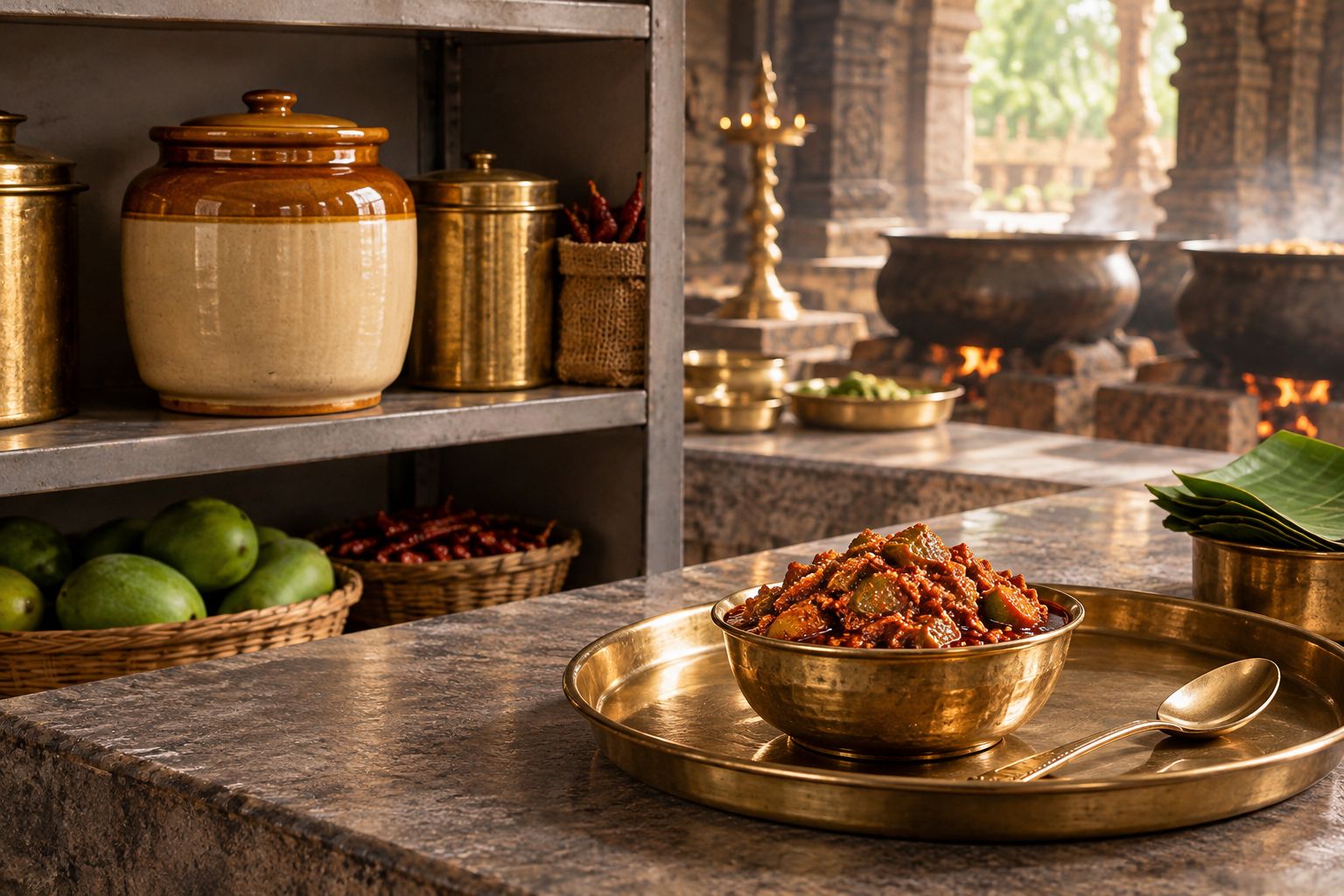
Recheck substitutions and supplier changes
Treat a replacement product as a fresh approval decision. A change in recipe, seasoning supplier or packing format deserves review wherever it affects your kitchen’s requirements. Previous acceptance is not permission to substitute any product with the same main ingredient.
Apply the same discipline if your kitchen prepares pickle itself. Selecting dried turmeric involves colour and flavour, but temple procurement also requires the actual supplied ingredient to match the approved recipe. Sensory quality and religious acceptability answer different questions.
Ask Tulasi Pickles to confirm the exact variant and ingredient information for the proposed order. Do not assume a repeat purchase has identical documentation; compare the new pack with your approval record before release to service.
- Review any proposed product substitution.
- Check the incoming label against the approved record.
- Record recipe or seasoning changes disclosed by the supplier.
- Refer unresolved differences to the authorised reviewer.
- Update the approval sheet before using the replacement.
Compare sourcing options for your temple kitchen
Choose the route your kitchen can approve and manage consistently. In-house preparation gives direct recipe control but requires preparation and storage work. Prepared products remove that task while adding a supplier-verification requirement.
The options below are review routes, not a ranking of religious suitability. No product name establishes approval for offerings or community meals.
| Option | Best for | Main advantage | Key limitation |
|---|---|---|---|
| In-house pickle using an approved recipe | Kitchens with an authorised recipe and suitable preparation arrangements | Direct control over ingredients and handling | Your team manages preparation, records and storage |
| Avakaya Pickle without Garlic (Mango) from Tulasi Pickles | Buyers reviewing a named garlic-free mango variant | The title explicitly distinguishes it from garlic-containing Avakaya | Full ingredients, preparation conditions and temple acceptance still need confirmation |
| Lemon Pickle | Kitchens whose approved menu calls for a lemon accompaniment | Provides a different main ingredient from mango | Lemon in the name does not establish onion-free or garlic-free status |
| No pickle accompaniment | Services where no candidate has been approved | Avoids introducing an unresolved ingredient question | Removes the intended accompaniment from the menu |
For 2026 purchasing, attach the chosen route to a named approver. A volunteer should be able to identify both the permitted item and the reason a similar-looking alternative is not interchangeable.
Common mistakes temple kitchens make
Treating vegetarian as a complete approval
Vegetarian describes only part of the decision. Your temple’s rules can include ingredient exclusions and preparation conditions that require separate confirmation. Approve the complete recipe and process, not the category label.
Confusing meal service with offering approval
Do not transfer a decision from annadanam service to an offering without authorisation. Record the permitted use on the approval sheet so a stored jar does not become an assumed ingredient for every kitchen activity.
Allowing donors to bypass ingredient review
Apply the same acceptance process to donated and purchased food. Ask donors to retain original labels and provide the product details before the planned service. Gratitude for a donation does not resolve an ingredient question.
Reordering from memory
A remembered colour, flavour or brand is not an exact purchasing specification. Keep the approved title and ingredient record accessible, and require approval before accepting an alternative. This is especially important when different volunteers handle ordering and receiving.
FAQ
What are the best Andhra pickles for temple kitchens?
The best Andhra pickles for temple kitchens are those approved for that temple’s specific ingredients, preparation conditions and intended service. Start with the written kitchen rules, then assess the exact product rather than choosing by variety alone.
Is garlic-free Avakaya automatically suitable for a temple kitchen?
No, garlic-free Avakaya is not automatically suitable for a temple kitchen. The complete recipe, preparation conditions and intended use still require approval from the temple’s authorised decision-maker.
Can we use the same pickle for annadanam and temple offerings?
Use the same pickle for both only when the temple’s authorised decision-maker approves both uses. Record offering approval separately from approval for community meal service.
Does Tulasi Pickles sell a garlic-free mango pickle?
Tulasi Pickles lists Avakaya Pickle without Garlic (Mango). Request the complete ingredient and preparation information before deciding whether that product meets your temple kitchen’s requirements.
How much pickle should we order for a temple meal?
Base the order on measured use from a comparable approved meal service. Record the amount issued, the amount remaining and the meals served rather than relying on a universal portion estimate.
How should volunteers store opened pickle?
Volunteers should follow the pack’s storage instructions and keep reserve stock separate from the serving container. Record the opening date, use clean dry utensils and do not return exposed serving leftovers to the reserve pack.
Can donated homemade pickle go straight onto the serving counter?
Donated homemade pickle should pass the same ingredient and handling review as purchased pickle. Keep it out of service until the authorised reviewer has approved its recipe, preparation information and intended use.
One last thing
Put the approved product name on the receiving checklist, not just the shopping list. The final control happens when the pack arrives: ordering the correct item does not prevent an unnoticed substitution. Make that check part of every 2026 kitchen handover.
Related guides
- How to choose the right spice level in pickles
- Best papad and pickle combo for a complete Andhra thali
- How to tell if a pickle jar has gone bad