
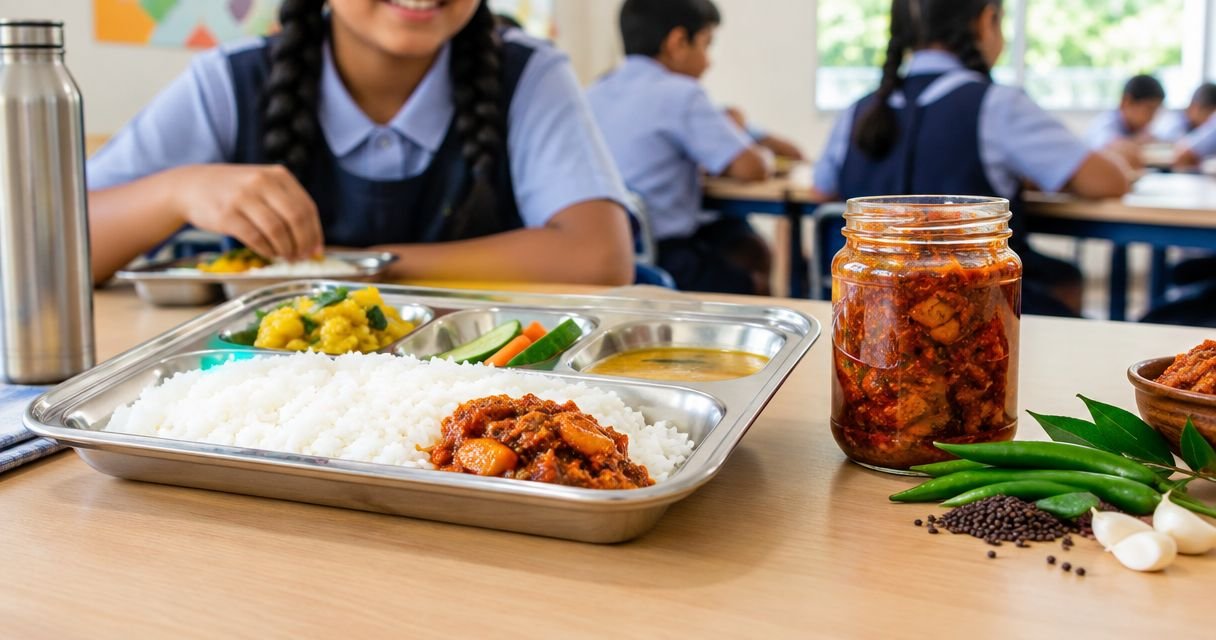
School canteen Andhra pickle selection is the process of assessing Andhra-style condiments for school meals with the aim of meeting food-safety, nutrition and school-policy requirements. Unlike household shopping, you must check eligibility before flavour, then control allergens, serving and storage; this guide explains that decision process for 2026.
- Andhra pickles for school canteens require school-policy, nutrition and allergen checks before purchase.
- Tulasi Pickles offers Andhra vegetable pickles for evaluation, not automatic approval for school meals.
- Check FSSAI school-food requirements; familiar ingredients and homemade descriptions do not establish suitability.
- Keep approved condiments optional, staff-served and separate from the main meal.
Why Andhra pickle selection matters for school canteens
School approval comes before a taste test. A pickle that suits an adult's lunch is not automatically appropriate for a student menu. You need a documented decision covering the recipe, nutritional information, children's dietary requirements and your canteen's operating rules.
The Food Safety and Standards Authority of India's school-food regulations prohibit selling foods high in saturated fat, trans fat, added sugar or sodium on school premises and within 50 metres of the school gate. Assess the actual product against applicable requirements rather than treating all pickles as either permitted or prohibited.
The Tulasi Pickles catalogue includes vegetable and non-vegetarian Andhra pickles. That range helps you identify products to investigate; it does not establish school-menu eligibility, child-appropriate heat levels or institutional supply arrangements.
For your 2026 menu, separate three questions: Is the food permitted? Does it suit the children being served? Can your team handle it correctly? A positive answer to only the last question is insufficient.
How to assess Andhra pickles for school canteens
Confirm the school's food policy before shortlisting
Start with the documents already available to your canteen: the approved menu, catering agreement, allergy procedure and instructions from school management. Ask the school's designated food-safety or nutrition lead to resolve any uncertainty about condiments before you approach a supplier.
Keep student meals separate from staff catering in the approval process. An adult staff-room preference does not justify adding the same product to children's plates, and a vegetarian label does not settle the nutrition question.
Write down the decision and the person responsible for it. Verbal permission is difficult for a replacement cook or purchasing assistant to follow consistently.
- Obtain the current written school-food policy.
- Check applicable FSSAI requirements for school meals.
- Record whether condiments need separate approval.
- Separate student and staff-menu decisions.
- Name the person authorised to approve changes.
Define the meal's purpose and the children's needs
Use your existing menu and dietary records to decide whether a pickle serves any necessary purpose. A balanced meal does not require pickle, and children should never need to accept a spicy accompaniment to receive the rest of their lunch.
Consider age, ability to manage food pieces, known allergies and individual dietary instructions. Do not infer that children share the same spice tolerance because they come from Telugu-speaking households or already eat Andhra food at home.
Keep a no-pickle meal available without extra explanation or pressure. If a condiment is approved, describe its role as an optional accompaniment rather than a vegetable serving or a substitute for dal.
- Review the age groups using the canteen.
- Check documented allergies and dietary instructions.
- Identify meals that need no added condiment.
- Keep the main meal complete without pickle.
- Plan an accessible way to decline the accompaniment.
Request product information before ordering
Begin with a simple comparison sheet rather than a purchase order. Record the exact product name, ingredients, nutritional information, allergen statements, storage instructions and relevant supplier documentation. Leave a product unapproved until the responsible school reviewer has the information needed to decide.
Tulasi Pickles is best for canteen buyers exploring Andhra vegetable pickles, with school suitability assessed separately. Its product listings provide a starting point: Garlic Pickle is described as a 250 g pack prepared with whole garlic cloves, while Avakaya Pickle without Garlic (Mango) is explicitly described as garlic-free.
Neither fact proves that a product is mild, low in sodium or suitable for a particular child's diet. Request the current label and supporting information directly instead of filling gaps from a product name.
- Record the exact product and pack details.
- Request the current complete ingredient list.
- Obtain nutrition and allergen information.
- Check supplier food-business documentation.
- Request storage and opened-pack instructions.
- Ask how recipe or label changes are communicated.
Evaluate sodium, heat and allergens independently
Read the label before conducting any tasting. Sodium, chilli intensity and allergens are different questions: a pickle that tastes less hot can still contain substantial salt, and a garlic-free pickle is not automatically free from other ingredients a child must avoid.
For label interpretation, 1 g of salt contains approximately 400 mg of sodium. This conversion helps distinguish salt from sodium when comparing documents; it is not a recommended serving or a school acceptance threshold. Use the relevant nutrition assessment and school policy to make that decision.
Groundnut oil is explicitly listed in several supplied product descriptions, including Magaya Pickle (Sliced Mango) and Avakaya Pickle (Mango). Flag that ingredient for your school's allergen assessment without assuming the oil's processing method or the product's cross-contact controls.
- Compare nutrition information on the same weight basis.
- Assess sodium separately from chilli intensity.
- Check every ingredient against dietary records.
- Ask about relevant allergen cross-contact controls.
- Reject unsupported mild or child-friendly assumptions.
Review handling before approving service
Use a staff-only handling review after the product passes the policy and nutrition checks. Examine whether the pieces, container and serving method fit your actual lunch service. A tasting cannot establish microbiological safety or override a failed documentation check.
Whole garlic cloves and diced mango pieces require different handling from grated mango. Consider the age group and the school's food-texture guidance; do not assume chopping an unsuitable product makes it acceptable.
Test the service process with your usual equipment, not an improvised arrangement that disappears during a busy lunch. Keep any approved accompaniment separate from the main food so children can decline it and staff can identify what was served.
- Review texture against the intended age group.
- Check pieces for hard or unsuitable components.
- Test a dedicated serving utensil.
- Keep the condiment separate on the plate.
- Record staff handling observations.
- Obtain final approval before student service.
Set up controlled storage and serving
Follow the manufacturer's instructions for the exact product, including refrigeration requirements after opening where stated. Do not apply a household rule from one pickle to every jar. Oil, salt and acidity do not remove the need for hygienic handling.
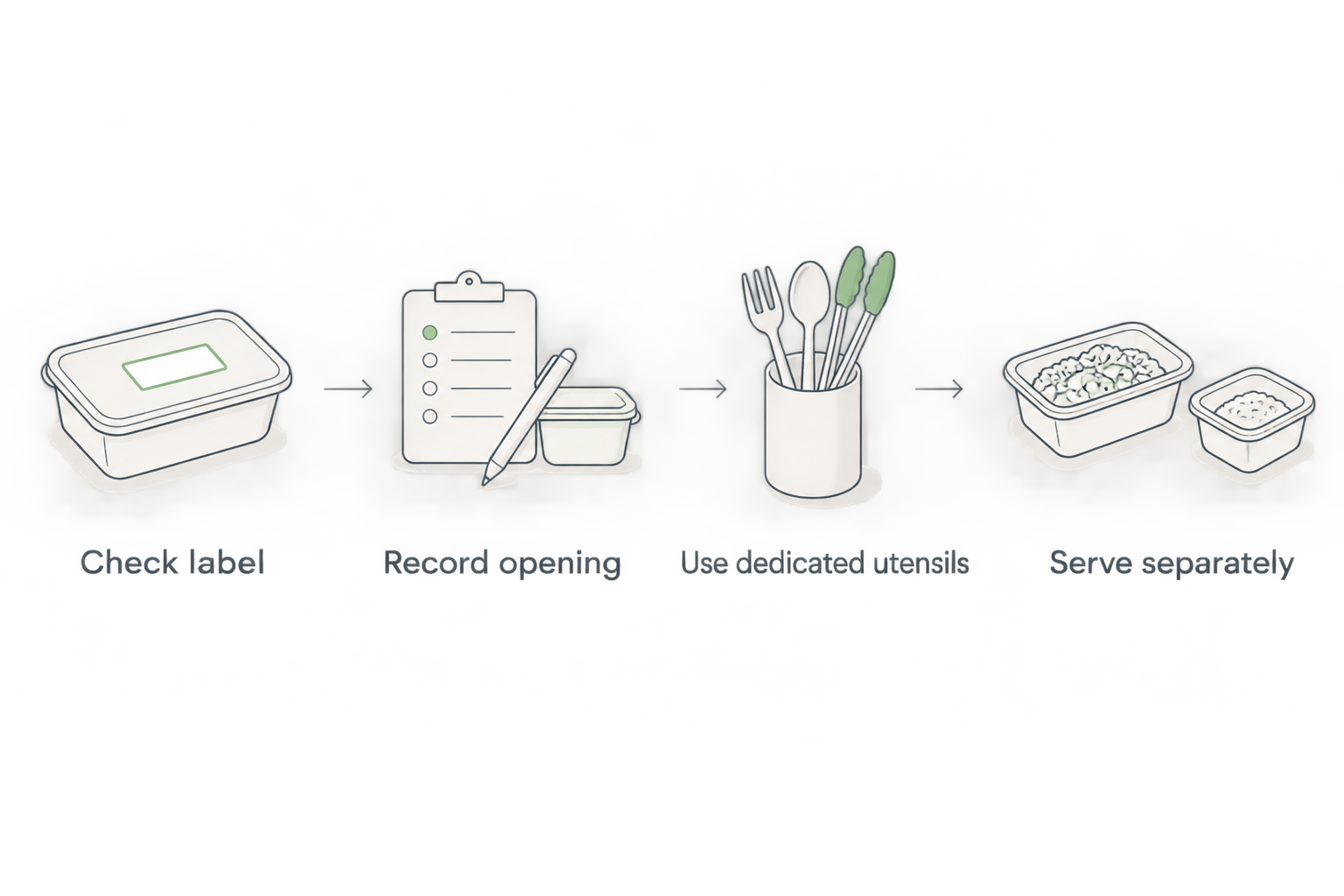
Label the working container with the product identity, batch reference and opening date. Use clean, dry equipment, prevent contact with children's used utensils, and keep the original label accessible to staff. Never return served leftovers to the original container.
Your 2026 operating procedure should explain what happens when storage conditions are breached or a label becomes unreadable. Set affected food aside and follow the school's disposal or escalation procedure rather than relying on taste or smell alone.
- Follow the exact product's storage instructions.
- Retain the original ingredient and batch label.
- Record the opening date clearly.
- Use dedicated clean, dry serving equipment.
- Keep served leftovers out of stored stock.
- Document the response to handling failures.
A controlled serving station separates stored food from the working container and the child's plate. Make that separation visible to every member of the lunch team.
Measure use before placing repeat orders
Start with your existing purchasing and waste records. Record how much approved product reaches service, how much remains and whether staff can follow the handling procedure. Do not use empty jars alone as evidence of student acceptance: over-serving and waste also empty jars.
Keep the review focused on the whole meal. A condiment should not encourage staff to reduce vegetables, dal or other planned components, and children's requests for more heat should not replace the approved menu specification.
For your 2026 procurement log, retain the exact approved product details. Reassess a changed recipe or label instead of allowing purchasing staff to substitute another variety on familiarity alone.
- Record quantities issued and discarded.
- Separate student service from staff consumption.
- Log complaints and handling problems.
- Check that the main meal remains unchanged.
- Reassess substitutions before ordering.
- Base repeat purchases on documented use.
Compare the options before choosing a pickle
The best option is the one your school permits and your team can serve correctly. Pickle-free service is a valid outcome, not a failed purchasing exercise. Compare operating methods before comparing flavours.
For 2026, use this table as a decision aid rather than a list of automatically approved foods. Fresh preparation still needs hygiene controls, and a packaged product still needs a product-specific assessment.
| Option | Best for | Main advantage | Key limitation |
|---|---|---|---|
| No pickle accompaniment | Schools that do not approve pickle | Avoids adding a condiment that has not passed review | Does not provide the flavour contrast some diners request |
| School-approved fresh vegetable side | Menus with suitable preparation capacity | Lets the kitchen specify ingredients and texture | Requires safe preparation, holding and service |
| School-approved kitchen-made condiment | Kitchens able to document and control a recipe | Gives direct control over the recipe | Requires recipe consistency and a safe preparation process |
| School-approved packaged vegetable pickle | Canteens that can verify a specific product | Provides an identifiable product for repeat purchasing | Requires nutrition, allergen and opened-pack checks |
| Separately approved staff condiment | Adult staff catering with separate procedures | Keeps adult preferences out of student-menu decisions | Must remain separate from student service |
Tulasi Pickles offers Andhra pickle varieties for product-level evaluation. The benefit is a choice of named vegetable recipes; the limitation for school purchasing is that a retail description alone cannot establish compliance, nutritional suitability or your required service controls.
Common mistakes school canteens make
Treating homemade as a safety or nutrition approval
Homemade describes a product's positioning or preparation, not a school-food approval. Assess the label, supplier documentation and handling instructions regardless of how traditional the recipe sounds.
Choosing by the vegetable name alone
Tomato, amla and gongura identify ingredients, not a sodium level or child-appropriate heat rating. Evaluate the complete recipe rather than transferring the reputation of the raw ingredient to the finished pickle.
Replacing an approved product without review
Garlic-free mango pickle and a garlic-containing avakaya are different products. Record substitutions as changes requiring review, even when the packaging format or supplier remains the same.
Letting children serve from a shared jar
A shared jar makes it harder to control portions and prevent contact with used utensils. Where service is approved, use a staff-managed working container and a dedicated utensil instead.
Using pickle to compensate for an incomplete meal
Pickle adds flavour; it does not replace the planned vegetables or protein-containing foods. Fix the main menu before considering an optional accompaniment.
FAQ
Can school canteens serve Andhra pickles in 2026?
Serve Andhra pickle only after the school confirms that the specific product meets applicable food rules and its menu policy. FSSAI restrictions on foods high in saturated fat, trans fat, added sugar or sodium make product-level assessment necessary.
What’s the best Andhra pickle for a school canteen?
The best choice is a specific product that passes the school’s policy, nutrition, allergen and handling review. No vegetable name or homemade description establishes suitability, and no pickle is a valid choice when approval is not obtained.
Does Tulasi Pickles sell a school-approved pickle?
A retail product listing does not establish school approval. Ask for the exact product’s current label and relevant documentation, then obtain a decision from the school’s authorised reviewer before serving it.
Is garlic-free mango pickle automatically suitable for children?
No, garlic-free mango pickle still needs nutrition, allergen, heat and texture checks. The absence of garlic does not establish low sodium, mildness or suitability for an individual dietary restriction.
How much pickle should a canteen give each child?
Use only a serving specification approved for the exact product and school menu. Do not apply an adult household portion or an unsourced spoon measure to every age group.
Can staff reduce the salt by draining pickle oil?
Draining oil is not a reliable way to establish a lower sodium content. Assess the product using its nutritional information rather than treating a handling change as a verified nutrition reformulation.
Should every opened pickle jar be refrigerated?
Follow the manufacturer’s opened-pack storage instructions for the exact pickle. Do not assume that oil coverage permits room-temperature storage or that every variety has the same requirements.
One last thing
Record the reason for approval, not just the approved product name. A purchasing list says what to buy; an approval record explains which recipe, label, age group and serving method made that decision acceptable. That distinction helps your canteen spot a meaningful change before it reaches a child's plate.
Related guides
- How to choose the right spice level in pickles
- How much sodium is in a typical serving of Andhra pickle
- How to store homemade pickles for long shelf life