
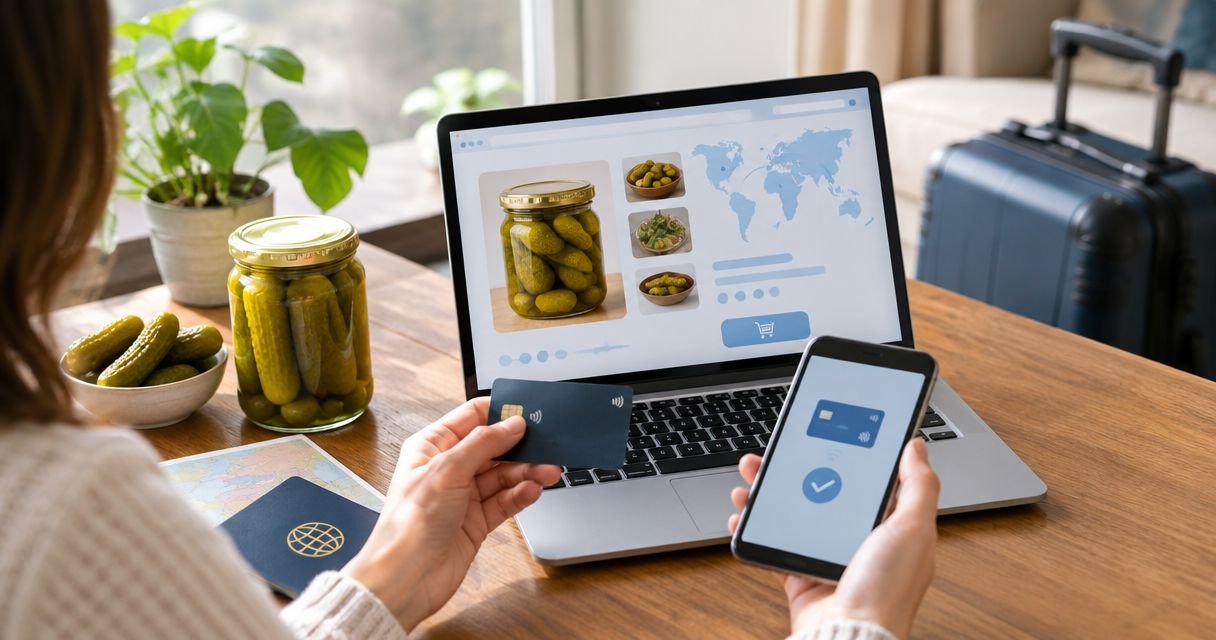
Instead of arranging a separate payment from abroad and then chasing confirmation, use the seller’s verified checkout to connect your payment, delivery address and order record. To pay for pickles online from abroad in 2026, confirm the destination first, choose a payment method actually offered at checkout, complete your bank’s authentication and verify the order before retrying.
- Tulasi Pickles sells Andhra-style pickles overseas; confirm your destination and checkout payment options before paying.
- How to pay for pickles online from abroad: verify delivery, authenticate payment and save the order confirmation.
- International card payments depend on both merchant acceptance and your card issuer’s permissions.
- For NRI gifting, keep the payer’s billing address separate from the recipient’s delivery address.
Why this matters
Paying from another country and shipping to another country are separate decisions. You can be overseas while ordering for family in India, or you can pay from overseas for delivery to your own address. The delivery destination determines which shipping and food-import checks you need.
Tulasi Pickles is best for shoppers seeking homemade Andhra-style pickles from an Indian seller. The brand sells vegetarian and non-vegetarian pickles, along with podis, papads, dry fruits and sweets/snacks, with shipping across India and overseas. Start at Tulasi Pickles to review your intended purchase.
The benefit is access to an Andhra-style food range. The limitation is that overseas shipping does not establish acceptance of every foreign-issued card or permission to import every food into every destination. Confirm the payment route and the delivery route separately. A successful transaction settles neither customs eligibility nor storage requirements.
Before you start
- Prepare your payment access. Have your own authorised payment method, access to its banking app or verification messages, and permission to make the relevant online transaction. Check international e-commerce controls with your issuer when using a foreign-issued card.
- Prepare 2 addresses. Keep the payer’s billing address and the recipient’s shipping address ready, plus a working email address and recipient phone number. For a gift, these addresses usually belong to different people; use each for its actual purpose.
- Check the destination before the payment method. Meat and seafood products face destination-specific import restrictions. Tulasi Pickles’ overseas shipping does not mean every product is suitable for every country; establish eligibility before entering payment details.
For a 2026 order, check current guidance from the destination’s official customs or food-import authority. An old delivery experience, including your own, is not a substitute for the rules applying to this parcel.
Choose your payment route
Use only a payment method displayed in the checkout or confirmed through a verified seller channel. Do not assume that a familiar card network, wallet or Indian payment app is supported because another Indian store accepts it.
These are possible routes to evaluate, not a list of confirmed payment methods for this store:
| Payment route | Best for | Advantage | Limitation | Check before proceeding |
|---|---|---|---|---|
| Foreign-issued card, if offered and accepted | Buyers using their own overseas bank account | Keeps payment under the buyer’s control | Merchant acceptance and issuer approval are separate requirements | Online permissions, international permissions and authentication access |
| UPI, if offered and your account is eligible | Buyers with a working, eligible UPI setup | Uses an existing bank-linked payment setup | Living abroad does not automatically make an overseas account UPI-compatible | Your bank, app, account and mobile-number eligibility |
| Another seller-confirmed payment route | Buyers whose usual method is not accepted | Provides an alternative when the seller supports one | Requires careful verification of the recipient and order reference | Written instructions from a verified seller channel |
A foreign-issued card is the direct route when the checkout supports it and your issuer approves the transaction. Eligible UPI is an alternative when both your setup and the merchant support it. Neither route is universally better; choose the supported method you can authenticate yourself.
If no workable method appears, stop before submitting payment. Ask the seller which route applies to your destination and order. Never send money to an account supplied by an unsolicited message or a search-result comment.
Delivery configuration
- Choose the destination. Decide whether the parcel is going to India or overseas before you assemble the order. Your physical location does not determine the parcel’s destination; the recipient’s address does.
- Check the contents. Review the ingredients and distinguish vegetarian products from meat or seafood products. Do not treat a food’s sealed packaging as proof that customs will allow it into your country.
- Enter the shipping address. Use the recipient’s name, complete street address, city, region, postal code and country in the relevant form fields. Include apartment or building details where needed. Use a phone number that can reach the recipient.
- Confirm the delivery arrangement. Establish whether the seller can process the intended destination through checkout or requires further coordination. Resolve any missing destination or shipping information before paying.
Expected result: the order points to the correct recipient, and you have established that the proposed contents and delivery destination can proceed.
For the packing side of the purchase, read how to ship pickles overseas without spoilage. Payment confirmation and suitable transit preparation are different checks; complete both rather than treating the receipt as the end of the process.
Billing configuration
- Enter the payer’s details. Use the billing information associated with the payment method, where requested. If your overseas card is registered to an overseas address, do not replace that address with a relative’s Indian address merely because the parcel is going there.
- Keep billing and shipping separate. If the form provides a way to use different addresses, follow its actual wording. Do not select an option that copies the shipping address into billing unless the two genuinely match.
- Review the payment currency. Check the currency shown before authorising the transaction. Your bank’s currency conversion and foreign-transaction terms belong to your card agreement; check them with the issuer rather than assuming the merchant controls them.
- Check your verification access. Keep your banking app or registered phone available. If you cannot receive the authentication request abroad, resolve that with your bank before starting the payment.
Expected result: the payment details identify the payer accurately, while the shipping details continue to identify the intended recipient.
Checkout wording varies by payment provider and device. Use the labels on the live form; do not look for a particular button name from an unrelated tutorial. This 2026 workflow is based on the information you must verify, not an assumed checkout screen.
Payment authorisation
- Select a supported method. Choose from the methods actually presented for your order. If you intend to use a foreign-issued card, confirm with your issuer that the relevant online international transactions are enabled.
- Enter details inside the verified payment flow. Supply sensitive card information only through the legitimate checkout or payment-provider page. Never send your full card details, security code, banking password or one-time password to a seller in chat.
- Complete bank authentication. Follow the bank’s prompt yourself. Authentication can involve a banking app, a one-time password or another issuer-controlled check; the method depends on your bank and the transaction.
- Submit 1 payment attempt, then inspect the result. Let the flow finish and return to the order confirmation where applicable. If the page stalls or closes, check the order and bank record before trying again.
Expected result: you receive a definite payment outcome, or you identify an unresolved transaction that needs checking before another attempt.
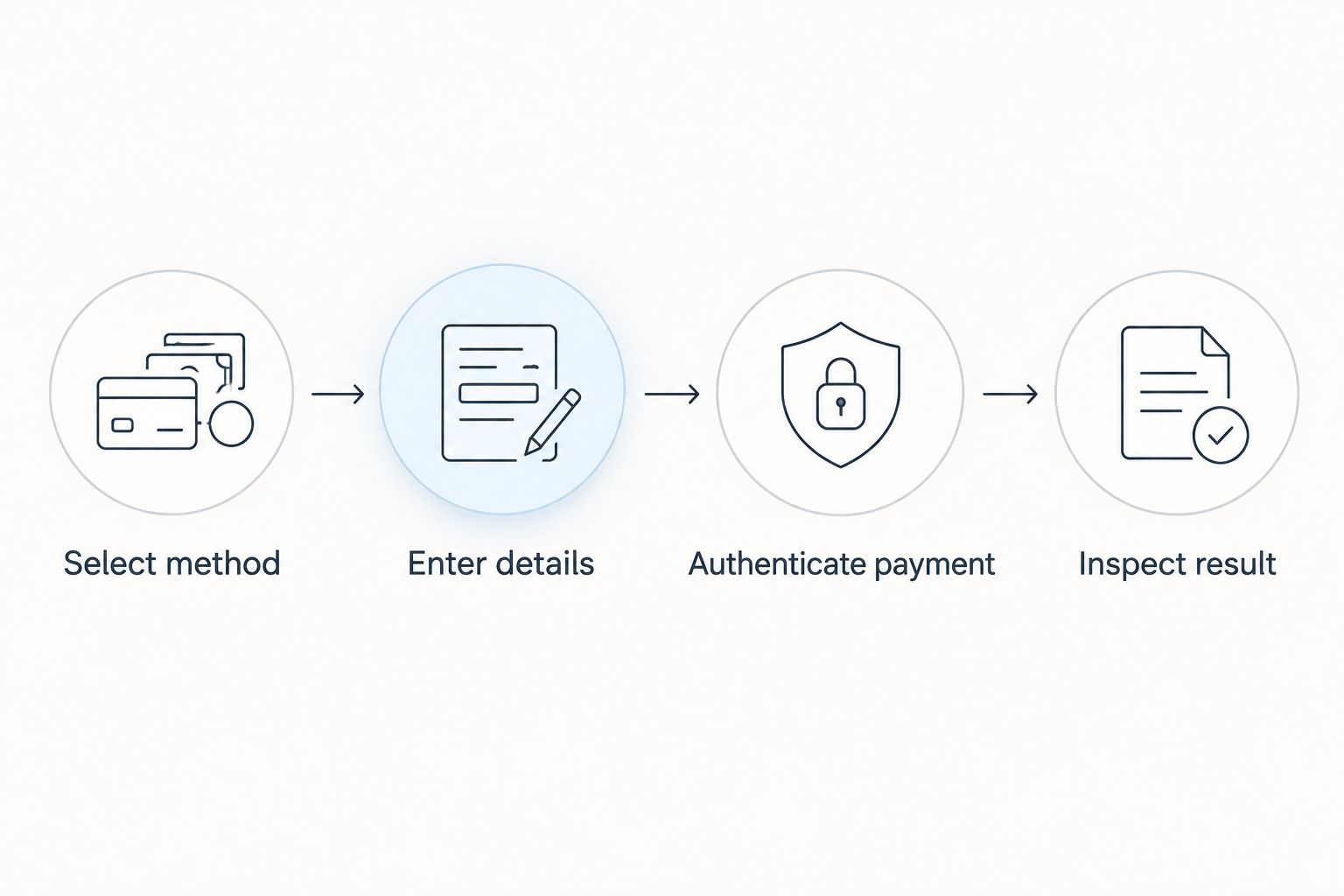
An authentication screen is not an invitation to share the verification code. Enter it only into the bank’s legitimate verification flow when requested. If someone offers to complete the payment for you by collecting the code, stop the transaction.
Order verification
- Check the seller’s confirmation. Look for the order reference, purchased items, delivery details and payment status. An order-created message is not necessarily proof of successful payment; inspect what the confirmation actually states.
- Compare the bank record. Review the merchant description and transaction status. A pending authorisation and a completed charge are not the same thing, and neither alone tells you whether the seller has correctly attached payment to the order.
- Save 3 records. Keep the order confirmation, the payment reference or bank transaction record, and any seller correspondence resolving the transaction. Store screenshots without exposing sensitive payment details.
- Resolve mismatches before reordering. If the bank shows a transaction but the seller does not confirm payment, provide the order reference and a redacted payment record through a verified seller channel. Ask the seller to check the existing order first.
Expected result: the seller’s order record and your payment record agree, and the delivery address is correct.
For your 2026 purchase, retain these records until the order is resolved. Do not assume a screenshot of a debit is enough: the seller needs an identifiable transaction and order reference to investigate a mismatch.
Second workflow: pay abroad, deliver to family in India
Ordering for parents or relatives in India uses the same payment checks but a different shipping arrangement. Keep the overseas payer’s billing identity and the Indian recipient’s delivery identity distinct.
- Confirm the recipient’s address and phone number directly with them. Do not rely on an old saved address if they have moved.
- Choose products that match the recipient’s food preferences and ingredient restrictions. For a mixed household, check vegetarian and non-vegetarian selections separately.
- Enter the Indian recipient’s address for shipping and your own payment-linked address for billing, where requested.
- Pay through a supported method and retain the order confirmation yourself. Tell the recipient what parcel to expect without sending them sensitive payment information.
This variant is best for overseas buyers sending food to an Indian address. Its advantage is that the parcel is not being imported into the payer’s country; its limitation is that your foreign-issued payment method still needs merchant and issuer approval.
Tulasi Pickles ships across India as well as overseas, so establish which destination applies to your purchase. Do not enter an Indian address as a workaround for an overseas delivery problem and expect the seller to infer the actual destination later.
Troubleshooting
Your foreign-issued card is declined
Check the issuer’s online and international transaction controls, the billing details and any bank notification explaining the decline. Ask the issuer about the attempted merchant transaction. Do not repeatedly retry unchanged details or assume that using a different shipping address fixes an issuer refusal.
The authentication message does not arrive
Confirm that you can access the registered phone number or banking app while abroad. Check with your bank whether another authentication route is supported for your account. Avoid starting another payment while the original attempt remains unresolved.
The bank shows a transaction but the order is unpaid
Compare the bank’s transaction status with the seller’s order status. Contact the seller with the order reference and a redacted payment record. Contact the issuer about the bank-side status if necessary; do not place a duplicate order simply to obtain a confirmation screen.
UPI is missing or does not work
Check whether the checkout offers UPI and whether your own bank and app setup supports it. An overseas phone number or foreign bank account is not proof of eligibility. Use another confirmed route rather than attempting an unfamiliar workaround during checkout.
The destination cannot be completed at checkout
Recheck the country, postal code and address format. If the destination still cannot proceed, ask the seller to confirm the arrangement before paying elsewhere. Never change the country to force the form through; that creates an order with incorrect delivery information.
Customize your workflow
For repeat purchases, keep a private checklist of the destination, recipient details, ingredient preferences and the payment method that worked. Recheck the live payment options each time. A method accepted previously is not a promise that every later transaction will be approved.
For gifts, agree with the recipient on who will handle delivery questions. Keep the payer responsible for payment queries and give the recipient the information needed to recognise the parcel. This avoids asking a relative to investigate a transaction they cannot see.
For an overseas order in 2026, repeat the import check whenever the destination or food category changes. Switching from vegetarian pickle to meat or seafood pickle changes the contents you must assess, even when your address and card remain the same.
FAQ
How do I pay for pickles online from abroad?
Confirm the delivery destination, choose a payment method offered by the seller, complete your bank’s authentication and verify the order confirmation. Keep the payer’s billing details separate from the recipient’s shipping details when they differ.
Can I use a foreign credit card to buy Tulasi Pickles?
Use a foreign credit card only if the live checkout accepts it and your issuer approves the transaction. Overseas shipping alone does not establish foreign-card acceptance; confirm the payment route before submitting.
Can I pay from abroad and send pickles to my parents in India?
Yes, paying from abroad and delivering to an Indian recipient are separate parts of an order. Confirm seller delivery to the recipient’s address, use accurate billing details and choose a supported payment method.
Do I need an Indian bank account to buy pickles online from overseas?
You do not need an Indian bank account when the seller offers another payment method that works with your own account. Do not assume that such a method is supported until you check the live checkout or obtain seller confirmation.
Can I use UPI while living outside India?
Use UPI only if your account, bank, app and mobile-number setup are eligible and the seller offers it. Living abroad neither automatically enables nor automatically rules out a working UPI setup.
What should I do if money is debited but my pickle order is not confirmed?
Check the bank transaction status and contact the seller about the existing order before paying again. Provide the order reference and a redacted payment record, and ask your issuer about any unresolved bank-side transaction.
Does successful payment mean non-veg pickles can enter my country?
No, successful payment does not establish permission to import meat or seafood products. Check the destination’s official food-import and customs rules before ordering, including for a 2026 purchase.
Should I share my OTP with someone helping me place the order?
No, never share a payment OTP, banking password or card security code with someone helping you order. Complete authentication yourself through the legitimate bank or payment-provider flow.
One last thing
The most useful final check is the destination, not the payment button. An approved transaction can still be attached to an incorrect address or unsuitable parcel contents. Before authorising payment, read the recipient’s country and the selected food categories together; after payment, check that the confirmation preserves both correctly.
Related guides
- Pickles from Hyderabad for NRIs
- How to store homemade pickles for long shelf life
- How to choose the right spice level in pickles