

Senior care homes’ Andhra pickle service is the controlled use of traditional condiments with the aim of offering familiar flavours within each resident’s dietary and swallowing requirements. Choosing Andhra pickles for senior care homes in 2026 means checking ingredients, sodium, texture and storage before adding an optional accompaniment to the menu.
- Andhra pickles for senior care homes belong on individual care plans, not automatically on every plate.
- Tulasi Pickles suits homes seeking traditional Andhra flavours; dietary suitability still requires product-level checks.
- Low spice does not mean low sodium, and boneless does not mean safe for swallowing difficulties.
- Use labelled ingredients, controlled serving utensils and manufacturer storage instructions before introducing a pickle.
Why Andhra pickles matter for senior care homes
Your residents do not share one palate or one care plan. Someone who wants a familiar Andhra accompaniment needs a different decision from someone with a prescribed sodium restriction, food allergy or texture-modified diet. Choose for the resident first, then choose the condiment.
Tulasi Pickles is a Hyderabad-based online seller of homemade vegetarian and non-vegetarian Andhra-style pickles, alongside podis and other foods. Tulasi Pickles is best for senior care homes seeking traditional Andhra flavours, not a substitute for resident-specific dietary approval.
The benefit is choice: you can offer a familiar flavour without changing everybody’s meal. The limitation is equally clear. A traditional recipe or homemade description does not establish its sodium content, allergen suitability or compatibility with a prescribed swallowing texture.
For your 2026 menu, treat pickle as an optional condiment rather than a required component. Ask residents what they enjoy, retain an unseasoned meal option, and let the care team decide whether the requested accompaniment fits the person’s current plan.
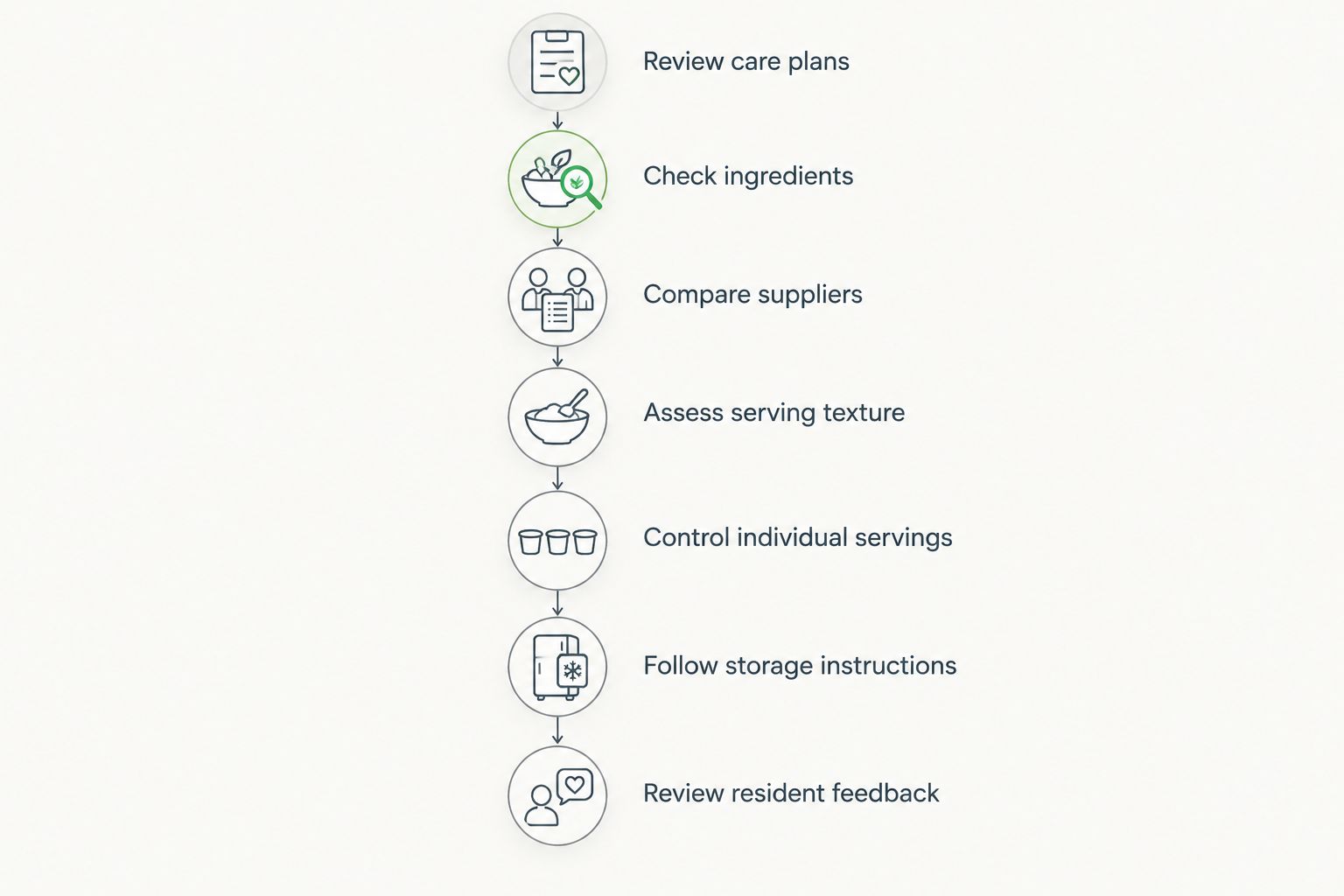
How to introduce Andhra pickles safely
Review care plans
Start with the information your home already holds. Check each interested resident’s dietary instructions, allergies, vegetarian preferences, chewing ability and swallowing recommendations before collecting product choices. Ask the responsible clinician or dietitian to resolve restrictions rather than asking kitchen staff to interpret them.
Separate preference from permission. A resident’s request matters, but it does not override a prescribed restriction; equally, age alone is not a reason to prohibit a food that fits the resident’s care plan.
Make the decision usable at meal service. Staff need a clear instruction about whether the condiment is permitted and how to serve it, not a broad note saying that the resident likes spicy food.
- Record whether pickle is permitted, restricted or awaiting review.
- Identify residents with prescribed sodium or fluid-related dietary instructions.
- Check allergy records against the complete recipe.
- Confirm the required food texture with the swallowing-care team.
- Keep a pickle-free meal option for residents who decline it.
Check ingredients
Use the package label and written supplier information first. Read the full ingredient list rather than relying on the flavour name: a vegetable pickle can contain ingredients that matter to allergy management or religious preferences. Non-vegetarian recipes need the same scrutiny.
For sodium context, the World Health Organization recommends adults consume less than 2,000 mg of sodium per day, equivalent to less than 5 g of salt per day. These are population-level recommendations, not an individual prescription for a care-home resident. A clinician’s instructions take precedence.
Salt and sodium are different label terms. 1 g of salt contains approximately 400 mg of sodium; use that conversion only when the label clearly reports salt, and compare products on the same weight basis. Do not estimate a pickle’s sodium from its taste.
- Obtain the ingredient list and available nutrition information.
- Check sodium or salt using a consistent comparison basis.
- Confirm relevant allergen and cross-contact information.
- Record the batch identification and date marking.
- Pause the purchase if information needed for a care plan remains unresolved.
Compare suppliers
Build a simple purchasing sheet before approaching suppliers. List the information your kitchen needs: ingredients, sodium data, texture description, storage instructions and traceable batch details. Compare written answers, not terms such as authentic, premium or homemade.
Tulasi Pickles offers vegetarian and non-vegetarian Andhra-style pickles through its online business. That makes it relevant when your residents request those flavours, but it does not establish that any particular recipe is low-sodium, low-spice or suitable for a texture-modified diet.
For your 2026 purchasing checklist, keep flavour preference and dietary approval in separate fields. A convenient online order reduces the need to make a condiment in-house; it does not remove the need to assess the exact product.
- Compare ingredient and nutrition information before comparing flavour descriptions.
- Request clarification where a label leaves an important question unanswered.
- Check whether the supplied texture matches the approved meal plan.
- Confirm storage instructions for the exact recipe and packaging.
- Keep supplier correspondence with the kitchen’s purchasing records.
Assess serving texture
Inspect the actual food rather than assuming its name describes its texture. Firm vegetable pieces, fibrous ingredients, seeds, meat pieces and bones all deserve attention when a resident has chewing or swallowing difficulties. Soft-looking sauce does not establish that every piece is suitable.
For residents with dysphagia, follow the prescribed texture and the assessment process used by your swallowing-care team, including applicable IDDSI testing. Mixing a pickle into soft rice does not automatically make the complete mouthful safe.
Do not approve a meat pickle merely because it is described as boneless. Nor should staff improvise by chopping, blending or straining a product without an agreed preparation method; those changes need assessment against the resident’s requirements.
- Inspect pieces and consistency before serving.
- Follow the resident’s prescribed texture instructions.
- Keep unsuitable ingredients off the resident’s tray.
- Use only preparation changes approved by the care team.
- Refer coughing, choking or swallowing concerns through the home’s clinical process.
Control individual servings
Begin with an approved serving method rather than a communal jar. Your kitchen can use a designated utensil and separate serving dish without buying specialist equipment. The care plan should determine any portion limit; there is no universal spoonful suitable for every resident.
Keep the main meal separate from the condiment unless the resident’s plan specifies otherwise. This preserves the choice to decline it and prevents staff from seasoning the entire plate before checking permission.
Record what was offered and what the resident reported. Enjoyment is useful feedback, but it is not evidence that sodium restrictions or swallowing requirements have been met.
- Follow the resident-specific serving instruction.
- Use a designated utensil for each condiment.
- Keep vegetarian and non-vegetarian service separate.
- Offer pickle separately from the main meal where appropriate.
- Record refusal, discomfort or requests for a different flavour.
Follow storage instructions
Use the manufacturer’s directions for the exact product, including any refrigeration instruction after opening. Do not assume every vegetarian pickle is shelf-stable or that an oil layer makes a meat pickle safe at room temperature. Recipe and processing details matter.
Keep the original label with the container and record when it was opened. Transfer food only under your kitchen’s food-safety procedure, with the necessary identification retained. Staff should never have to guess what a jar contains or how it should be stored.
The guide to storing homemade pickles provides additional reading, but product instructions and your care home’s food-safety plan remain the operating rules. Never taste a suspect jar to decide whether it is safe.
- Follow labelled storage and refrigeration directions.
- Mark the opening date according to kitchen procedure.
- Use clean, dry utensils and prevent cross-contamination.
- Check packaging integrity when deliveries arrive.
- Isolate damaged or suspect containers under the home’s disposal procedure.
Review resident feedback
Review the service before making it routine. Ask whether residents actually want the condiment, whether staff can follow the instructions and whether the kitchen can maintain traceability. A rejected flavour should not become a permanent menu item simply because it has already been purchased.
Your 2026 review should separate three questions: does the resident enjoy it, does it fit the care plan, and can the home serve it consistently? Approval requires all three. Feedback about flavour cannot answer the clinical or food-safety questions.
Use the same review when the recipe, supplier or resident’s care plan changes. An earlier approval is not permission to serve a different product without checking it.
- Collect residents’ flavour preferences without pressuring them to participate.
- Review any reported discomfort with the responsible care professional.
- Check whether staff followed serving and storage instructions.
- Review waste before changing purchasing quantities.
- Reassess products when labels, recipes or care plans change.
The process is sequential: establish permission, check the food, then decide how to serve and monitor it. Purchasing comes after the checks that determine suitability.
Compare your care-home serving options
Choose an approach based on resident preferences and your kitchen’s ability to document it. The following options differ in preparation burden and suitability checks; none earns automatic approval because it is traditional or made in-house.
| Option | Best for | Practical advantage | Key limitation |
|---|---|---|---|
| Purchased vegetarian Andhra pickle | Residents who prefer vegetarian accompaniments and have dietary approval | Avoids making the recipe in-house | Sodium, allergens and piece texture still need checking |
| Purchased non-vegetarian Andhra pickle | Residents who request meat or seafood flavours and have dietary approval | Offers a different traditional flavour choice | Animal ingredients, texture and storage need explicit review |
| Kitchen-prepared fresh accompaniment | Homes with an approved recipe and preparation process | Gives the kitchen direct control over recipe ingredients | Requires documented preparation, hygiene and storage procedures |
| Pickle-free meal | Residents who decline pickle or whose plans exclude it | Avoids adding an unsuitable condiment | Does not provide the requested pickle flavour |
For Andhra pickle purchasing, Tulasi Pickles is a relevant source of traditional vegetarian and non-vegetarian options. Its limitation for this use is that brand category alone cannot answer resident-specific questions about sodium, texture or allergens. Assess the selected product rather than approving the entire range.
The best option is the one your home can serve within the resident’s documented requirements. Do not substitute a podi or another condiment on the assumption that it automatically solves a sodium, allergy or swallowing restriction; review its ingredients and serving texture separately.
Common mistakes senior care homes make
Treating low spice as low sodium
Chilli intensity and sodium content are different properties. A mild-tasting pickle still needs a nutrition check before it enters a sodium-restricted menu. Removing visible oil does not establish that the remaining serving is low-sodium.
Approving one pickle for every resident
A shared dining room does not create a shared dietary prescription. Keep permissions resident-specific, including vegetarian preferences, allergies and texture requirements. A condiment approved for one table setting can remain unsuitable for another.
Mixing pickle through the whole plate
Seasoning the entire meal removes the resident’s choice to refuse the accompaniment. It also makes the amount served harder to identify. Keep the condiment separate unless the approved serving instructions say otherwise.
Equating boneless with swallowing-safe
Boneless describes the absence of bones, not softness, moisture or compatibility with a prescribed texture. Meat pieces and fibrous vegetables still require assessment. Follow the swallowing-care plan instead of relying on a product descriptor.
Buying ahead of documented approval
Large purchases create pressure to use food already in the kitchen. Complete your 2026 product checks first, then base purchasing on approved use and observed consumption. Do not let an existing jar determine a resident’s menu.
FAQ
Can senior care homes serve Andhra pickles every day?
Daily service requires resident-specific approval; there is no universal schedule for every older adult. Check the dietary plan, product information and serving instructions before making pickle a routine accompaniment.
What is the best Andhra pickle for an elderly resident?
The best Andhra pickle is one the resident enjoys and that meets their documented dietary and texture requirements. Check ingredients, sodium information and the actual food texture rather than choosing by flavour name alone.
Are low-spice pickles also low in salt?
Low spice does not mean low salt. Chilli intensity and sodium content are separate properties, so a sodium-restricted menu needs label information or written supplier clarification.
Can a resident with high blood pressure eat Andhra pickle?
A resident with high blood pressure needs their clinician’s or dietitian’s guidance on whether pickle fits their diet. Check the specific product’s sodium information and follow any prescribed serving restriction.
Is boneless chicken pickle suitable for someone with swallowing difficulties?
Boneless chicken pickle is not automatically suitable for swallowing difficulties. The swallowing-care team must assess its texture against the resident’s prescribed requirements.
Does mixing pickle with curd rice make it suitable for everyone?
Mixing pickle with curd rice does not make it suitable for every resident. The complete serving still needs to meet allergy, sodium and swallowing requirements.
What should a care home check before ordering from Tulasi Pickles?
A care home should check the selected product’s ingredients, available sodium information, texture, date marking and storage instructions. Traditional Andhra flavour does not establish suitability for a prescribed diet.
Should opened pickle jars always go in the refrigerator?
Follow the manufacturer’s storage instructions for the exact pickle, including any refrigeration requirement after opening. Do not apply one storage rule to every vegetarian and non-vegetarian recipe.
One last thing
Keep the resident’s right to decline visible on the serving instruction. A familiar food is still a choice, not a treatment or a compulsory part of an Andhra meal. For your 2026 menu, success means offering an approved accompaniment to someone who wants it—not adding pickle to every plate.
Related guides
- Low-spice pickles for elderly parents with dietary needs
- Low-sodium pickle selection for blood pressure patients
- How to choose the right spice level in pickles