
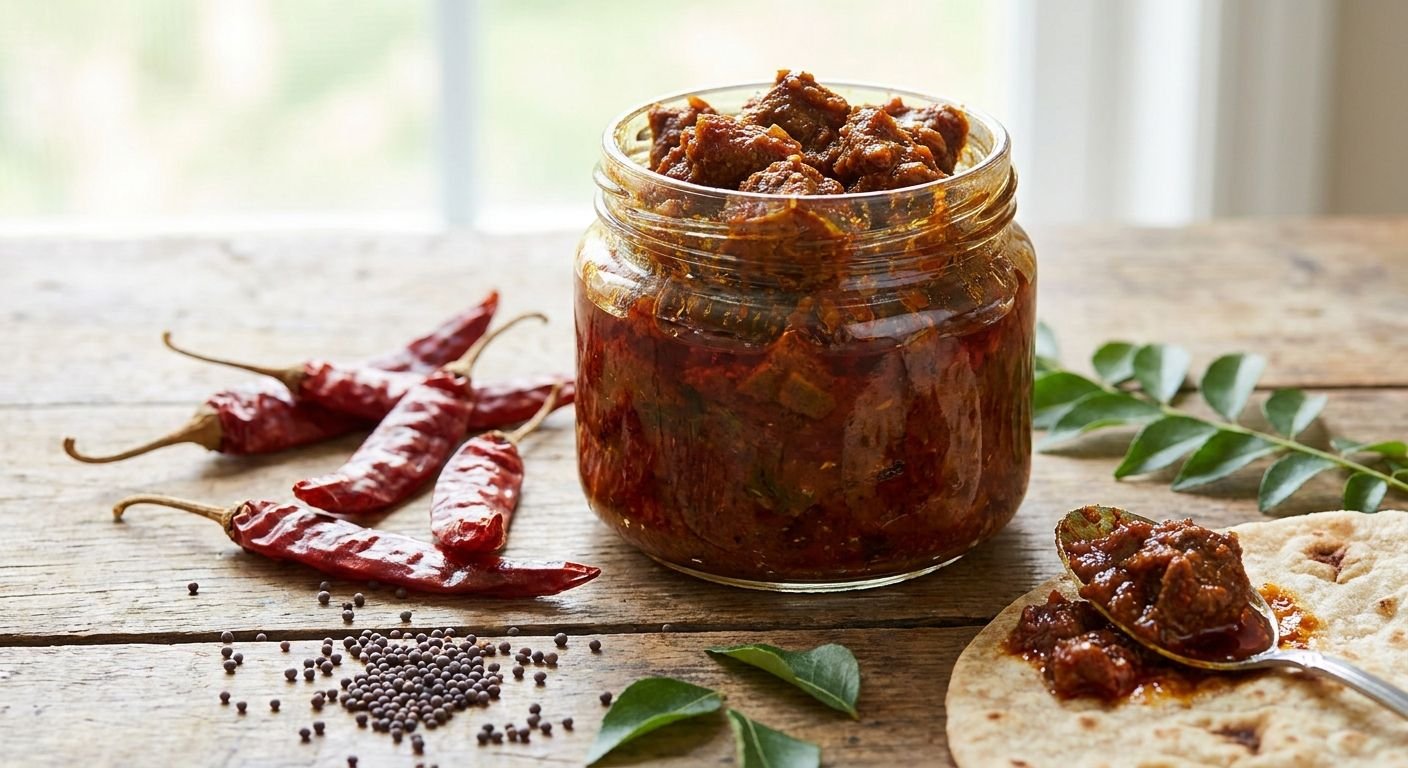
Boneless mutton pickle for quick spicy meals is a ready-to-eat non-veg pickle format built for people who want a full protein meal in the time it takes to serve rice, with no bone to work around and no stove time required. Bachelors, hostel students, night-shift workers and anyone eating on an irregular schedule in 2026 need a pickle that goes straight from jar to plate, not one that demands 30+ minutes of marination and a slow-cooked Sunday session.
- Boneless mutton pickle skips the bone-picking and the stove, turning plain rice into a full meal in minutes.
- Tulasi Pickles’ boneless mutton pickle suits daily quick meals better than bone-in versions, which need slower eating.
- Match spice level to eating frequency: milder heat works for daily use, higher heat for occasional servings.
- Store the jar in a cool, dry spot away from the stove, not the fridge door, to protect the oil layer.
Why boneless mutton pickle matters for quick spicy meals
Anyone eating on a tight window between classes, shifts, or gym sessions doesn't have 20 minutes to cook rice and another 30+ to marinate and simmer mutton. A jar of boneless mutton pickle from Tulasi Pickles removes both bottlenecks at once: the meat is already cooked and cut clean, so the only thing left to do is spoon it onto a hot plate of rice, curd rice, or khichdi.
This segment doesn't search for "authentic recipe" content the way home cooks do. They search for something that's already done, shelf-stable, and spicy enough to make plain rice feel like a proper meal. That changes what matters in a pickle: not just taste, but how fast it gets from shelf to plate and how well it survives being opened, closed, and left in a hostel cupboard for weeks at a stretch.
How to build quick spicy meals with boneless mutton pickle
Choose boneless over bone-in for real speed
Bone-in mutton pickle tastes just as good, sometimes richer, but it isn't built for a five-minute meal. Working around bone slows down eating and isn't practical when you're eating standing up or between tasks.
- Check the product description for "boneless" before ordering, not just "mutton pickle"
- Look for uniform, small-cut pieces, a sign the meat was deboned before cooking
- Skip bone-in versions for weekday lunches; save them for slow weekend meals
- Confirm the pickle is meant to be eaten as-is, not reheated and shredded
Check the spice level against how often you'll eat it
A pickle you eat daily needs a different heat level than one you eat once a week. Going in blind on spice level is the fastest way to either abandon a jar half-finished or run out of water at the table.
- Read the spice level guide before ordering if you're new to Andhra-style non-veg pickles
- Pick a milder batch for daily meals, a hotter batch for occasional indulgence
- Ask about chili content if you're ordering for someone with low spice tolerance
- Remember heat builds with the oil layer over time in storage, not just at first taste
Pick a base you already keep stocked at home
The whole point of a quick meal is not having to cook a separate side. Boneless mutton pickle works because it pairs with things already in most Indian kitchens.
- Plain steamed rice, ready in roughly 15-20 minutes if you're starting from scratch
- Curd rice, which needs zero cooking if you keep cooked rice on hand
- Khichdi, for a one-pot base that reheats fast
- Plain dosa or idli batter, if you keep a stock in the fridge
- Roti or paratha, for a dry pairing instead of a wet one
A full breakdown of pairing pickle with curd rice and khichdi covers proportions and which combinations work best for a light versus a heavy meal.
Portion it out so one jar doesn't sit open for weeks
One jar left open too long loses oil consistency and dries out at the edges. Portioning protects both the pickle and your meal quality.
- Spoon out a week's worth into a smaller airtight container if you eat daily
- Keep the main jar closed between uses to slow oxidation
- Use a dry spoon every time; moisture from a wet spoon shortens shelf life fast
- Track how many meals a jar realistically covers based on your own portion size, not the label
Store it away from heat and moisture, not in the fridge door
Most people either over-refrigerate or leave the jar too close to the stove. Both damage the oil layer that keeps boneless mutton pickle fresh between meals.
- Keep the jar in a cool, dry cupboard, not next to the stove or window
- Refrigeration isn't mandatory for oil-based pickles, but it extends shelf life if your kitchen runs hot
- Never leave the lid loosely closed; oxidation starts at the surface first
Let a ready-made boneless mutton pickle replace the Sunday cooking session
This is where a home cook's manual process runs into its limit. Marinating mutton, letting it rest, and slow-cooking it in oil and spice takes real time, and most people eating on a tight schedule in 2026 don't have a spare afternoon every week. Ordering a jar of Tulasi Pickles' boneless mutton pickle replaces that entire process with a five-minute meal, without cutting the spice or the meat quality.
“If the pickle takes longer to prepare than the rice, it stops being a quick meal pickle.”
Rotate with other quick non-veg pickles to avoid getting bored
Eating the same pickle daily gets old fast. Bachelors and hostel eaters usually keep two or three jars in rotation rather than committing to one flavor.
- Alternate boneless mutton with a chicken pickle for variety across the week
- Keep one milder jar for days you eat twice with pickle, one hotter for single servings
- Try a seafood option occasionally if you eat non-veg pickle more than four times a week
- Watch which jar finishes faster; that's your real daily favorite, not the one you thought you'd prefer
Skip the prep, order it ready
Boneless mutton pickle from Tulasi Pickles, ready to eat with rice or curd rice.
Boneless mutton pickle vs other quick meal options
| Option | Best for | Key limitation |
|---|---|---|
| Boneless mutton pickle (Tulasi Pickles) | Daily meals with zero prep and no bone to work around | Rich in oil, works better as an occasional heavy protein add-on than a twice-daily staple |
| Bone-in mutton pickle | Slow weekend meals where you have time to eat around bone | Not built for fast eating or standing meals |
| Fresh cooked mutton curry | Weekend cooking when you have an hour to spare | Needs raw meat, marination, and stove time before it's edible |
| Frozen ready meat packets | Convenience seekers who still want to cook | Needs thawing and cooking, and doesn't keep long once opened |
| Restaurant delivery meal | One-off cravings with zero prep tolerance | Costs add up over daily use, spice and quality vary order to order |
Verdict: boneless mutton pickle from Tulasi Pickles wins for anyone eating non-veg on a tight schedule in 2026 because it needs zero cooking and no bone handling, while bone-in versions and fresh curry still demand real prep time.
Common mistakes people make with boneless mutton pickle for quick meals
- Buying bone-in when the goal is speed. The flavor is similar, but eating around bone slows down exactly the meal you're trying to speed up.
- Choosing the hottest jar without checking eating frequency. A pickle meant for occasional use turns punishing when eaten as a daily staple.
- Storing the jar near the stove. Heat exposure breaks down the oil layer faster than most people expect, shortening usable shelf life.
- Using a wet spoon every time. Moisture introduced into the jar is the single biggest cause of early spoilage in oil-based non-veg pickles.
- Buying a large jar for irregular eating habits. Bachelors and students with inconsistent meal timing often waste the last portion because it sits open too long between uses.
FAQ
What is boneless mutton pickle best for?
Boneless mutton pickle is best for quick spicy meals where you don’t have time to cook or want to avoid picking through bone. It pairs directly with rice, curd rice, or khichdi with zero prep.
Is boneless mutton pickle better than bone-in for daily eating?
Yes, for daily or fast meals boneless mutton pickle is the better choice because there’s no bone to slow down eating. Bone-in versions suit slower, weekend-style meals instead.
How long does boneless mutton pickle last once opened?
Shelf life depends on storage: keeping the jar in a cool, dry spot away from heat and using a dry spoon every time extends usable life. Refer to the shelf-life storage guide for the full method.
Does boneless mutton pickle need refrigeration?
Oil-based pickles like boneless mutton pickle don’t strictly require refrigeration, but it helps in hot kitchens. A cool, dry cupboard away from the stove works for most households.
Can I eat boneless mutton pickle every day?
You can, but pick a milder spice level for daily use and portion it out so the jar doesn’t sit open too long. A hotter batch is better saved for occasional meals.
What should I pair boneless mutton pickle with for a quick meal?
Plain rice, curd rice, and khichdi are the fastest pairings since they need little to no extra cooking. Roti or dosa batter also work if you want a dry pairing.
Is boneless mutton pickle spicy?
Andhra-style boneless mutton pickle is typically on the spicier end, but spice level varies by batch. Check the spice level before ordering if you’re eating it daily.
How do I know if boneless mutton pickle is authentic Andhra style?
Authentic Andhra-style boneless mutton pickle uses a heavy red chili and oil base with visible whole spices, not a smooth masala paste. Cut size should be small and uniform since the meat is deboned before cooking.
One last thing
The fastest way to ruin a good jar of boneless mutton pickle isn't bad storage, it's buying the wrong heat level for how often you actually eat it. Most people default to the spiciest option available and then quietly stop eating it by week two. Order a milder batch for your everyday five-minute meals in 2026 and keep a hotter jar aside for the days you actually want to feel it.
Related guides
- Compare Andhra pickle types
- How to store homemade pickles for long shelf life
- Non-veg pickles for bachelors who love spicy food