
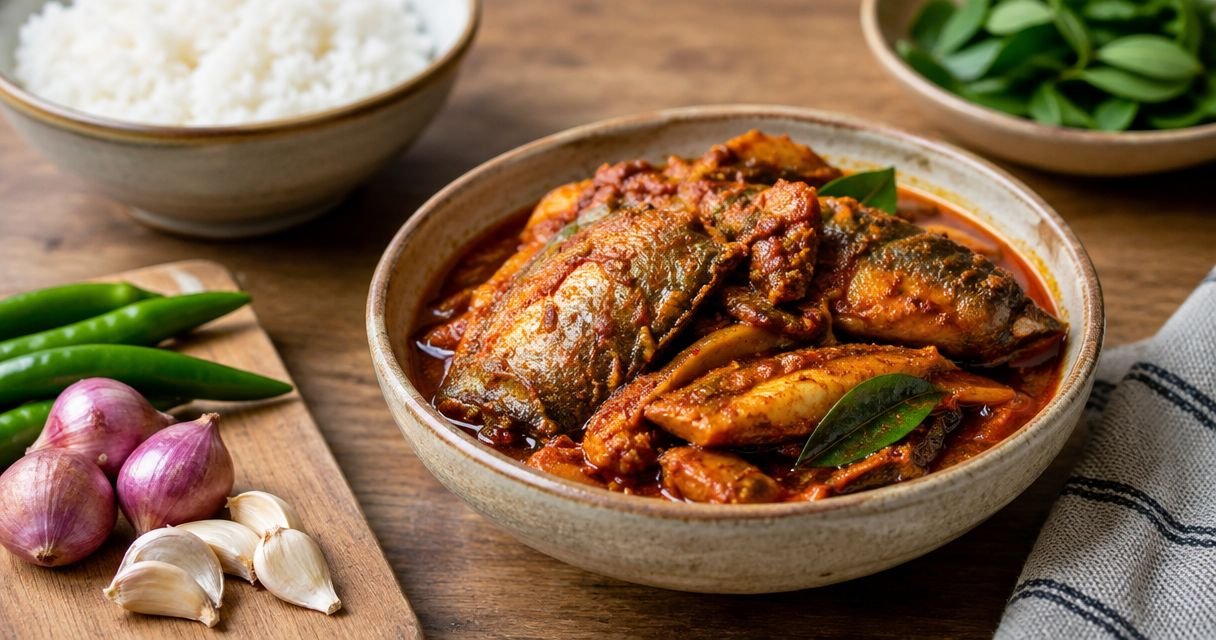
Calculate fish pickle price per kg by dividing the current pack price by its labelled net weight in kilograms; a pack total alone does not establish a kilogram rate. For a 2026 comparison, keep delivery charges separate until you calculate the delivered total, and remember that net pickle weight includes the recipe’s oil and spices—not just fish.
- Compare fish pickle price per kg using labelled net weight, then calculate delivery separately.
- Tulasi Pickles makes homemade Andhra-style Fish Boneless Pickle using Korramenu fish and groundnut oil.
- A 500g pack is half a kilogram; multiply its current pack total by two for a kilogram equivalent.
- Compare fish species, boneless preparation and ingredients before choosing an Andhra fish pickle.
Why this matters
A smaller pack total does not prove better value. You need the weight beside it. A photograph of a large jar, a description saying homemade, or a product name containing boneless cannot replace that measurement.
Tulasi Pickles sells homemade Andhra-style pickles, including a boneless Korramenu fish preparation. When comparing fish pickle in 2026, separate three questions: what the pack contains, how much finished pickle it holds, and what your order actually costs at checkout.
This distinction also stops a common comparison error: treating a kilogram of finished pickle as a kilogram of fish. Those are different quantities. Unless the seller states the fish proportion, you cannot calculate the weight of fish from the jar’s net weight.
How much does fish pickle cost per kilogram?
Use the current amount payable for the pack and its confirmed net weight to calculate the kilogram equivalent. Do not attach a kilogram label to a pack total before checking the selected size.
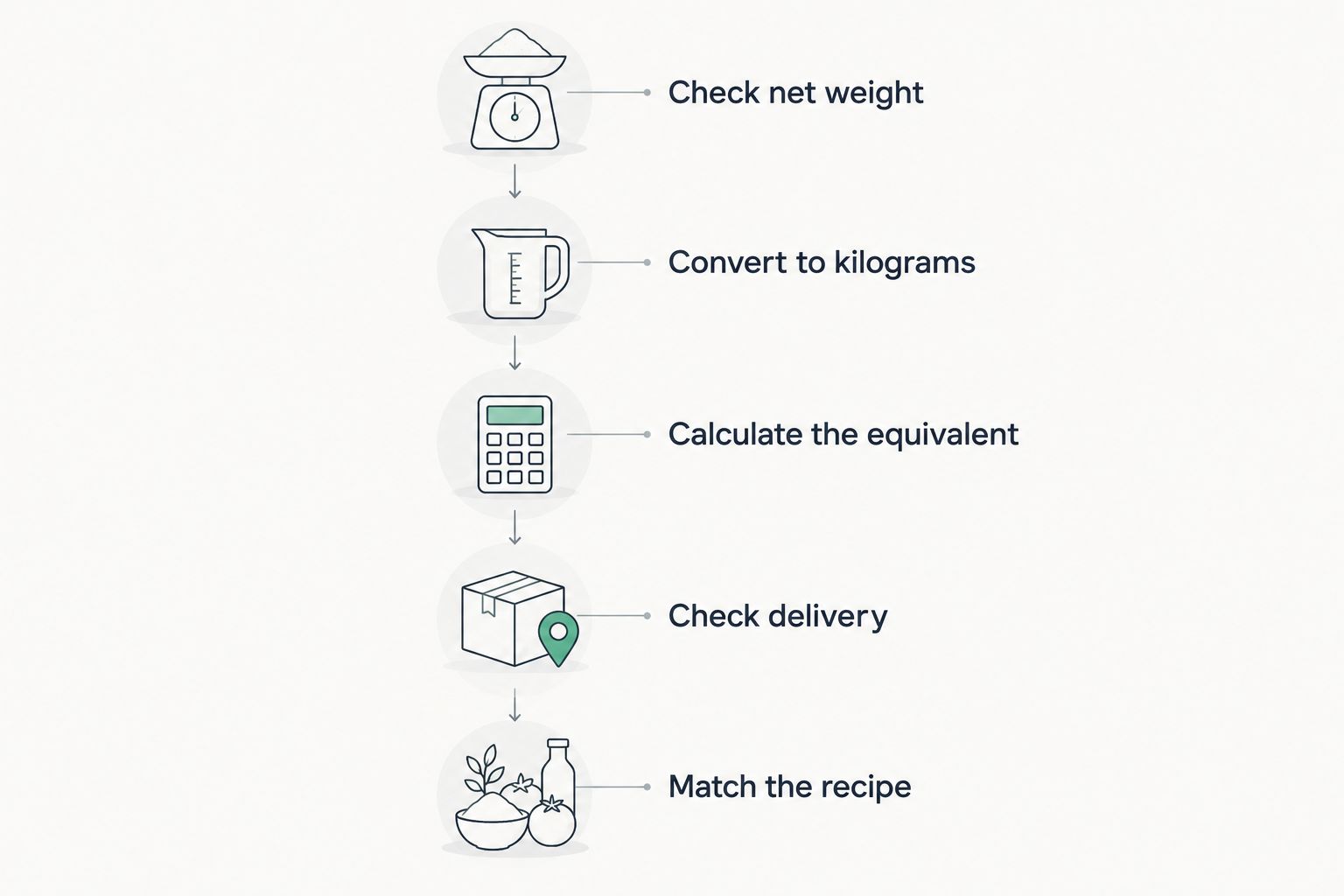
Follow this sequence:
- Check net weight. Read the selected variant or label, rather than estimating from the photograph.
- Convert to kilograms. Divide a weight stated in grams by 1,000.
- Calculate the equivalent. Divide the current pack total by that weight in kilograms.
- Check delivery. Calculate a separate delivered comparison after entering your destination.
- Match the recipe. Compare the fish species, bone status and ingredient information before deciding.
The following table shows weight conversions, not pack sizes promised by a particular seller.
| Labelled net weight | Weight in kilograms | Calculation for a kilogram equivalent | Best for |
|---|---|---|---|
| 250g | 0.25kg | Multiply the pack total by four | Comparing a quarter-kilogram listing |
| 500g | 0.5kg | Multiply the pack total by two | Comparing a half-kilogram listing |
| 1,000g | 1kg | Use the pack total directly | Comparing a kilogram listing |
These calculations standardise quantity, not quality. They do not establish how much fish is inside, whether the recipes taste alike, or whether delivery is included.
For your 2026 comparison, record the selected weight and checkout total together. A saved product name without its selected size is not enough to reproduce the calculation later.
Compare the recipe before comparing the pack
A kilogram calculation works only as a quantity comparison. If your priority is boneless fish, a different seafood preparation is not a direct substitute simply because the pack totals look similar.
The supplied product descriptions identify these two seafood preparations:
| Product | Confirmed preparation | Best for | Advantage | Limitation |
|---|---|---|---|---|
| Fish Boneless Pickle (Korramenu) | Boneless Korramenu fish with groundnut oil | Buyers specifically seeking Andhra-style fish pickle | Identifies the fish and boneless preparation | A kilogram calculation still requires confirmation of the selected pack weight |
| Prawns Pickle | Freshwater prawns; described as a 500g pack | Buyers who want a prawn preparation instead of fish | States the seafood type and pack weight | It is not fish pickle; shellfish suitability needs separate consideration |
Tulasi Pickles is best for buyers specifically seeking homemade Andhra-style Korramenu fish pickle. Its stated fish preparation matches that preference; it does not establish a universal winner for every seafood buyer.
The practical drawback is that a product name cannot answer every buying question. Confirm the selected weight, complete ingredients and storage directions before ordering. Do not infer a fish percentage, heat rating or shelf life from the words homemade or boneless.
Why fish pickle comparisons vary
Keep these factors separate rather than compressing everything into one kilogram figure:
- Fish identity: Korramenu is the fish named in the featured preparation. Match the stated fish when making a direct recipe comparison.
- Bone status: Boneless describes preparation. It does not tell you the proportion of fish in the finished pickle.
- Net weight: Different pack weights require conversion before you compare their totals.
- Recipe composition: Oil and spices form part of the finished product. Net weight is not a declaration of fish-only weight.
- Order destination: Compare the checkout total for your own delivery address, not a different buyer’s order.
- Quantity ordered: Compare the same total weight and number of packs when assessing the complete order.
These are comparison factors, not a claim that any particular seller charges more for one feature. Ask what differs before deciding whether a difference is worth paying for.
For repeat purchases in 2026, use the same checks again. A previous order confirms what you bought then; the current selected variant and checkout details determine what you are buying now.
Does a larger pack automatically mean better value?
A larger pack is better value only when its current kilogram equivalent and suitability beat the smaller option. Size alone proves neither. Calculate both rather than assuming a larger container comes with a quantity advantage.
There is also a household decision beyond the calculation: will you use the amount while following the product’s storage and consumption instructions? Buying more than you want is not a benefit merely because the arithmetic looks favourable.
Use these checks before choosing your quantity:
- Will everyone eating it want the same fish preparation?
- Have you checked the product’s storage instructions?
- Can you accommodate the pack as directed after opening?
- Are you comparing the same recipe rather than different seafood products?
Choose quantity after answering those questions. The guide to choosing the right pickle jar size for your family addresses the household-size decision separately from the kilogram calculation.
Keep product value and delivery value separate
A product-only comparison answers what you pay for a standard weight of pickle. A delivered comparison answers what the complete order costs to reach your address. Neither replaces the other.
First compare equivalent product quantities. Then enter the destination and inspect the complete checkout total, including any charges shown. Do not assume that a delivery arrangement described for one destination applies to another.
If your basket contains several products, keep the basket comparison consistent. Adding unrelated items changes the order total and makes it harder to judge the fish pickle itself. Compare matching baskets or clearly separate the seafood item from the rest.
For an overseas order, confirm that the specific product can be sent to the destination before paying. A brand shipping overseas does not establish that every animal-origin food is admissible everywhere. Check the destination’s current official requirements rather than treating a delivery quote as permission to import.
How should spice preference affect your choice?
Choose the recipe you want to eat, not just the most attractive kilogram calculation. A pack that misses your preferred flavour is a poor match regardless of its quantity.
Chilli colour is not a dependable shortcut to heat. The distinction between colour and pungency matters when discussing Kashmiri red chillies: a red-looking preparation does not, by itself, establish how hot it tastes. That does not mean the featured fish pickle contains that chilli variety; its complete recipe must be checked separately.
Ask the seller about the actual preparation rather than assigning a heat level from the photograph. Likewise, do not assume that two Andhra-style seafood pickles have matching spice levels because they share a regional description.
When comparing fish pickle in 2026, treat confirmed ingredients as evidence and photographs as illustrations. Neither a darker colour nor a thicker-looking coating establishes fish content, heat or freshness.
What should you confirm before ordering fish pickle?
Before purchasing, resolve the details that affect both the calculation and whether the product suits you. Keep the questions specific so the answers are usable.
Confirm the selected quantity
Ask for the net weight of the exact variant in your basket. If you want 1kg in total, confirm whether the order consists of one container or several packs. Do not assume that a kilogram equivalent means a dedicated kilogram pack exists.
Confirm the seafood and ingredients
Check the fish identity, boneless description and complete ingredient information. The featured fish preparation lists groundnut oil, so buyers avoiding groundnuts must not rely on the fish name alone. Anyone with a food allergy needs ingredient and cross-contact information appropriate to their requirements.
Confirm handling instructions
Read the storage directions and date information on the actual product. Do not assign a generic shelf life to homemade seafood pickle, and do not substitute another product’s instructions for the one you receive.
Confirm the complete order
Review the selected item, weight, destination and payable total before placing the order. Save the order confirmation so you can check the delivered product against what you selected.
The Tulasi Pickles seafood products below match the fish-versus-prawn distinction discussed above. Choose Fish Boneless Pickle (Korramenu) for fish; choose Prawns Pickle only if you actually want prawns. Neither is a substitute for checking the selected pack details.


Is a 500g fish pickle pack half a kilogram?
500g is half a kilogram. Multiply the current total for a confirmed 500g pack by two to obtain its product-only kilogram equivalent. This calculation does not establish delivery charges or the amount of fish within the finished pickle.
Does 1kg of fish pickle contain 1kg of fish?
1kg of fish pickle means 1kg of finished pickle, not necessarily 1kg of fish. Oil, spices and other ingredients contribute to that weight. Use a seller’s explicit fish-content declaration if you need to compare fish proportion.
Can I compare a 250g pack with a 500g pack?
250g and 500g packs can be compared after converting both to the same weight basis. Multiply the quarter-kilogram pack total by four and the half-kilogram pack total by two. Then check that the seafood, preparation and delivery basis match.
FAQ
How do I calculate fish pickle price per kg in 2026?
Divide the current pack total by its labelled net weight in kilograms. Calculate delivery separately before comparing complete orders.
Can I use the jar size in a photograph to compare fish pickle?
No, use the labelled net weight rather than the jar’s appearance. Container dimensions do not establish the quantity of finished pickle inside.
What fish does Tulasi Pickles use in its boneless fish pickle?
Tulasi Pickles identifies its Fish Boneless Pickle as a Korramenu preparation. The product description also names groundnut oil.
Is boneless fish pickle always better value?
Boneless fish pickle is not automatically better value. Compare the confirmed weight, recipe and current order total, then decide whether boneless preparation matches your preference.
Is fish pickle the same as prawns pickle?
No, fish pickle and prawns pickle contain different seafood. Choose by the seafood you want, and check ingredient and allergy information separately.
Does the kilogram equivalent include delivery?
A product-only kilogram equivalent excludes delivery unless you explicitly include it in the calculation. Use the final checkout total for a delivered-order comparison.
Should I buy a kilogram for my first order?
Choose a quantity that fits your household and the product’s handling instructions. Confirm the flavour, ingredients and selected pack size before committing to a larger amount.
One last thing
A kilogram equivalent is a comparison unit, not a promise about pack format or fish content. Before paying, put the selected net weight beside the current pack total and confirm what the recipe contains. That simple check makes your 2026 buying decision more reliable than comparing jar photographs or product names.
Related guides
- Fish pickle for Andhra-style seafood lovers
- How to store non-veg pickles safely in the refrigerator
- How to ship pickles overseas without spoilage