
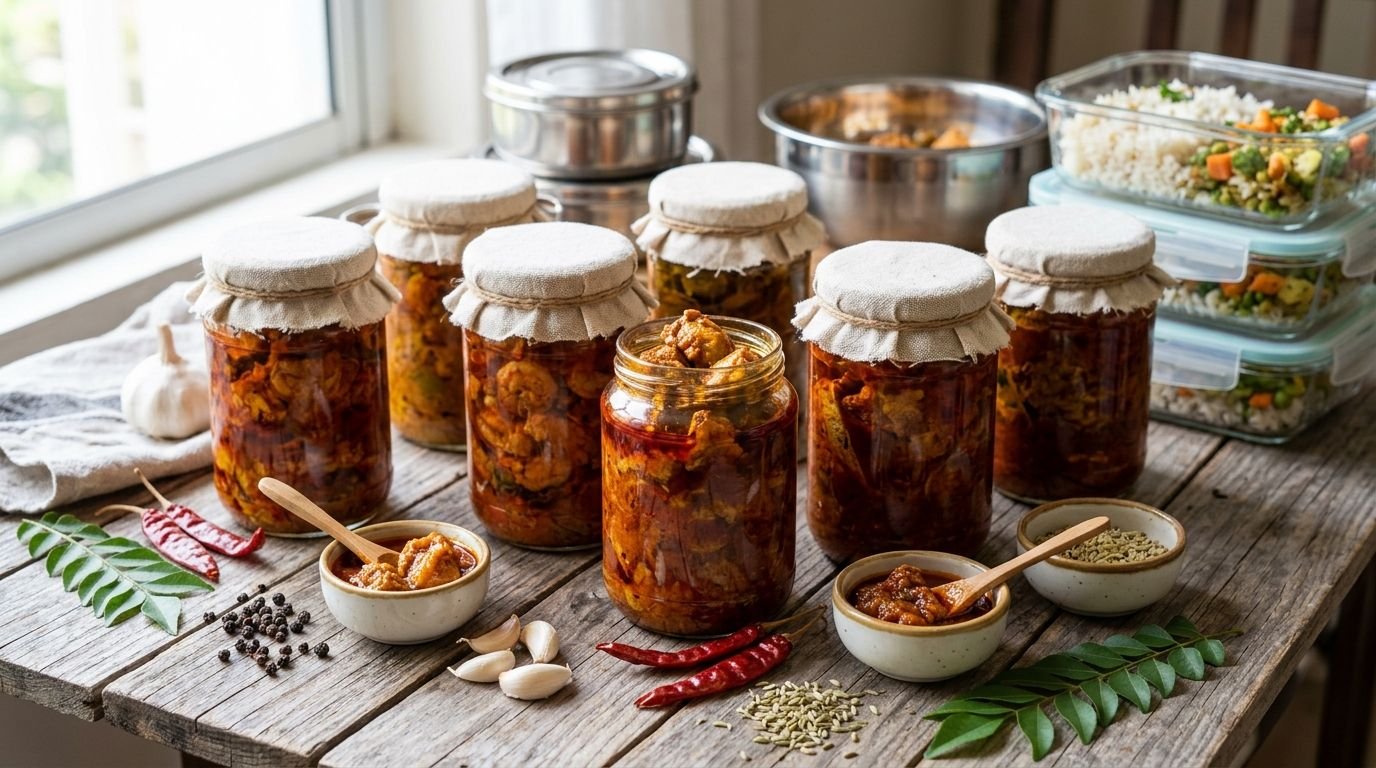
Non veg pickles bulk order buyers are households, hostel messes, offices, and meal-preppers who stock chicken, mutton, prawns, or fish pickle in multi-kilogram batches to turn a jar into a five-minute protein side for weeks at a stretch. Their buying pattern is different from a single-jar shopper: storage life, oil ratio, and variety rotation matter more than the flavor of any single batch, and the whole point of bulk buying falls apart if half the stock goes stale before it gets eaten.
- Boneless chicken and mutton pickle from Tulasi Pickles hold up well for bulk meal-prep because the oil layer on top slows spoilage once refrigerated.
- Split a bulk order across 2-3 varieties instead of one flavor; palate fatigue is why meal-preppers abandon a single jar by week three.
- Refrigerate any opened jar within a day or two of first use – bulk buyers who leave jars on the counter see oil separation faster.
- Boneless cuts save prep time for meal-prep buyers; bone-in mutton and chicken pickle need extra minutes to portion before eating.
Why this matters
A single-jar buyer tastes a pickle once and moves on. A bulk buyer is committing to eating the same jar of chicken pickle or mutton pickle across dozens of meals, which changes the calculus entirely. Get the variety mix wrong and you're staring at a half-finished 2026 batch by month two. Get the storage wrong and the spoilage risk climbs faster than a single-jar buyer would ever notice.
Meal-prep bulk buyers also carry a different failure mode than casual buyers: they order once and forget to reorder, or they order once and over-order a flavor nobody in the household actually wants three weeks in. Both are fixable with a plan, not a bigger jar.
Why non veg pickle bulk orders matter for meal-prep buyers
Meal-prep households and mess kitchens are optimizing for one thing: fewer cooking decisions per week. A jar of non-veg pickle replaces a stovetop curry when reheating time is the constraint, and that's exactly why storing non-veg pickles safely in the refrigerator is the first skill a bulk buyer needs, not an afterthought. A jar bought to last six weeks needs a different handling routine than a jar bought to finish in six days.
The segment also skews toward people cooking for more than one person – joint families, small offices splitting a lunch order, hostel mess managers stretching a weekly budget. That means portion consistency and reheat speed matter as much as spice level.
Calculate your batch size before ordering
Don't guess the quantity. Work backward from how many meals the pickle is replacing.
- Count servings per week where pickle substitutes for a cooked curry, not just a side
- Multiply by the number of weeks you want the batch to last
- Check available fridge shelf space before committing to a large multi-jar order
- Account for shared households where more than one person is eating from the same jar
- Build in a 10-15% buffer for occasional extra servings on weekends
Pick pickle types that hold up to bulk storage
Not every non-veg pickle behaves the same way in a fridge over weeks. Chicken, mutton, prawns, and fish pickle each have different oil-to-meat ratios and different textures once chilled.
- Boneless chicken or mutton pickle for faster daily portioning
- Bone-in versions when flavor depth matters more than prep speed
- Prawns or fish pickle in smaller batches since seafood pickle is typically eaten faster than meat pickle
- Rotate at least two protein types so the same flavor isn't on the table every single day
- Check the spice level against household tolerance before scaling the order up
Check shelf-life and storage instructions before ordering bulk
A bulk order is only worth it if the jar survives the timeline you're planning around. Read storage guidance before, not after, the order ships.
- Confirm the oil layer on top is intact when the jar arrives
- Refrigerate opened jars instead of leaving them on a kitchen counter
- Use a clean, dry spoon every time to avoid introducing moisture
- Keep unopened jars in a cool, dark spot until you're ready to start one
- Label each jar with the date it was opened so nothing gets forgotten at the back of the shelf
Compare boneless vs bone-in for meal-prep speed
This is the single biggest time-saver decision for bulk buyers who are prepping meals on a schedule.
- Boneless chicken pickle portions in seconds – no picking around bone while plating
- Bone-in mutton pickle carries more flavor per bite but slows down quick lunches
- Office meal-preppers and hostel eaters generally do better with boneless for speed
- Weekend family meals can absorb the extra time bone-in versions need
- Mixing both across a bulk order covers weekday speed and weekend indulgence
Verify packaging before a large or long-distance order
Bulk orders travel further and sit in transit longer than a single jar picked up locally. Packaging quality decides whether the batch arrives usable.
- Look for tightly sealed jars with an oil seal at the top, not just a lid
- Ask about packing methods for long-distance or overseas bulk shipping
- Avoid ordering bulk non-veg pickle right before extreme weather swings without checking packing adjustments
- Confirm the order ships in insulated or protective packing for multi-jar quantities
- Check delivery timelines before scheduling a meal-prep week around the arrival date
Set a reorder point instead of ordering once
Bulk buying isn't a one-time event for meal-preppers – it's a cycle. Treat it that way from the start.
- Track how many weeks a typical jar lasts your household
- Reorder when you're down to your last unopened jar, not when the shelf is empty
- Keep a rotating stock of at least two varieties so no single jar sits open too long
- Note which pickle finished fastest and adjust the next bulk order's mix accordingly
Loop in a caterer-style order for events or mess kitchens
Hostel messes, small offices, and event caterers ordering non-veg pickle in genuinely large volumes have different needs than a family stocking a fridge. Andhra pickles for restaurants and caterers covers the recurring-order side of this that a household bulk buyer usually skips.
- Set a recurring order schedule instead of ad-hoc large batches
- Standardize on one or two proteins across the whole kitchen to simplify prep
- Confirm bulk packaging can handle repeated scooping across a service window
- Check whether the supplier can commit to a consistent delivery day each cycle
Comparing your bulk-order options
| Option | Best for | Key limitation |
|---|---|---|
| Online bulk order from Tulasi Pickles | Families and meal-preppers ordering across India | Delivery timelines vary by pickle type and distance |
| Local Hyderabad pickle shop pickup | Buyers based in Hyderabad wanting same-day stock | Fewer non-veg varieties available in a single visit |
| Wholesale or recurring caterer order | Mess kitchens, caterers, and restaurants with repeat volume needs | Requires a recurring commitment and standardized flavor choices |
| Homemade batch cooking | Buyers wanting full control over spice and oil ratio | Time-intensive and shelf life depends entirely on your own process |
Verdict: a split bulk order across boneless chicken and mutton pickle from Tulasi Pickles is the practical default for most meal-prep households in 2026 – it covers weekday speed and weekend flavor without locking a family into one protein for a month.
“A bulk order only pays off if every jar gets a date on the lid the day it’s opened.”
Common mistakes meal-prep bulk buyers make
- Ordering one giant batch of a single flavor instead of splitting across 2-3 varieties, then abandoning the jar by week three out of sheer boredom
- Leaving opened jars on the kitchen counter instead of refrigerating them, which speeds up oil separation and spoilage
- Skipping the boneless vs bone-in decision for a mess kitchen or office with tight lunch windows, then losing prep time daily
- Ignoring the oil-to-meat ratio before bulk buying – a low-oil jar spoils faster once it's opened and closed repeatedly
- Treating bulk buying as a one-time event instead of setting a reorder point before the last jar runs out
Place your bulk non-veg pickle order
Browse chicken, mutton, and prawns pickle for meal-prep quantities.
FAQ
What’s the best way to store bulk non-veg pickle for meal prep?
Keep unopened jars in a cool, dark spot and refrigerate any jar within a day or two of opening it. The oil seal on top should stay intact until the jar is first used, and every scoop after that should come from a clean, dry spoon.
How much non-veg pickle should a family order in bulk?
Count how many meals per week the pickle will replace a cooked curry, then multiply by how many weeks you want the stock to last. Add a small buffer for weekends, and split the total across at least two protein varieties.
Is boneless chicken pickle better than bone-in for meal prep?
Boneless chicken pickle portions faster, which matters for weekday lunches and office meal-prep. Bone-in versions carry more flavor per bite but take longer to eat, so they suit weekend meals better than daily prep.
Can non-veg pickle bulk orders be shipped across India safely?
Yes, non-veg pickle bulk orders ship across India when packed with a proper oil seal and protective packaging for the distance involved. Delivery timelines vary by pickle type and destination, so confirm the schedule before planning a meal-prep week around it.
How long does a bulk-ordered non-veg pickle jar last once opened?
Shelf life once opened depends on how consistently the jar is refrigerated and whether a clean spoon is used every time. Jars left at room temperature after opening spoil noticeably faster than ones refrigerated immediately.
Should hostels and mess kitchens order non-veg pickle in bulk?
Mess kitchens benefit from a recurring bulk order on a set schedule rather than one-off large batches. Standardizing on one or two proteins across the kitchen simplifies portioning and cuts prep time for staff.
What’s the best non-veg pickle for meal-prep bulk buyers in 2026?
Boneless chicken and mutton pickle are the practical default for 2026 meal-prep buyers because they portion quickly and hold up well to repeated refrigeration. Splitting an order across both avoids the flavor fatigue that comes with a single-variety bulk buy.
Is it cheaper to order pickle in bulk than in single jars?
Bulk pricing structures vary by pickle type and order size, so check current bulk pricing directly on the site before comparing it against single-jar totals. The bigger cost risk in bulk buying is usually spoilage from poor storage, not the per-jar price.
One last thing
The single biggest predictor of whether a bulk order gets finished before it goes stale isn't the pickle – it's whether every opened jar has a date on the lid. A strip of masking tape marked the day you open a jar turns a guess into a system, and it's the one habit that separates meal-prep buyers who reorder smoothly in 2026 from the ones who throw out a forgotten jar every few months.
Related guides
- Pickle combo packs for large joint family households
- Combo pack of veg and non-veg pickles for mixed families