
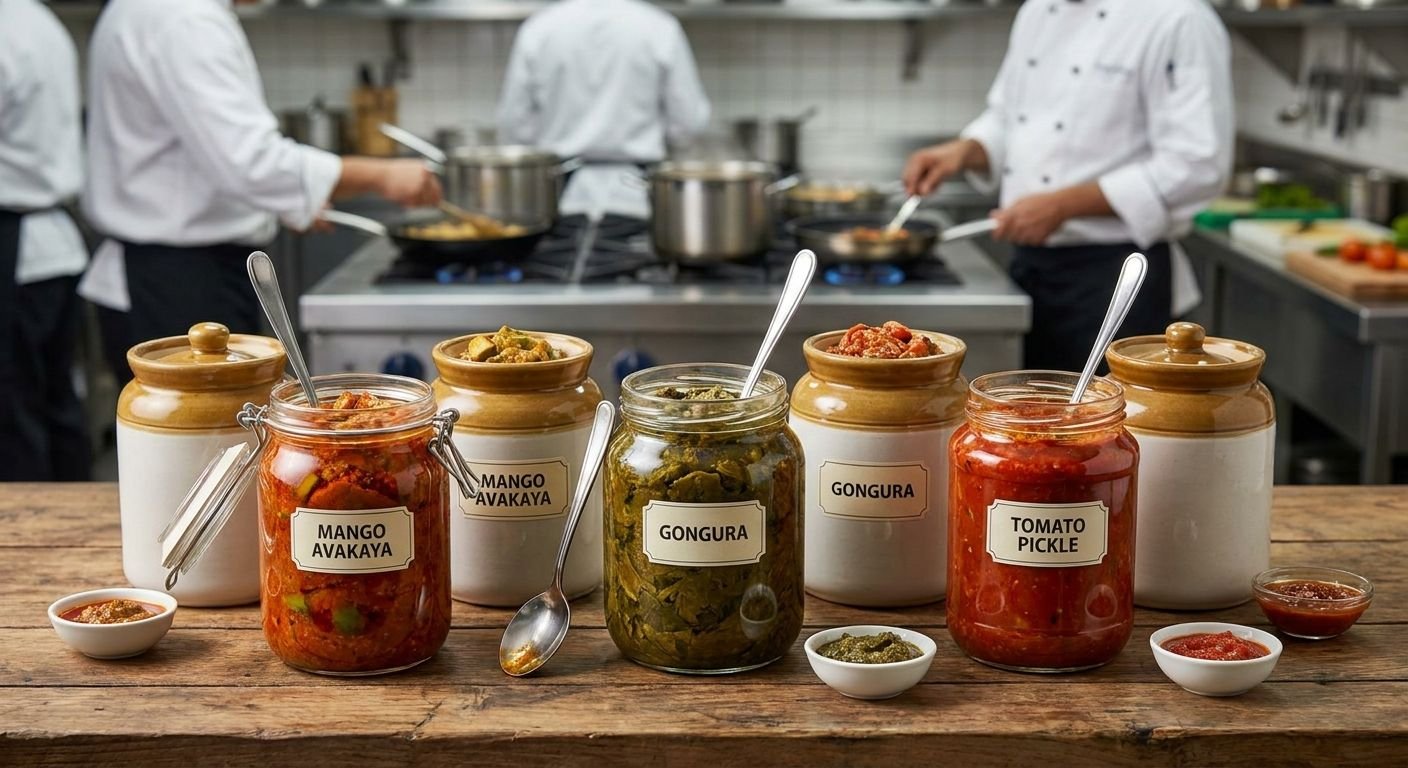
Andhra pickles for restaurants and caterers means sourcing homemade-style veg and non-veg pickles in bulk batches with consistent spice levels, verified shelf life, and formats built for catering trays, buffet counters, and thali service, not the single-jar retail pack meant for a home fridge. A restaurant kitchen or a wedding caterer has different constraints than a home buyer: batch-to-batch spice consistency, storage that survives a busy kitchen, and combo formats that scale to guest counts instead of one household's monthly stock.
- Pickles for restaurants need batch consistency and verified shelf life, not just flavor — treat sourcing as a supply decision, not a taste test.
- Tulasi Pickles ships homemade Andhra-style veg and non-veg pickles from Hyderabad and offers combo packs suited to weddings and functions.
- Test spice level and storage behavior on a sample order before committing to a bulk run for a menu launch or event.
- Combo packs built for weddings and functions are a faster route than assembling single-variety jars for large guest counts.
Why pickles for restaurants and caterers need a different approach
A home buyer picks one jar and eats it over weeks. A restaurant or caterer runs through the same jar in a single service, then needs the next batch to taste identical — no drift in salt, oil separation, or chili heat between orders placed in March and orders placed in October 2026. That consistency requirement is the single biggest difference between retail pickle buying and catering pickle sourcing.
Caterers also buy for events, not for daily rotation. A wedding function or a corporate lunch needs pickle quantity that matches guest count on a fixed date, packed to survive transport and buffet service without breaking down in heat. Tulasi Pickles sells homemade Andhra-style veg and non-veg pickles, podis, papads, and dry fruits out of Hyderabad, with shipping across India and overseas — the same catalog a home buyer uses, but the sourcing decisions below are what change when you're buying for a kitchen instead of a kitchen table.
Test spice level before you commit to a large order
Andhra pickles range from mild to genuinely fierce, and what reads as "medium" to one home cook is unusable on a mixed-guest banquet menu. Restaurants that skip this step end up with complaint calls mid-event or a full batch nobody touches.
- Order a small sample of the exact variety before the bulk order, not a different flavor from the same brand
- Taste-test with actual kitchen staff, not just the person placing the order
- Ask specifically whether spice level is fixed per batch or varies by season's chili stock
- Check the spice level guide before choosing between mild, medium, and extra-hot for a mixed-guest event
- Separate veg and non-veg spice expectations — a chicken or mutton pickle running hot reads very differently on a thali than a mild gongura
Match variety to your menu format
A thali restaurant and a wedding catering table don't need the same pickle lineup. A thali service usually rotates 2-3 veg pickles daily; a wedding function needs a fixed combo that covers vegetarian and non-vegetarian guests without runouts.
- Stock at least one tangy veg option (lemon, tamarind, or gongura) for daily thali rotation
- Add a non-veg pickle only if the menu format includes meat-eating guests as a side, not the main course
- Keep dry, ambient-stable options like podis and papads as backup when fresh pickle stock runs low mid-service
- Avoid stocking five pickle varieties when your menu format only rotates through two — unsold stock is the most common waste point
Check shelf life and storage before bulk ordering
A restaurant kitchen isn't a home pantry — walk-in coolers, high turnover, and staff who don't always reseal jars properly all change how long a pickle batch actually stays usable. Ordering six months of stock without checking storage guidance is how kitchens end up discarding a third of it.
- Read the storage guide for homemade pickles before deciding order frequency
- Assign one staff member to reseal and refrigerate jars after each service, not whoever's closest
- Order in a cadence that matches actual kitchen turnover instead of one large annual bulk order
- Separate oil-based pickles (longer shelf stability) from lower-oil or fresh-cut varieties that need faster turnover
Plan combo packs for weddings and large functions
A wedding or corporate function needs one order that covers the whole guest list, not five separate jar purchases assembled the week before. This is where a caterer's buying pattern genuinely differs from a restaurant's weekly reorder.
- Confirm guest count and menu format (veg-only, mixed, or separate counters) before placing the order
- Look at combo packs built for weddings and functions instead of assembling single-variety orders manually
- Place the order with enough lead time for a homemade-batch supplier to prepare volume, not a last-week rush order
- Confirm packaging survives transport to the venue if the function isn't at the kitchen's own location
Set a recurring order cadence instead of one-off bulk buys
Restaurants that reorder ad hoc lose the consistency benefit entirely — a new batch every few weeks from the same supplier is what keeps taste and texture stable across a menu's lifetime. Treat pickle sourcing the way you'd treat any recurring kitchen supply line, with a fixed reorder point rather than a panic order when the shelf runs empty.
- Set a reorder trigger at a fixed stock level, not "when we notice we're out"
- Keep one supplier as primary for a given variety rather than switching between vendors and reintroducing taste drift
- Track which varieties actually move on the menu versus which sit in storage past their useful window
- Revisit the order plan every quarter as menu items change
Confirm packaging fits kitchen and buffet handling
A jar that's fine on a home shelf may not hold up on a buffet line under a heat lamp for three hours, or survive being scooped by serving staff all evening.
- Ask whether packaging is meant for direct buffet service or needs decanting into serving bowls first
- Check that lids reseal properly for jars going back into cold storage mid-service
- For events with a transport leg, confirm the supplier's packaging is rated for that, not just for postal shipping
Sourcing pickles for a wedding or function
Combo packs built for guest-count catering, veg and non-veg together.
Comparison: sourcing options for restaurants and caterers
| Option | Best for | Consistency across batches | Key limitation |
|---|---|---|---|
| Single-jar retail purchase | Small thali counters testing a new variety | Low — no bulk guarantee | Doesn't scale to event or weekly kitchen volume |
| Unorganized local home cook | One-off small functions with a known supplier | Variable — depends on the cook's batch that week | Hard to reorder identically once the batch changes |
| Organized homemade-style brand (e.g. Tulasi Pickles) | Restaurants and caterers needing repeat orders and combo packs | Higher — same recipe, same sourcing process each batch | Still needs a sample order first to confirm fit for your menu |
| Commercial mass-market pickle brand | Very high-volume kitchens prioritizing shelf stability over authentic Andhra taste | High, but flavor profile is generic, not regional | Lacks the homemade Andhra character restaurants market on |
Verdict: for a Hyderabad-based restaurant or caterer wanting authentic Andhra taste with batch consistency, an organized homemade-style supplier sourced with a sample order first beats both unorganized local cooks and generic commercial brands. Buy the sample, confirm spice level and shelf behavior, then move to a recurring order.
Common mistakes restaurants and caterers make
- Skipping the sample order and jumping straight to bulk — the fastest way to discover a spice mismatch after 50 kilos are already delivered
- Treating veg and non-veg pickle needs the same way — a thali counter and a mixed-guest wedding table need different variety splits
- Ignoring storage guidance and stocking six months of pickle in a walk-in that wasn't set up for it, leading to avoidable spoilage
- Ordering single jars for events instead of using combo packs designed for guest-count catering, which forces last-minute top-up orders
- Switching suppliers frequently to chase small differences, which reintroduces the exact taste-drift problem consistency sourcing was meant to solve
FAQ
What pickles for restaurants work best for Andhra thali service?
A rotating set of 2-3 veg pickles — lemon, tamarind, or gongura are common — covers most daily Andhra thali service in 2026. Non-veg pickles work as a side option rather than a daily rotation item.
Can restaurants order pickles in bulk from Tulasi Pickles?
Tulasi Pickles ships homemade veg and non-veg Andhra pickles across India and overseas, and restaurants can place recurring or event-based orders through the same catalog used for retail customers. Confirm variety and quantity details directly before a large order.
How long do bulk pickles for restaurants stay fresh?
Shelf life depends on the pickle type and how it’s stored after opening, with oil-based varieties generally holding longer than lower-oil or fresh-cut pickles. Follow a dedicated storage guide rather than guessing based on home-use timelines.
Do caterers get combo packs for weddings and functions?
Yes — combo packs built specifically for weddings and functions bundle multiple pickle varieties to match guest-count catering instead of requiring separate single-jar purchases. This is the faster route for event-based ordering.
What’s the difference between veg and non-veg pickle sourcing for restaurants?
Veg pickles like lemon, gongura, or tamarind suit daily thali rotation and vegetarian guests, while non-veg pickles such as chicken or mutton work as a side option for mixed-guest events. Restaurants typically stock more veg variety than non-veg for daily service.
How do restaurants control spice level across large orders?
Test a small sample of the exact variety with kitchen staff before placing a bulk order, since spice level perception varies between individual cooks and even between batches from the same supplier. Ask the supplier whether spice level is fixed or varies seasonally.
Is homemade pickle sourcing better than commercial pickle brands for restaurants?
Homemade-style Andhra pickles generally deliver more authentic regional flavor than mass-market commercial brands, which prioritize shelf stability over taste character. The tradeoff is that homemade suppliers need a sample-order step to confirm batch consistency before a restaurant commits to bulk.
One last thing
Most restaurants treat pickle sourcing as an afterthought bolted onto the main menu supply chain, when it's actually one of the few items on the table that customers specifically remember and ask about by name. Tulasi Pickles operates out of Chanda Nagar in Hyderabad, and a restaurant or caterer within reach of that base has an easier path to a working relationship — sample first, confirm spice and storage fit, then move to a recurring or event-based bulk order in 2026 rather than a one-time panic buy before a big function.
Related guides
- Andhra pickles online buying guide
- How to store homemade pickles for long shelf life
- Andhra pickles for corporate gifting to clients and employees