
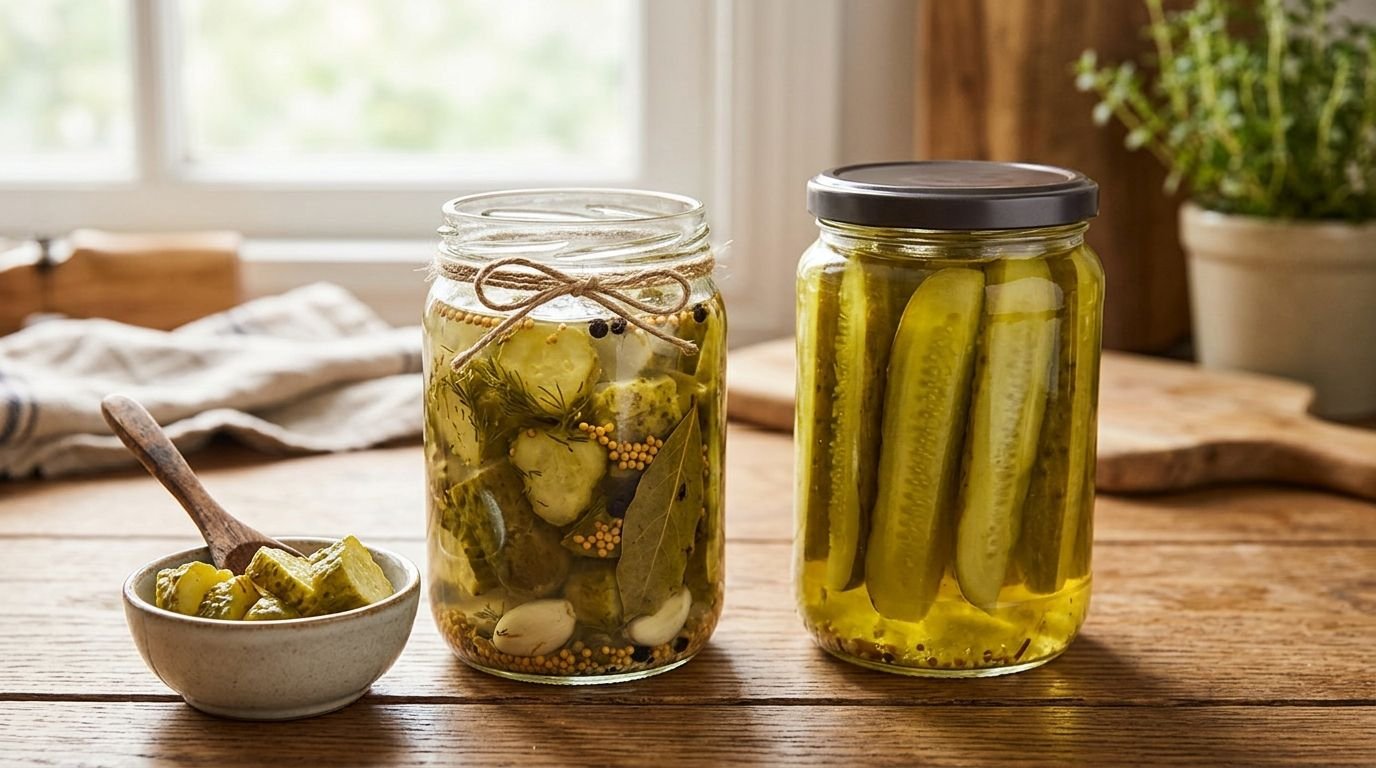
Homemade pickle is not automatically healthier than store-bought pickle: the better choice depends on sodium, oil, added sugar, portion size and safe preparation. Added preservatives alone do not decide whether a pickle is healthy, and a homemade recipe can still contain substantial salt and oil.
- Homemade pickle vs store bought pickle has no automatic health winner; compare ingredients, sodium and portions.
- Added preservatives and nutritional quality are different questions; preservative-free does not mean low-sodium.
- Tulasi Pickles suits buyers seeking homemade Andhra-style pickles, not an assumed nutritional advantage.
- Safe preparation and correct storage matter for homemade and commercially packaged pickles alike.
Is homemade pickle healthier than store-bought preservative pickle?
Neither homemade nor store-bought pickle wins on health without checking the actual recipe or label. Homemade preparation gives you control over ingredients; a packaged product gives you information to assess when its ingredients, nutrition and storage instructions are clearly declared.
Buying homemade-style food and buying online are not opposites. Tulasi Pickles sells homemade Andhra-style veg and non-veg pickles through its e-commerce store, so the useful distinction is how a pickle is made and labelled—not simply where you buy it.
| Option | Best for | Main advantage | Main limitation | What to verify |
|---|---|---|---|---|
| Home-prepared pickle | Cooks who want recipe control | You know which ingredients you add | Nutrition and storage safety still depend on the recipe | Salt, oil, preparation and storage method |
| Purchased homemade-style pickle | Buyers seeking a traditional preparation style | You do not need to prepare it yourself | Homemade wording does not establish nutritional quality | Ingredients, nutrition information and storage instructions |
| Commercially packaged pickle | Buyers who want a labelled, ready-to-use condiment | Declared information supports comparison | Salt, oil and sugar vary between recipes | Sodium on an equivalent basis, ingredients and serving size |
The strongest choice in 2026 is the jar you can assess, store correctly and use in a portion that fits your diet. A familiar recipe name is not enough.
Why this matters
Pickle is a condiment, not a replacement for vegetables, pulses or other main foods. Its contribution to your diet depends on what is in it and how much you eat alongside the rest of your meal.
A comparison focused only on preservatives misses the more useful questions. How much sodium does your portion contribute? Does the recipe contain added sugar? Are you following the storage instructions after opening?
Judge nutritional quality and food safety separately. A pickle with less sodium is not a better choice if it has been prepared or stored unsafely; a safely preserved pickle is not automatically suitable for a sodium-restricted diet.
Home-prepared pickle: best for ingredient control
Making pickle yourself lets you choose the produce, spices and other ingredients. You can also record the recipe rather than relying on memory when deciding how much salt or oil went into a batch.
The limitation is that ingredient control does not equal nutritional measurement. Knowing that you added salt does not tell you the sodium content of each spoonful, especially when the distribution of solids and liquid varies.
Food safety also limits casual recipe changes. Do not cut salt, acid or other preservation ingredients in a shelf-stable recipe simply to make it sound healthier; use a tested recipe designed for the intended storage method.
Choose home preparation for control, not for an automatic health claim. If you need a medically restricted diet, a familiar family recipe still needs assessment.
Purchased homemade-style pickle: best for traditional preference
A purchased homemade-style pickle suits you when you want that preparation style without making a batch yourself. The health comparison still rests on ingredients, nutritional information and handling instructions.
The word homemade does not tell you whether a pickle contains less salt, less oil or no added preservatives. Those are separate claims, and each needs supporting information about the specific product.
For your 2026 purchase, distinguish a taste preference from a nutrition requirement. Traditional flavour is a valid reason to choose a pickle; it is not evidence that the pickle meets a low-sodium eating plan.
Choose purchased homemade-style pickle when its ingredients and instructions fit your needs. Ask for clarification when a health-relevant detail is unclear rather than interpreting the description as a guarantee.
Commercially packaged pickle: best for label-based comparison
Commercial packaging can make comparison easier when the label provides clear ingredient, nutrition and storage information. You can check what is declared rather than assuming every factory-made recipe has the same composition.
The limitation is variation. A packaged pickle can contain substantial sodium or added sugar, and a small stated serving can make the figures appear modest until you compare equivalent amounts.
An added preservative is not, by itself, proof that a product is unhealthy. Food additives are assessed for specified uses and limits; the relevant questions are which additive is present, whether it is permitted for that use and whether you have a specific reason to avoid it.
Choose packaged pickle on its declared composition, not on a blanket judgement about commercial production. A long ingredient list needs interpretation, not an automatic rejection.
Why pickle healthfulness varies
These factors explain more than the homemade-versus-store-bought distinction:
- Sodium: Salt contributes sodium, and your total intake includes everything else you eat that day. Compare products on an equivalent quantity before considering your actual portion.
- Oil: Oil contributes energy. The amount in the recipe and the amount you serve both matter; an oily appearance alone is not a nutritional analysis.
- Added sugar: Some recipes include sugar or jaggery. Read the ingredients rather than assuming every sour or spicy pickle is unsweetened.
- Portion size: The same pickle contributes more sodium and energy when you eat more of it. A small label serving is useful only if it resembles your serving.
- Preservation and handling: Preparation, acidity, salt, processing and storage affect safety. No-added-preservative wording does not replace handling instructions.
- Personal dietary needs: Hypertension, kidney disease, allergies and prescribed eating plans change what you need to check. A general healthy-food label cannot resolve those requirements.
For an everyday 2026 decision, start with the factor that matters to your health rather than the most prominent claim on the jar. Someone managing sodium intake needs sodium information, not reassurance about traditional preparation.
How do you compare pickle labels fairly?
Compare like quantities first, then judge the portion you actually eat. Different serving sizes can obscure the difference between recipes.
- Read ingredients. Identify the main ingredient, oil, salt, sweeteners and declared additives. Check allergen information relevant to you.
- Compare sodium. Use the same weight basis wherever information allows. Do not compare one product's small serving with another product's much larger serving.
- Check sugar. Look for added sweeteners in the ingredients and interpret the nutrition information alongside them. Tanginess does not rule out added sugar.
- Check storage. Read unopened and after-opening instructions separately. Follow the product's directions instead of copying the routine used for another jar.
- Assess your portion. Consider how much you serve and the other salty foods in the meal. A favourable comparison does not make unlimited servings appropriate.
Missing nutrition information is not evidence of a healthier recipe. When sodium matters medically, ask for usable product information or discuss the choice with your dietitian instead of estimating from taste.
How much sodium should you consider?
The World Health Organization recommends that adults consume less than 2,000 mg of sodium per day, equivalent to less than 5 g of salt per day. That is also expressed as less than 2 g of sodium daily; these are equivalent units, not separate allowances.
For this 2026 comparison, that established WHO adult guidance provides context—not a pickle serving recommendation. The daily total includes salt from cooking, packaged foods, snacks, sauces and condiments.
There is no reliable universal sodium figure for all Andhra pickles. Recipes and serving sizes differ, so use the specific product's nutrition information when available.
If your clinician has given you an individual sodium limit, use that limit. Do not interpret a general adult guideline as permission to add pickle without considering the rest of your diet.
Are preservatives in store-bought pickle bad for you?
A declared preservative is not, on its own, evidence that a pickle is harmful. Preservatives serve a food-safety or quality function, and their permitted uses depend on the substance and food category.
“No added preservatives” describes one aspect of a recipe. It does not mean no salt, no acid, no oil or no need for careful storage, and it does not establish a lower sodium content.
Some people need to avoid particular ingredients because of an allergy, sensitivity or medical advice. Identify the ingredient that matters to you instead of treating every unfamiliar additive name as interchangeable.
Likewise, a preservative does not make a jar immune to contamination. Follow the storage instructions and do not use a product with a damaged seal or signs of spoilage.
Is homemade pickle always probiotic?
Homemade pickle is not automatically probiotic. Not every pickle is fermented, and fermentation alone does not establish a proven probiotic benefit.
Acidification, fermentation and oil-based preparation are different processes. You cannot infer live beneficial microorganisms from a sour taste, a traditional recipe or the word homemade.
For your 2026 shopping decision, treat a probiotic claim as a separate question requiring product-specific evidence. Do not choose a salty condiment as a substitute for medical treatment or a balanced diet.
How should you store homemade and store-bought pickle?
Follow the recipe's validated instructions or the manufacturer's directions, including any refrigeration requirement. Use clean utensils, close the container properly and avoid introducing food remnants into the jar.
Do not assume a visible oil layer proves the whole jar is safe. Oil does not replace a suitable preservation process, and meat or seafood pickle needs its own product-specific handling instructions.
Do not taste a suspicious pickle to test its safety. Visible mould, a leaking or bulging container, or other unexpected changes are reasons to stop using it; an apparently normal smell cannot establish safety either.
For handling questions beyond the label, read the guide to storing homemade pickles. Do not transfer a shelf-life expectation from one recipe to another.
Where does Tulasi Pickles fit in this comparison?
Tulasi Pickles is a fit for buyers seeking homemade Andhra-style pickles, not a shortcut to a healthier label. The brand sells veg and non-veg pickles; choosing between them still requires checking the specific ingredients and instructions.
That is the useful distinction between product fit and nutritional suitability. A pickle can match your preferred taste while still requiring a smaller portion or further information for a prescribed diet.
FAQ
Is homemade pickle healthier than store-bought pickle?
Homemade pickle is not automatically healthier than store-bought pickle. Compare sodium, oil, added sugar, portion size and safe preparation rather than relying on where it was made.
Does preservative-free pickle contain less salt?
Preservative-free pickle does not necessarily contain less salt. Check sodium information separately because the absence of added preservatives does not describe the salt content.
Can I eat pickle if I have high blood pressure?
Pickle needs to fit the sodium limit recommended for your high blood pressure. Check the specific product and your portion with your clinician or dietitian rather than assuming homemade pickle is suitable.
Is homemade Andhra pickle good for gut health?
Homemade Andhra pickle is not automatically a probiotic food. The preparation method and product-specific evidence matter; sourness alone does not establish a gut-health benefit.
Does removing pickle oil remove the salt too?
Removing visible pickle oil does not reliably remove salt from the pickle pieces. Do not treat drained pickle as low-sodium without nutritional evidence.
Can I reduce the salt in a homemade pickle recipe?
Do not casually reduce salt in a pickle recipe intended for preservation. Use a tested recipe designed for the intended storage conditions, because changing preservation ingredients can affect safety.
Is Tulasi Pickles healthier than other packaged pickles?
Tulasi Pickles cannot be ranked as healthier without comparable product-level nutrition information. Compare equivalent quantities, ingredients and storage instructions for the particular pickles you are considering.
One last thing
Removing visible oil does not turn pickle into a low-sodium food. Salt remains in the food and surrounding liquid, so an appearance-based adjustment is not a substitute for checking nutritional information.
Your most useful habit is to serve pickle deliberately rather than repeatedly adding it throughout the meal. Choose it for flavour, check it against your dietary needs and keep the health verdict tied to the recipe—not the homemade label.
Related guides
- How much sodium is in a typical serving of Andhra pickle?
- How to check for preservative-free pickles before buying online
- Is it safe to eat pickle every day?