
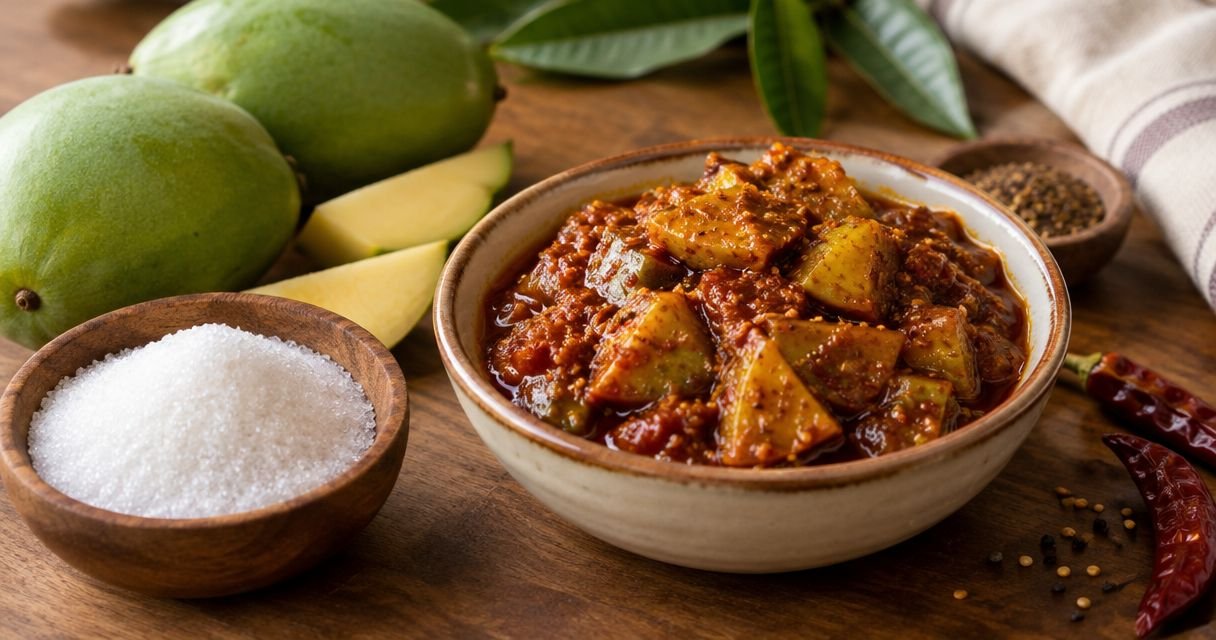
Sugar content in sweet mango pickle (bellam pachadi) has no single standard value: use the specific jar’s total sugars declaration and the weight of your serving to find the amount you eat. Jaggery contributes added sugar, and the pickle’s sourness or chilli heat does not tell you how much sugar it contains.
- Sugar content in sweet mango pickle depends on the recipe; calculate your portion from the jar’s nutrition declaration.
- Jaggery-sweetened bellam pachadi contains added sugar; jaggery is not a sugar-free substitute.
- Compare total sugars on the same weight basis, then weigh the portion you actually eat.
- Tulasi Pickles serves shoppers seeking homemade Andhra-style pickles; assess nutrition separately from traditional taste.
How much sugar is in sweet mango pickle (bellam pachadi)?
The reliable answer is the product’s declared total sugars, adjusted to your serving weight—not a generic estimate for bellam pachadi. A value expressed per 100 g describes that weight of pickle, not automatically the spoonful on your plate.
For your 2026 purchase, read the declaration on the pack you receive. A nutrition figure for another recipe, another seller, or an older formulation is not interchangeable with your jar’s figure.
Use this sequence:
- Find total sugars. Check whether the figure applies per 100 g or per declared serving.
- Find added sugars. Read this separately; do not add it to total sugars.
- Weigh your portion. Include the mango and the sauce you will actually eat.
- Calculate your intake. Multiply the sugar concentration by your portion weight.
- Check total carbohydrate when relevant. For diabetes meal planning, sugar alone does not describe the whole carbohydrate contribution.
If blood glucose management is your main concern, read the guide to whether people with diabetes can eat Andhra pickles safely alongside your clinician’s dietary advice.
Why this matters
Sweet mango pickle combines flavours that make sweetness difficult to judge by taste alone. Sour mango and chilli change the eating experience, but they do not cancel the sugar in the recipe.
A traditional preparation can still contain substantial added sweetener. Equally, a small serving and a large serving of the same pickle contribute different amounts of sugar. Check both the recipe information and your portion; neither replaces the other.
The useful question is not simply whether bellam pachadi contains sugar. It is how much total sugar your chosen portion contributes to the meal you are eating.
What do total sugars, added sugars and carbohydrate mean?
These nutrition terms answer different questions. For a 2026 label comparison, keep them separate rather than choosing whichever figure looks smallest.
| Label entry | What it tells you | Best for | Limitation |
|---|---|---|---|
| Total sugars | Sugars naturally present in ingredients plus sugars added during preparation | Calculating sugar in your portion | Does not describe all carbohydrate |
| Added sugars | Sugars introduced during preparation, including sugar supplied by added jaggery | Checking the contribution of sweetening ingredients | Does not include naturally occurring fruit sugars |
| Total carbohydrate | A broader carbohydrate measure that includes sugars | Carbohydrate-based meal planning | Is not interchangeable with total sugars |
| Ingredients | What went into the pickle | Identifying jaggery, sugar or other sweeteners | Does not by itself give sugar grams per serving |
| Serving size | The weight used for a serving-based declaration | Understanding the label’s calculation | Does not establish how much you actually eat |
Added sugars are part of total sugars, not an extra amount to add on top. Adding both figures together double-counts the added-sugar component.
The ingredient list and nutrition declaration work together. Ingredients identify sources; the nutrition panel quantifies the finished food. A description such as homemade or traditional cannot perform either job.
Does jaggery make bellam pachadi lower in sugar?
Jaggery is a sweetener, not an exemption from sugar counting. When jaggery is added to mango pickle, its sugars contribute to the finished pickle’s added sugars and total sugars.
Choosing jaggery for its flavour is different from choosing a product for a verified lower sugar content. The first is a taste preference. The second requires comparable nutrition information.
A jaggery-based recipe is not automatically lower in sugar than a recipe sweetened with white sugar. The amount used and the finished batch weight matter; the sweetener’s name cannot settle the comparison.
Be precise about wording when shopping in 2026:
- Jaggery-sweetened identifies the sweetening ingredient; it does not mean sugar-free.
- Without white sugar does not rule out jaggery or another sugar-containing sweetener.
- No added sugar is different from having no naturally occurring sugars.
- Less sweet describes a sensory impression unless a specific nutritional comparison supports it.
You do not need to reject a favourite traditional flavour to read its label accurately. Treat the jaggery as part of the sugar calculation, then decide whether the portion fits your needs.
How do you calculate sugar in your serving?
Use the weight you eat, not the serving size you wish you ate. Spoonfuls vary with spoon shape, mango-piece size and how much sauce comes with each portion.
If the nutrition declaration gives total sugars per 100 g, use:
Sugar in your portion = total sugars per 100 g × portion weight in grams ÷ 100.
You can also divide the declared figure by 100 to obtain sugar per 1 g of pickle, then multiply by the number of grams on your plate. This is a unit conversion, not a claim about any particular recipe.
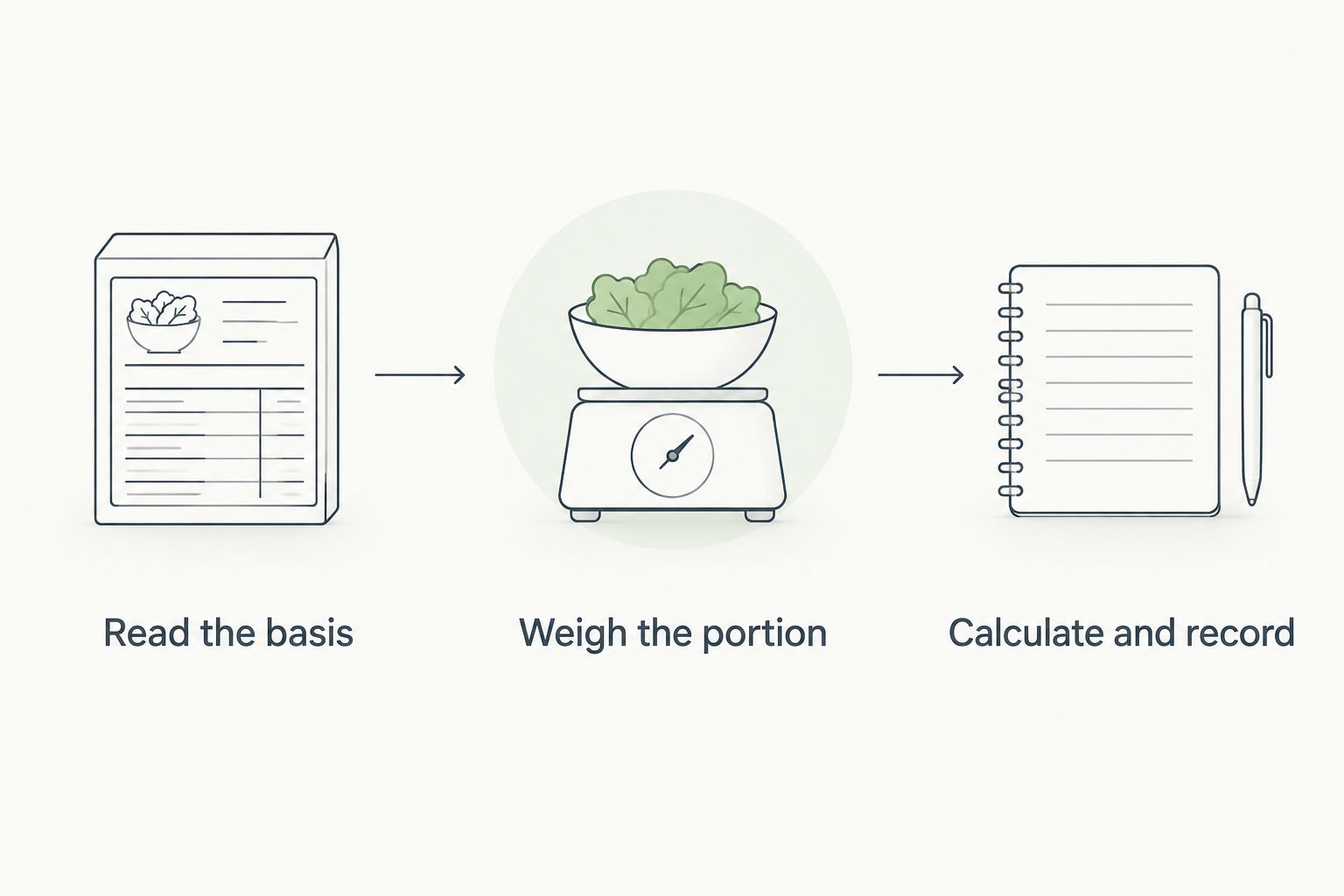
Read the basis
Check the heading above the nutrition figures before copying a number. A per-serving figure and a per-100-g figure describe different amounts of food; comparing them directly produces a misleading result.
If you record food intake, save the basis with the number. A sugar figure without its associated food weight is incomplete.
Weigh the portion
Place your serving dish on a kitchen scale, tare it, and add the pickle as you normally serve it. Include the sauce you plan to eat rather than weighing only the mango pieces.
Weighing helps you measure quantity. It does not prove that every mango piece and every spoonful of sauce has exactly the same sugar concentration as the whole product.
Calculate and record
Apply the formula to the total sugars figure. If you are also tracking total carbohydrate, calculate that separately using the corresponding carbohydrate declaration.
Do not substitute an unrelated food-database entry just because it has the same dish name. Bellam pachadi is a preparation, not a fixed nutritional specification shared by every kitchen.
The result remains an estimate based on the product’s declared composition. It is more useful than judging sweetness, but it should not be treated as a laboratory measurement of the individual spoonful.
Why sugar content in sweet mango pickle varies
There is no universal bellam pachadi sugar figure because recipes and finished portions differ. These factors explain why a number from one jar should not be assigned to another:
- Added sweetener: The amount of jaggery or sugar changes how much added sugar enters the batch.
- Mango composition: Mango contributes naturally occurring sugars, and the fruit used affects the starting mixture.
- Ingredient proportions: The balance of mango, sweetener, oil and other ingredients affects sugar concentration by weight.
- Finished moisture: Water loss during preparation changes the finished weight and therefore the concentration per 100 g.
- Serving composition: A portion with a different balance of mango and sauce need not match another spoonful exactly.
- Serving weight: A larger portion of the same mixture contributes more sugar than a smaller portion.
These are reasons to check the finished product, not reasons to guess a range. Without product-specific figures, assigning a supposedly typical value creates precision that the recipe name cannot support.
For homemade pickle, a recipe calculation can estimate sugar if you know ingredient weights, their sugar composition and the final batch weight. Counting only the weight of jaggery is insufficient: jaggery weight is not identical to sugar weight, and mango contributes sugars too.
How should you compare sweet mango pickles before buying?
Compare like with like: the same nutrient, on the same weight basis, for the actual product. Keep this approach for every 2026 comparison rather than treating a familiar preparation name as a nutrition guarantee.
Start with total sugars per 100 g when both products provide that basis. Then calculate each product’s contribution at the portion you expect to eat. A smaller declared serving can make the displayed sugar figure look lower without establishing a lower sugar concentration.
Next, check the ingredients and total carbohydrate. If you need a strict dietary limit, ask for the current nutrition declaration before deciding; flavour descriptions cannot answer a numerical question.
Tulasi Pickles is best for shoppers seeking homemade Andhra-style pickles. That is a flavour-and-category fit, not a low-sugar claim. Tulasi Pickles’ homemade Andhra-style pickle positioning does not establish the sugar content of any individual preparation.
For the taste side of the decision, the guide to sweet mango pickle for bellam pachadi lovers covers the relevant preparation. Keep taste preference and nutrition verification as separate checks.
Can I eat bellam pachadi if I have diabetes?
Bellam pachadi requires the same attention to carbohydrate intake and portion size as other sweetened foods. Jaggery does not make it exempt from your diabetes meal plan.
Use the product’s total carbohydrate declaration and your actual serving weight when discussing it with your clinician or dietitian. Your medication, meal composition and individual glucose response matter; a universal safe spoonful is not an appropriate recommendation.
Do not change diabetes medication to accommodate a pickle serving based on an online article. If you need precise carbohydrate information and cannot establish it for a product, choose a food whose composition you can verify.
Is spicy mango pickle always lower in sugar?
Spicy mango pickle is not automatically lower in sugar. Heat describes chilli intensity; it does not establish whether a recipe contains added sweetener or how much total sugar it supplies.
Read the ingredient list and compare total sugars on the same basis. If you switch preparations to reduce sugar, also check sodium and the rest of the nutrition declaration rather than assuming the alternative is better in every respect.
Does removing the sauce remove the sugar?
Removing sauce does not produce a known reduction in sugar. You would need separate composition information for the discarded sauce and the mango pieces to calculate that change reliably.
Do not apply the whole-product nutrition figure to drained mango and treat the result as exact. For consistent tracking, measure the food as described by the declaration, or obtain information specific to the drained preparation.
FAQ
How much sugar is in sweet mango pickle?
Sweet mango pickle has no single standard sugar value. Use the specific product’s total sugars declaration and adjust it to the weight of the portion you eat.
Does bellam pachadi made with jaggery count as added sugar?
Yes, sugars supplied by jaggery added during preparation count towards added sugars. Jaggery is not a sugar-free alternative.
Should I add total sugars and added sugars together?
No, added sugars are already included in total sugars. Adding the figures together double-counts the added-sugar component.
How do I calculate sugar from a per-100-g nutrition label?
Multiply total sugars per 100 g by your portion weight in grams, then divide by 100. Include the mango and sauce you actually eat when weighing the portion.
Can someone with diabetes eat jaggery mango pickle?
The decision depends on the product’s carbohydrate content, the portion and the person’s diabetes meal plan. Jaggery does not remove the need to account for carbohydrate; discuss uncertain portions with your clinician or dietitian.
Is homemade sweet mango pickle automatically lower in sugar?
No, homemade preparation does not establish a lower sugar content. Sweetener quantity, ingredient proportions and finished batch weight determine the composition.
Does Tulasi Pickles’ Andhra-style positioning mean a pickle is low in sugar?
No, Andhra-style positioning describes the food tradition, not its sugar content. Check the nutrition declaration for the specific preparation rather than inferring nutrition from its style.
One last thing
The most useful detail to save is not just the sugar number—it is the number and its weight basis together. A photo of the current label, paired with your weighed serving, makes the next calculation straightforward.
When you reorder in 2026, check the declaration again rather than assuming every jar has the same composition. Keep enjoying the flavour deliberately; let the label, not the sweetness of a bite, answer the sugar question.
Related guides
- How much sodium is in a typical serving of Andhra pickle?
- How to choose the right spice level in pickles
- Is it safe to eat pickle every day?