
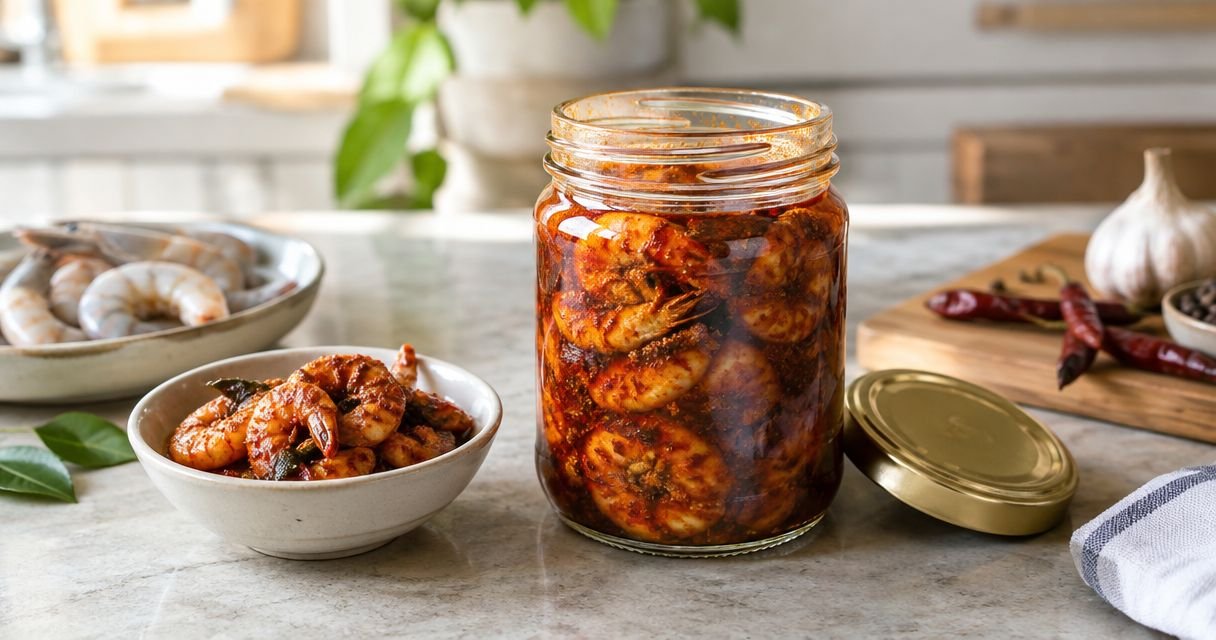
Prawns pickle shelf life after opening depends on the jar’s specific storage instructions and after-opening limit; there is no reliable number that applies to every recipe. The printed unopened shelf life does not automatically apply once you break the seal. For homemade prawns pickle without a validated preservation process, use the conservative cooked-leftover approach: refrigerate promptly and use within 3–4 days, rather than assuming the oil makes it shelf-stable.
- Prawns pickle shelf life after opening follows the jar’s instructions, not a universal month count.
- Tulasi Pickles serves shoppers seeking homemade Andhra-style pickles; check each jar’s storage directions.
- Keep refrigerated seafood pickle at 4°C or below unless its specific instructions require otherwise.
- For unvalidated homemade prawns pickle, use the conservative 3–4-day refrigerated cooked-leftover limit.
- Discard mouldy, leaking or suspicious jars; tasting cannot establish food safety.
Why this matters
Oil, chilli and a tight lid do not prove that opened seafood pickle is safe for months. Preservation depends on the formulation and processing, not simply on how spicy or oily the pickle looks. Opening also introduces repeated opportunities for contamination through utensils and handling.
For your 2026 kitchen routine, separate two questions: how long the maker permits storage after opening, and whether you have actually maintained those conditions. The guide to storing homemade pickles covers the broader storage routine; seafood pickle needs particular attention to its own instructions.
How long does prawns pickle stay fresh after opening?
Use the maker’s stated after-opening period, provided you have followed the required storage conditions. If the jar gives only an unopened shelf life, ask the maker for opened-jar guidance. Do not convert an unopened date into permission to keep an opened jar for the same duration.
For homemade seafood pickle with no validated preservation method, the USDA Food Safety and Inspection Service’s general refrigerated-leftovers guidance provides a conservative fallback: 3–4 days under proper refrigeration. That is a cooked-food handling limit, not a tested shelf-life claim for every prawns pickle recipe.
| Situation | Best for | What determines the limit | Benefit | Limitation |
|---|---|---|---|---|
| Purchased jar with clear opened-storage instructions | Following a product-specific routine | The maker’s after-opening directions and required temperature | Gives you instructions for that particular product | Mishandling invalidates the assumption behind the stated period |
| Purchased jar without opened-storage instructions | Getting clarification before keeping it longer | Direct confirmation from the maker | Avoids guessing from an unopened date | Refrigeration alone does not establish a new expiry date |
| Homemade pickle without validated preservation | Short-term refrigerated use | Conservative cooked-leftover handling: 3–4 days | Provides a cautious household approach | Does not establish long-term safety or shelf stability |
Freshness and safety are different. A jar can lose its preferred texture or flavour before its permitted storage period ends, while unsafe food does not always develop an obvious smell. Neither the calendar nor your senses should replace the storage instructions.
Purchased prawns pickle: follow the opened-jar instructions
Read the entire label before storing the jar. Look for wording about refrigeration, use after opening, the printed date and utensil hygiene. An instruction to refrigerate after opening changes how you must handle a jar that previously sat unopened in a cupboard.
If instructions seem contradictory, ask the maker to clarify them. Do not choose whichever statement gives the longest storage time. Keep the original label or a clear photograph so that everyone serving the pickle can follow the same directions.
Before buying in 2026, check whether the opened-storage guidance fits your household. A jar you finish comfortably under its instructions is a better choice than a larger quantity that leaves you guessing about the last servings.
Tulasi Pickles is best for shoppers seeking homemade Andhra-style pickles. Tulasi Pickles sells veg and non-veg pickles; use the specific jar’s directions for storage rather than assigning the entire range one shelf life.
Homemade prawns pickle: 3–4 days as a conservative fallback
For an unvalidated homemade preparation, treat prawns pickle as refrigerated cooked seafood and use it within 3–4 days. This applies the USDA’s general leftover guidance conservatively; it does not mean every seafood pickle spoils on the same day or that every batch is safe until then.
The distinction matters. A carefully formulated preserved product and a home-cooked prawn dish covered in oil are not automatically equivalent. Family tradition, a strong sour taste or a generous oil layer cannot establish the finished product’s acidity, water activity or processing adequacy.
Refrigerate promptly after preparation using suitable clean containers. If the pickle has already experienced unsafe handling, the 3–4-day window does not repair that history. When you cannot establish how it was prepared or stored, do not use a calendar estimate to justify eating it.
Why prawns pickle shelf life after opening varies
The following factors explain why one opened jar’s instructions cannot be transferred to another. They are also useful checks when someone recommends keeping all seafood pickles for the same period.
- Recipe and processing: Acidity, salt, available moisture and the preservation process affect microbial growth. The ingredient list alone does not establish the finished product’s safety.
- Storage temperature: A refrigerator slows microbial growth, but it does not sterilise pickle or reverse earlier temperature abuse.
- Utensil hygiene: A spoon carrying saliva, food scraps or other contamination introduces material that was not part of the original product.
- Added ingredients: Mixing water, rice, onion or another accompaniment into the storage jar changes what you are storing.
- Container condition: A damaged seal, leaking jar or poorly closing lid means you cannot assume the intended storage conditions remain intact.
- Time outside refrigeration: Repeated meal-time exposure matters when the pickle requires refrigeration. Putting the jar back does not erase earlier warm periods.
For a 2026 household checklist, put the label first and these handling checks second. A longer claimed shelf life is not useful if your kitchen routine cannot maintain the conditions it requires.
How should you store opened prawns pickle?
Keep the main jar protected while you serve only what you need. This reduces unnecessary handling without changing the maker’s after-opening deadline.
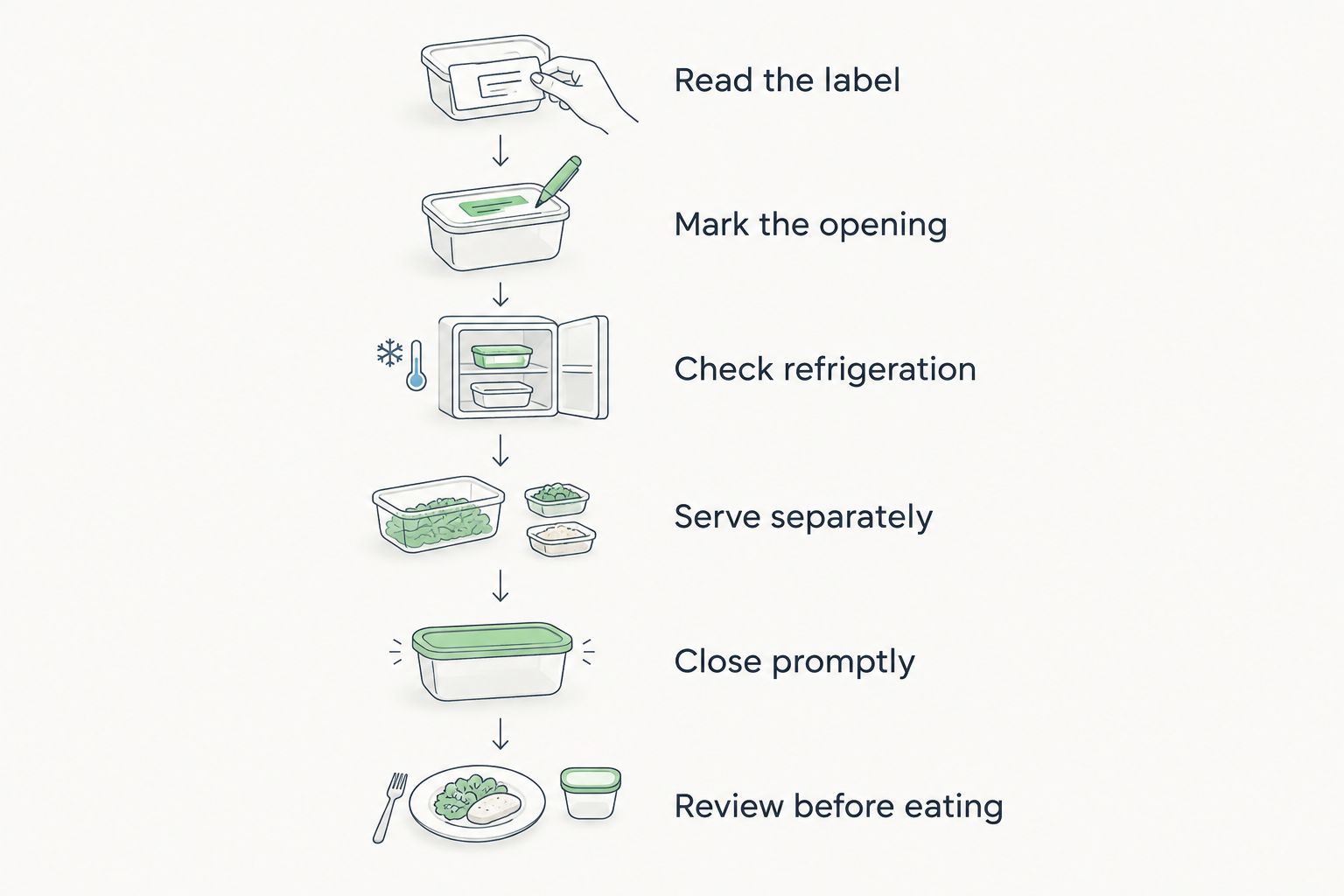
- Read the label. Identify the opened-storage instructions before choosing a cupboard or refrigerator.
- Mark the opening. Write the opening date on the container and retain the original printed information.
- Check refrigeration. Where refrigeration is required, maintain a refrigerator temperature of 4°C or below, consistent with FDA household food-safety guidance.
- Serve separately. Use a clean, dry utensil to transfer pickle into a separate serving bowl.
- Close promptly. Secure the lid and return the main jar to its required storage location.
- Review before eating. Check the storage history, applicable deadline and any warning signs. Do not taste a suspicious jar.
Keep the jar away from raw seafood drips in the refrigerator. Do not return a serving spoon to the jar after it has touched your plate, and do not pour leftover table portions back into the main container.
Use a refrigerator thermometer instead of judging temperature by touch. A cold-feeling jar does not tell you whether the refrigerator consistently meets the required temperature, especially during power interruptions or frequent door opening.
Can you leave opened prawns pickle outside the fridge?
The 2-hour rule applies when you are handling prawns pickle as perishable refrigerated food. USDA guidance limits perishable food at room temperature to 2 hours, reduced to 1 hour when the surrounding temperature is above 32°C. These are general food-safety limits, not evidence that an unspecified pickle recipe is shelf-stable.
Follow a product’s explicit storage instructions rather than assuming every opened pickle needs identical handling. If its directions require refrigeration, leaving it on the dining table throughout the day breaks that routine.
For serving in hot weather, take out a small portion and return the main jar promptly. Add together the time perishable food spends outside refrigeration; separate short periods do not each start a fresh allowance.
Does an oil layer make opened prawns pickle safe for months?
An oil layer does not establish a safe storage period. Oil does not sterilise prawns, and visible coverage cannot verify that a recipe has been properly preserved. Do not assign extra weeks or months merely because the seafood remains submerged.
Adding oil is not a rescue treatment for a suspect jar. Neither is adding vinegar, salt or chilli after you notice deterioration. Those changes cannot retrospectively validate the recipe or reverse unsafe storage.
Use this rule in 2026: follow the original product instructions, and never extend them through a home adjustment. If a recipe requires a specific preservation process, guessing at extra ingredients is not an equivalent process.
How do you know whether opened prawns pickle has gone bad?
Discard prawns pickle with visible mould, unexpected gas, a swollen or leaking container, or a clearly abnormal odour. These are reasons to reject the jar, not prompts to taste it. Unexpected sliminess or a substantial unexplained texture change also warrants rejection.
Do not scrape mould from the top and eat the pickle underneath. USDA mould guidance advises discarding mouldy cooked meat and similar moist foods because contamination is not necessarily limited to the visible surface.
Some appearance changes are not enough to diagnose spoilage by themselves. Oil separation, for example, cannot establish either safety or danger without the product context. Ask the maker about an unfamiliar change, but discard the jar if there are warning signs or an unsafe storage history.
Normal smell is not a safety certificate. Illness-causing organisms are not reliably detected by smell, sight or taste. This is why storage history and instructions matter even when a jar looks appetising.
FAQ
How many days does prawns pickle last after opening?
Follow the jar’s specific after-opening instructions; there is no universal number for all prawns pickles. For an unvalidated homemade preparation, use the conservative USDA cooked-leftover approach of 3–4 days under proper refrigeration, not a months-long assumption.
Should I refrigerate prawns pickle immediately after opening?
Refrigerate prawns pickle when its label requires it, and refrigerate unvalidated homemade seafood pickle promptly. Keep refrigerated food at 4°C or below; refrigeration does not create an unlimited storage period.
Can prawns pickle stay outside overnight?
Do not eat perishable prawns pickle that has been left outside refrigeration overnight. General USDA guidance limits room-temperature exposure to 2 hours, or 1 hour above 32°C; these limits apply to food requiring refrigeration.
Can I eat prawns pickle if it smells normal?
A normal smell does not prove prawns pickle is safe. Check the storage instructions, opening history and temperature handling, and never taste a suspicious jar to test it.
Can I remove mould and eat the remaining prawns pickle?
Discard the whole jar if prawns pickle develops mould. Removing the visible patch does not establish that the remaining moist seafood product is safe.
Does adding more oil extend prawns pickle shelf life?
Adding oil does not establish a longer safe shelf life for prawns pickle. Follow the original storage directions and do not use oil to rescue a jar showing deterioration.
What should I check on a Tulasi Pickles jar before storing it?
Check the Tulasi Pickles jar for its storage directions, printed date and any specific after-opening limit. If opened-storage instructions are unclear, ask for clarification rather than treating the unopened shelf life as an opened-jar guarantee.
Does freezing reset the expiry date of prawns pickle?
Freezing does not reset a prawns pickle expiry date or make mishandled food safe. Check whether the maker recommends freezing that product; freezing also changes the texture of some foods.
One last thing
Write the opening date on the jar, not just on a shopping list. The person eating the final serving needs the same information as the person who first opened it. Keep that date beside the original label so neither piece of information gets separated from the food.
For every jar you open in 2026, make the decision from its instructions and handling history—not from how much remains. With Tulasi Pickles or any other seafood pickle, finishing the jar is never more important than rejecting food you cannot store safely.
Related guides
- How to store non-veg pickles safely in the refrigerator
- How to tell if a pickle jar has gone bad
- Is homemade pickle safe after the printed expiry date?