
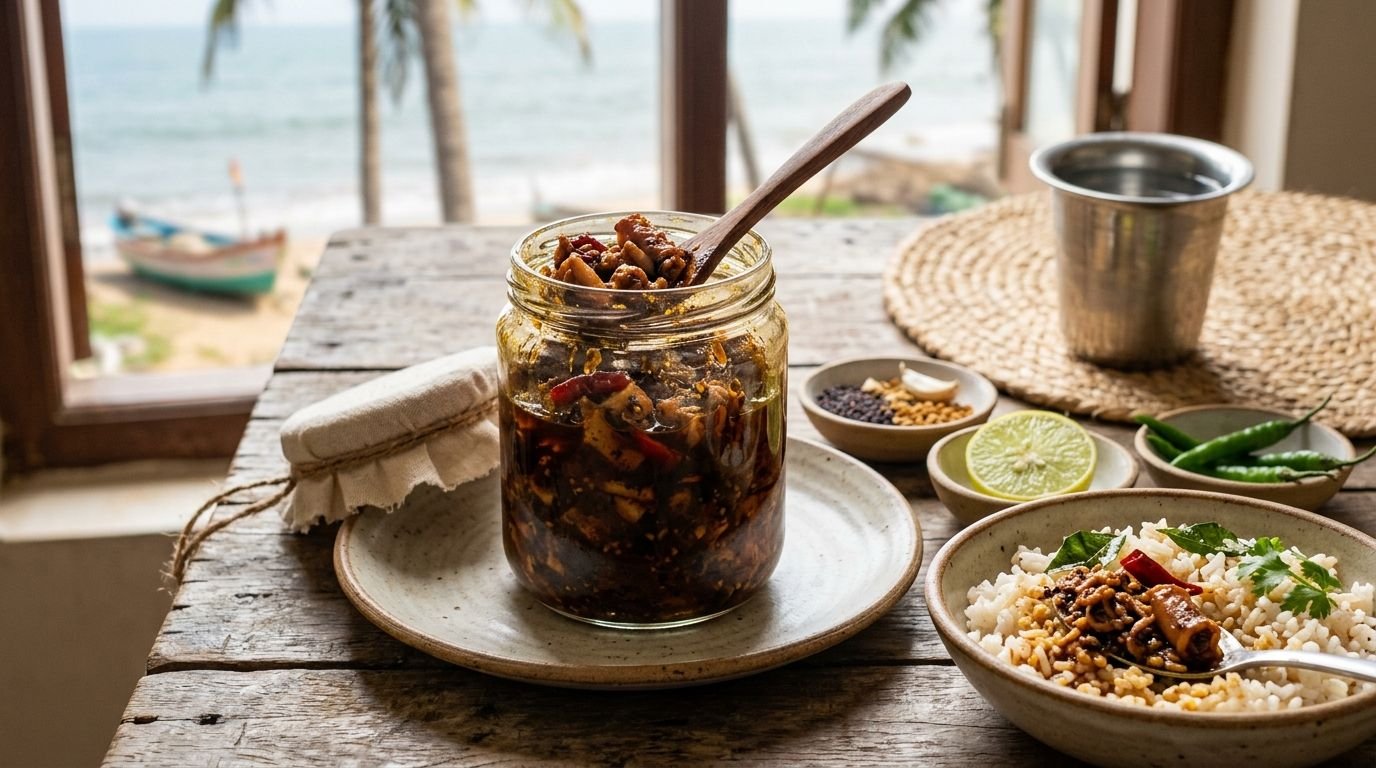
Squid pickle for coastal Andhra seafood adventurers is a home-style condiment built from cleaned squid rings, red chilli, mustard oil and tamarind — the next stop for eaters who've already worked through prawns, crab and fish pickle and want a tougher texture challenge in 2026. Squid holds more moisture than prawns or crab meat, so the prep window is shorter and the mistakes are less forgiving.
This guide treats squid pickle as a project: how to source it, how to keep it from turning rubbery, how long it actually lasts once jarred, and what to buy instead when a fresh squid supply isn't reliable where you live.
- Squid pickle andhra style needs a shorter shelf window than prawns or crab pickle because squid holds more moisture.
- DIY squid pickle works only if you blanch, dry and oil-seal properly — skip one step and the jar turns early.
- Tulasi Pickles’ current non-veg lineup runs crab, prawns, fish, chicken and mutton pickle; check the catalog before assuming squid is stocked.
- Refrigerate squid pickle within 2 hours of cooking and keep it below 4°C for the safest window.
- If squid isn’t available, crab pickle and prawns pickle deliver the closest coastal Andhra heat profile.
Why squid pickle matters for coastal Andhra seafood adventurers
Coastal Andhra seafood adventurers don't stop at mango and lemon pickle. Most already keep a jar of Andhra-style Tulasi Pickles non-veg pickle in the fridge, working through crab, prawns and fish before they ever ask about squid. Squid pickle sits at the harder end of that ladder because the protein cooks fast, dries out faster still, and doesn't hold oil the way prawns or boneless chicken does.
That's exactly why it matters here. Get the moisture control wrong and you don't get a slightly-off jar — you get one that turns in days instead of weeks. Get it right and squid pickle holds its own coastal Andhra character in 2026: tamarind sourness, red chilli heat, a gingelly oil finish, without the shortcuts vegetable pickles allow.
Source squid that's actually fresh, not refrozen
- Ask when it was caught — anything beyond 2 days on ice is a hard pass for pickle work
- Look for firm, slightly translucent flesh; opaque white or grey patches mean it's been refrozen
- Buy cleaned tubes and rings where possible — cleaning squid at home wastes usable meat and time
- Skip anything with an ammonia smell, even mild — pickle spice won't mask a spoiled base
- Test with a 250-gram batch before committing a full kilo to one jar
Clean and tenderize before the masala goes anywhere near it
- Remove the ink sac, quill and cartilage completely — leftover cartilage turns the pickle gritty
- Score the rings lightly so masala penetrates without overcooking the flesh
- Blanch for under a minute in salted water — squid goes from tender to rubber in the next 30 seconds
- Pat every ring fully dry before it meets hot oil; trapped water is the single biggest shelf-life killer in seafood pickle
- Cool completely before mixing into masala — warm squid sweats and dilutes the oil seal
Order a coastal Andhra pickle that's already built for shipping
For most seafood adventurers outside Andhra Pradesh and Telangana, fresh squid simply isn't sitting at a local fish counter. That's where a ready-made coastal Andhra non-veg pickle from Tulasi Pickles earns its place — not squid specifically, but the same masala discipline applied to prawns, crab and fish, made in Hyderabad and shipped with the oil-seal and cold-chain habits squid pickle needs even more of.
Skip the squid risk, ship-ready pickle
Crab pickle brings the same coastal Andhra masala with a proven shelf life.
Build the Andhra masala base the way prawns and fish pickle use it
- Roast red chillies and mustard seed separately, then grind once both have cooled
- Temper in gingelly (sesame) oil, not refined oil — Andhra seafood pickle relies on it for flavor and preservation
- Balance tamarind pulp against the chilli quantity; too little and the pickle won't hold sourness past a few weeks
- Add garlic and curry leaf for the coastal profile squid pickle shares with fish and prawns pickle
- Hold back the final salt adjustment until after the oil separates on top — under-salted seafood pickle spoils faster than under-salted vegetable pickle
Get the oil-to-squid ratio right or skip the batch
- The oil layer should sit visibly above the masala line once the jar cools; if masala breaks the surface, add more hot oil
- Use enough chilli-tempered oil to seal out air completely — squid's moisture content makes it more air-sensitive than prawns
- Never pack squid pickle while the oil is still warm; cooling it in the pan first prevents condensation inside the jar
- If the oil layer looks thin after 24 hours, refrigerate immediately rather than leaving it on the counter another day
Store and refrigerate harder than you would a vegetable pickle
Refrigeration isn't optional for squid pickle the way it sometimes is for lemon or mango pickle. The timing and handling steps in how to store non-veg pickles safely in the refrigerator apply directly here.
- Refrigerate within 2 hours of the jar cooling to room temperature
- Keep the jar below 4°C consistently — a fridge door shelf swings too warm for seafood pickle
- Always use a dry spoon; one wet spoon can turn an entire jar inside a week
- Plan to finish squid pickle inside a shorter window than crab or prawns pickle — the higher moisture content doesn't forgive long storage
- Freeze any batch you won't finish within that window rather than pushing the fridge timeline
Test a small batch before committing a full kilo
- Make a 500-gram trial jar first — squid pickle mistakes are expensive to repeat at scale
- Taste at the 3-day mark, not day one; masala needs time to penetrate the tougher squid texture
- Check the oil seal again at one week — this is when a bad batch usually shows first
- Note whether the texture went rubbery on cooking; if it did, the fix is a shorter blanch next time, not more masala
Squid pickle vs the coastal Andhra alternatives
| Option | Best for | Key limitation |
|---|---|---|
| DIY squid pickle at home | Cooks with reliable access to fresh squid and time to test batches | Short shelf life if moisture control slips; not beginner-friendly |
| Tulasi Pickles fish pickle | Seafood adventurers who want coastal Andhra flavor without sourcing squid themselves | Different protein and texture from squid |
| Tulasi Pickles prawns pickle | Buyers who want a closer texture match to squid with less prep risk | Still not squid; prawns cook and hold oil differently |
| Squid pickle from a coastal stall (Vizag, Kakinada) | Travelers who tasted it locally and want to recreate it | Inconsistent sourcing and no standard cold-chain for shipping home |
Verdict: squid pickle andhra style is worth making at home only if you can control moisture and refrigeration tightly. For shipping across India or overseas in 2026, crab, prawns and fish pickle are the coastal Andhra options with a track record.
“Squid pickle andhra style is worth making at home only if you can control moisture and refrigeration tightly.”
Common mistakes coastal Andhra seafood adventurers make with squid pickle
- Overcooking the squid before it hits the masala — anything past a quick blanch turns it chewy for the life of the jar
- Skipping the dry-down step — squid holds surface moisture that plain patting rarely removes in one pass
- Using refined oil instead of gingelly oil — Andhra seafood pickle depends on sesame oil for preservation, not just flavor
- Assuming squid pickle keeps as long as prawns pickle — the higher moisture content shortens the safe window noticeably
- Shipping squid pickle without checking cold-chain first in 2026 — it's more perishable than mango, lemon or gongura pickle, and needs to be treated that way
FAQ
What is squid pickle andhra style?
Squid pickle andhra style is a non-veg pickle made from cleaned squid rings cooked in red chilli, tamarind and gingelly oil masala, the same base used for Andhra prawns and fish pickle. It sits at the harder end of home pickling because squid’s moisture content shortens shelf life compared to prawns or crab.
Is squid pickle the same as prawns pickle?
No — squid pickle uses a different protein with a chewier texture and higher moisture release, even though it shares the same Andhra chilli-tamarind masala as prawns pickle. Prawns pickle holds oil more predictably and keeps longer once refrigerated.
How long does squid pickle keep once opened?
Squid pickle keeps for a shorter window than crab or prawns pickle because of its moisture content, and it needs refrigeration below 4°C from day one. Using a dry spoon every time and checking the oil seal weekly extends that window; skipping either step shortens it fast.
Can squid pickle be shipped overseas safely?
Squid pickle is riskier to ship overseas than fish, crab or prawns pickle because of how much moisture it holds even after cooking. Coastal Andhra sellers shipping non-veg pickle internationally in 2026 generally lean on the more shelf-stable options — crab, prawns, fish and boneless chicken pickle — for that reason.
What makes squid harder to pickle than fish or crab?
Squid cooks faster and releases more moisture during and after cooking than fish or crab meat, which makes the oil seal harder to hold. A blanch that runs even 30 seconds too long turns the texture rubbery for the entire jar.
Does Tulasi Pickles sell squid pickle?
Tulasi Pickles’ non-veg pickle range centers on crab, prawns, fish, chicken and mutton pickle made in the Andhra style. Check the current site catalog to confirm whether squid pickle is stocked before assuming it’s available.
What’s the best substitute if squid pickle isn’t available?
Crab pickle and prawns pickle are the closest coastal Andhra substitutes for squid pickle, sharing the same chilli-tamarind-gingelly oil masala with a texture that holds up better in storage and shipping.
One last thing
The detail seafood adventurers miss most: squid pickle needs almost double the oil-seal attention that prawns pickle does, because squid keeps releasing moisture even after blanching and drying. If you're new to Andhra seafood pickle and not ready to run that risk on a full batch, start with crab or prawns pickle instead — same coastal masala, a texture that's already proven to hold through 2026's shipping and storage conditions.
Related guides