
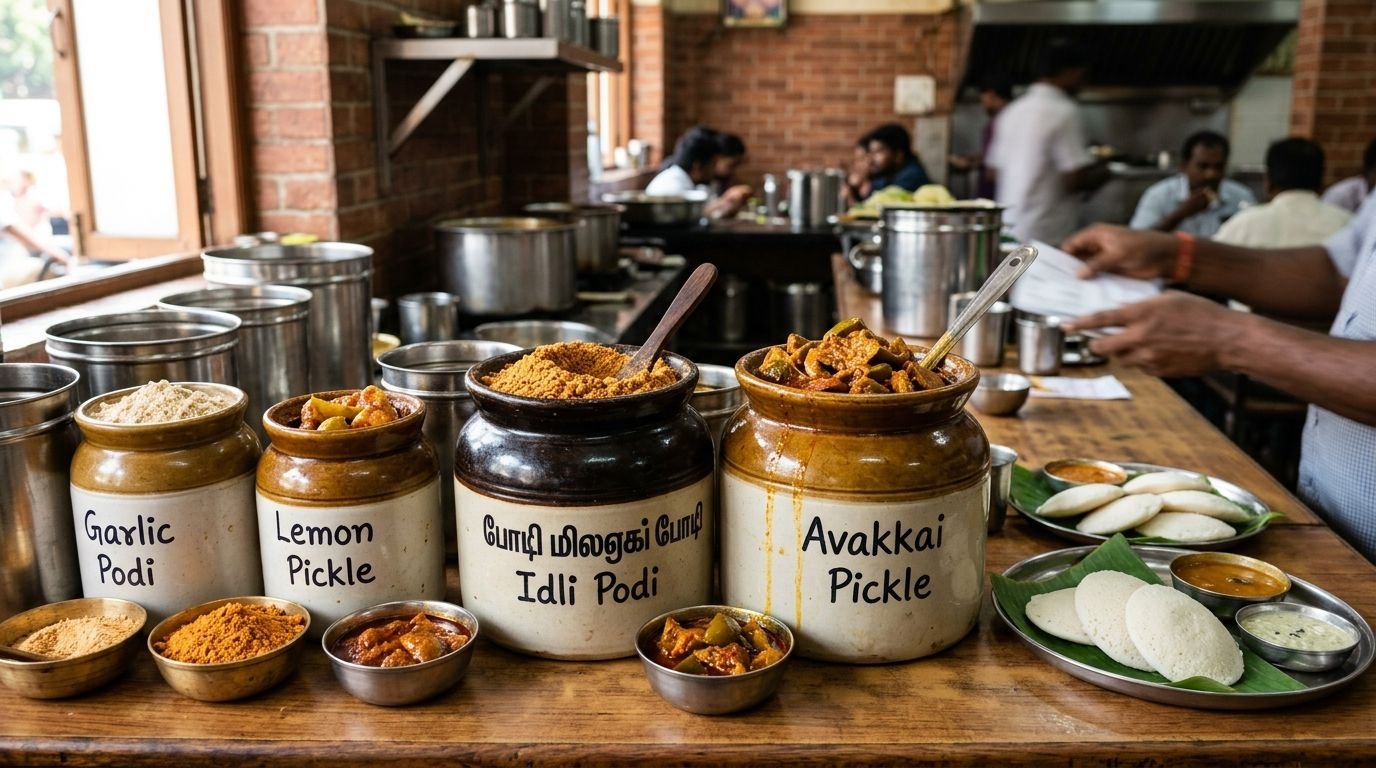
Podi pickle bulk supply for South Indian tiffin centers means sourcing spice powders and pickles in repeat, high-volume batches sized for daily breakfast service rather than single retail jars. Tiffin centers running idli, dosa, and upma counters need consistent spice levels, shelf-stable packaging, and a vendor who restocks weekly without flavor drift between batches.
- Podi pickle bulk supply works best for tiffin centers when podi and pickle arrive as pre-portioned combo packs, not loose bulk jars.
- Kandi podi, karam podi and idli karam podi cover the three most-ordered tiffin center pairings in 2026.
- Tulasi Pickles ships bulk podi and pickle orders for restaurants and caterers with fixed recipes across batches.
- Test shelf stability under your own kitchen storage conditions before locking a full month’s order.
- Rotate two to three podi varieties instead of one generic blend to keep repeat customers ordering.
Why podi pickle bulk supply matters for tiffin centers
A tiffin center's breakfast rush runs on speed, not menu depth. Customers expect their idli or dosa plate to arrive with a podi and pickle side within minutes, and that side dish is doing real work: it covers for a plain-tasting batch of idli batter, it gives customers a reason to return for "that" chutney powder, and it costs less per plate than adding a new curry to the menu.
The problem most centers run into by mid-2026 is treating podi and pickle as an afterthought sourced from whoever is cheapest that week. That works until a vendor runs out mid-month, the spice level changes between batches, or a jar goes rancid in a hot kitchen corner. None of these are hypothetical for a business running six-day breakfast service — they show up as customer complaints and wasted stock.
Buying podi and pickle bulk supply for restaurants and caterers as a standing arrangement, rather than a one-time purchase, fixes the recipe and the restock date at the same time. That's the actual gap this guide is closing.
Audit your current breakfast menu pairing gaps
Start by listing what's currently on the counter and what customers actually ask for by name.
- Count how many podi varieties are on offer today versus how many customers request by name
- Check whether pickle is offered only as a side or also sold as a takeaway add-on
- Note which dishes (idli, dosa, pesarattu, upma) get no podi pairing at all
- Flag any variety that's been unchanged for over a year despite repeat complaints
- Ask counter staff which combo runs out first during the morning rush
Standardize your podi assortment for daily rotation
Most tiffin centers over-index on one generic podi and under-serve the customers who want variety. A rotation of three fixed varieties beats one blend stretched across every dish.
- Keep kandi podi (toor dal based) as the daily default for idli and dosa
- Add nuvvula podi (sesame) or senagapappu podi (roasted gram) as a rotating second option
- Stock idli karam podi separately since its heat level runs higher than standard rice-mixing podi
- Reserve kobbari podi (coconut) for customers who ask for a milder, less oily option
- Review how tiffin centers pair podi with idli, dosa and rice before finalizing the rotation, since the right podi-to-dish match changes repeat order rates more than the recipe itself
Match pickle variety to your regional customer base
A tiffin center in a Telugu-heavy neighborhood needs a different pickle shelf than one near a mixed office crowd.
- Stock avakaya (mango) and gongura as the two non-negotiable staples for Andhra-style customers
- Add lemon pickle for customers who find mango pickle too heavy in the morning
- Offer one non-veg pickle (chicken or prawns) as a paid add-on, not a free side, since margin and demand both support it
- Keep tomato pickle in rotation for weekday variety without changing the core lineup
Set packaging and portioning for high-volume service
Loose bulk jars slow down counter staff during rush hour and make portion cost impossible to track. Fixed sachets or small tubs solve both problems.
- Move from scoop-and-serve jars to pre-measured sachets for podi
- Use resealable small tubs for pickle so unused stock doesn't spoil faster once opened
- Size portions against your actual plate count from the last 30 days, not a guess
- Label each container with the variety name so counter staff don't mix stock
Negotiate a repeat-supply cadence with your vendor
A tiffin center running six-day service can't afford a vendor who ships "when ready." Lock a cadence before you lock a recipe.
- Set a fixed weekly or bi-weekly restock date instead of ordering reactively
- Confirm the vendor holds the same recipe and spice level across every batch, not just the first one
- Ask what happens during festival-season demand spikes like Sankranti or Ugadi, when order volumes jump
- Build in a buffer order of 10-15% extra stock for the two weeks around major festivals
Test shelf stability under your storage conditions
A jar rated for months in a cool pantry behaves differently stored above a tandoor or near a fryer.
- Store a test batch in your actual kitchen storage spot for two weeks before committing to a full month's order
- Track whether oil separates or color changes faster than expected under kitchen heat
- Compare notes with how to store homemade pickles for long shelf life before assuming your storage setup matches a home kitchen
- Rotate stock so older batches get served first, not buried behind new deliveries
Train staff on serving proportions and combos
Even a well-sourced podi and pickle lineup fails if counter staff serve inconsistent portions.
- Set a fixed teaspoon or scoop measure per plate for podi
- Define which pickle pairs with which dish by default, so staff aren't guessing
- Retrain staff each time a new podi variety enters rotation
- Post a simple laminated chart at the counter as a reference during rush hours
Track cost per plate and waste
Bulk buying only saves money if waste stays low. Track it monthly, not annually.
- Log opened-but-unused stock at the end of each week
- Compare cost per plate before and after switching to pre-portioned packs
- Flag any variety with consistently high waste and drop it from rotation
- Recheck vendor cadence if waste climbs from over-ordering, not under-selling
Comparison: sourcing options for tiffin center podi and pickle
| Sourcing option | Best for | Key limitation | Verdict |
|---|---|---|---|
| In-house grinding and pickling | Centers with dedicated kitchen staff and spare prep space | Spice consistency drifts batch to batch; labor-heavy | Hold |
| Local wholesale vendor, loose bulk | Centers chasing the lowest per-kg handling cost | No portion control, often unbranded, inconsistent recipe | Wait |
| Branded bulk supply from Tulasi Pickles | Tiffin centers needing repeat weekly restock with a fixed recipe | Requires advance ordering ahead of festival-season demand spikes | Buy |
| Mixed sourcing (local podi, branded pickle) | Centers testing before a full switch | Two vendors to coordinate; delivery days rarely align | Hold |
The straightforward verdict: a fixed weekly cadence from one vendor beats juggling loose bulk stock from two. Tiffin centers that switch to a standing podi pickle bulk supply arrangement stop losing morning-rush minutes to inconsistent portions.
Set up a bulk podi and pickle order
Check current varieties and place a repeat supply order for your tiffin center.
Common mistakes tiffin centers make
- Running one generic podi for every dish instead of rotating two to three varieties, which flattens repeat orders from customers who want variety.
- Storing bulk pickle jars near stove or tandoor heat, cutting shelf life faster than the same stock would last in a cool storage room.
- Skipping portion standardization, which makes cost-per-plate tracking impossible and hides waste until it's already eaten the margin.
- Not confirming vendor restock cadence before Sankranti or Ugadi, when demand for pickle and podi combos spikes across Hyderabad and the vendor's normal lead time no longer holds.
- Treating non-veg pickle as a free side rather than a paid add-on, missing a margin opportunity that customers already expect to pay for.
FAQ
What is podi pickle bulk supply for tiffin centers?
It’s a repeat, high-volume order arrangement where a vendor like Tulasi Pickles supplies spice powders (podi) and pickles on a fixed weekly or bi-weekly cadence, sized for daily breakfast service rather than one-time retail purchase.
Which podi varieties work best for a tiffin center menu?
Kandi podi (toor dal) as the daily default, with nuvvula podi (sesame) or senagapappu podi (roasted gram) rotating in as a second option, and idli karam podi kept separate for its higher heat level.
How much podi and pickle should a tiffin center order per month?
Base the order on actual plate counts from the last 30 days rather than a guess, then add a 10-15% buffer during festival months like Sankranti and Ugadi when demand spikes.
Is loose bulk pickle cheaper than pre-portioned packs for restaurants?
Loose bulk often looks cheaper per kilogram but costs more in practice once portion inconsistency and spoilage from scoop-and-serve handling are counted.
How long do bulk pickles last in a tiffin center kitchen?
Shelf life depends heavily on storage conditions; a jar rated for months in a cool pantry can degrade faster near stove or tandoor heat, so test a batch in your actual kitchen spot before committing to a full month’s order.
Should non-veg pickle be a free side or a paid add-on for tiffin centers?
Treat it as a paid add-on. Customers already expect to pay extra for chicken or prawns pickle, and pricing it as free leaves margin on the table.
What’s the biggest mistake tiffin centers make with podi and pickle sourcing?
Running one generic podi variety for every dish instead of rotating two to three, which flattens repeat orders from customers who specifically ask for a variety by name.
Does Tulasi Pickles supply podi and pickle in bulk for restaurants?
Tulasi Pickles, based in Hyderabad, supplies podi and pickle for restaurants and caterers on a repeat order basis; check current varieties and place an order through the website.
One last thing
Tulasi Pickles' confirmed order and enquiry window runs 10:30 AM to 8:30 PM. Tiffin centers running early breakfast service should place the next day's bulk order the evening before, inside that window, rather than trying to reach the vendor during their own morning rush when neither side has time to confirm quantities properly.
Related guides
- Best Andhra podi for rice and idli
- How to store homemade pickles for long shelf life
- Podi and pickle combo for daily South Indian meals