

IT professionals’ pickles and podi routine is a meal-planning approach that uses Andhra-style condiments to add flavour to everyday meals without preparing a fresh accompaniment each time. If your workday includes office commutes, late calls or irregular breaks, choose around the meals you actually eat and the storage you can reliably manage.
- Pickles and podi for IT professionals work best as accompaniments, not replacements for vegetables, dal or other protein foods.
- Tulasi Pickles suits buyers seeking homemade Andhra-style pickles and podis through an Indian e-commerce brand.
- Choose podi for rice and breakfast pairings; choose pickles for a separate, strongly flavoured side.
- Pack condiments separately, read storage instructions and keep perishable lunch components cold.
Why pickles and podi matter for IT professionals
The useful distinction is preparation versus assembly. Pickle can accompany an existing meal; podi is a spice powder you can mix into rice or serve with suitable breakfast foods. Neither removes the need to prepare or obtain the rest of your lunch.
For your 2026 meal plan, start with familiar combinations rather than a large collection of unfamiliar flavours. The guide to using podi with idli, dosa and rice explains the basic pairings before you decide what belongs in your kitchen.
Your working arrangement determines what is practical. At home, you can assemble a meal just before eating; at an office, you need suitable containers and access to refrigeration for perishable components. In shared accommodation, clear labels and separate utensils matter as much as flavour.
The best workday condiment is the one that fits your existing meal and its storage requirements. A spicy accompaniment that stays untouched because packing it is inconvenient does not solve your lunch problem.
Build a workday routine in six steps
Match condiments to your meals
Write down the breakfasts and lunches you already eat. Use a paper note or your phone; no special meal-planning system is necessary. Match the condiment to those meals instead of planning an entirely new diet around a jar.
For rice-based lunches, decide whether you want a dry seasoning mixed through the rice or a separate pickle accompaniment. For idli and dosa, check whether the podi’s ingredients and texture suit your preferred way of serving it. Recipes differ, so one powder is not automatically interchangeable with another.
Separate office needs from home preferences. A condiment you enjoy at dinner might require more careful packing than you want to handle during a commute. Your 2026 office routine should accommodate the workplace you have, not an imagined kitchen beside your desk.
- List your usual breakfasts and lunches.
- Identify meals that need an accompaniment.
- Choose podi for mixing or dipping.
- Choose pickle for a separate side.
- Note whether you eat at home or carry lunch.
Check ingredients before choosing flavours
Read the ingredient list and allergen information before comparing taste descriptions. For homemade batches, ask the person who prepared them what went into the recipe. For packaged products, use the product information and the pack label rather than assuming every Andhra-style recipe is identical.
Podi can contain ingredients such as pulses, peanuts or sesame, depending on the recipe. Check the actual formulation, particularly if you have an allergy. A spice powder’s name alone does not provide a complete ingredient list.
Vegetarian, vegan and non-vegetarian requirements need separate checks. A vegetarian podi served with ghee is not a vegan meal, and a shared spoon can transfer ingredients between containers. If you follow a medically prescribed sodium restriction, compare the nutrition information against your clinician’s advice rather than treating homemade food as automatically suitable.
- Read the full ingredient list.
- Check declared allergens and cross-contact information.
- Confirm vegetarian or vegan suitability where relevant.
- Compare sodium information when your diet requires it.
- Keep separate utensils for incompatible dietary needs.
Choose a manageable buying or preparation route
Start with what you can prepare or obtain through your existing routine. Making podi yourself gives you control over the recipe, but it also requires preparation, cleaning and suitable storage. Homemade pickle requires its own reliable recipe and food-handling process; do not improvise preservation instructions.
Buying prepared condiments removes that preparation task. Tulasi Pickles is best for buyers seeking homemade Andhra-style pickles and podis online. The Hyderabad-based brand sells vegetarian and non-vegetarian pickles and spice powders, with shipping across India and overseas.
Browse Tulasi Pickles after deciding which category fits your meals. The limitation of online buying is straightforward: you cannot taste the condiment before ordering, and you still need to check the exact ingredients and storage directions for the item you choose.
For a 2026 starter routine, select a familiar flavour before expanding into several varieties. This keeps your decision tied to actual meals rather than the appeal of a long shopping list.
- Make your own podi if preparation fits your schedule.
- Buy prepared condiments if you want to skip that task.
- Choose familiar flavours before experimenting.
- Read item-specific ingredients and storage directions.
- Check delivery information for your destination.
Assemble a complete meal around the condiment
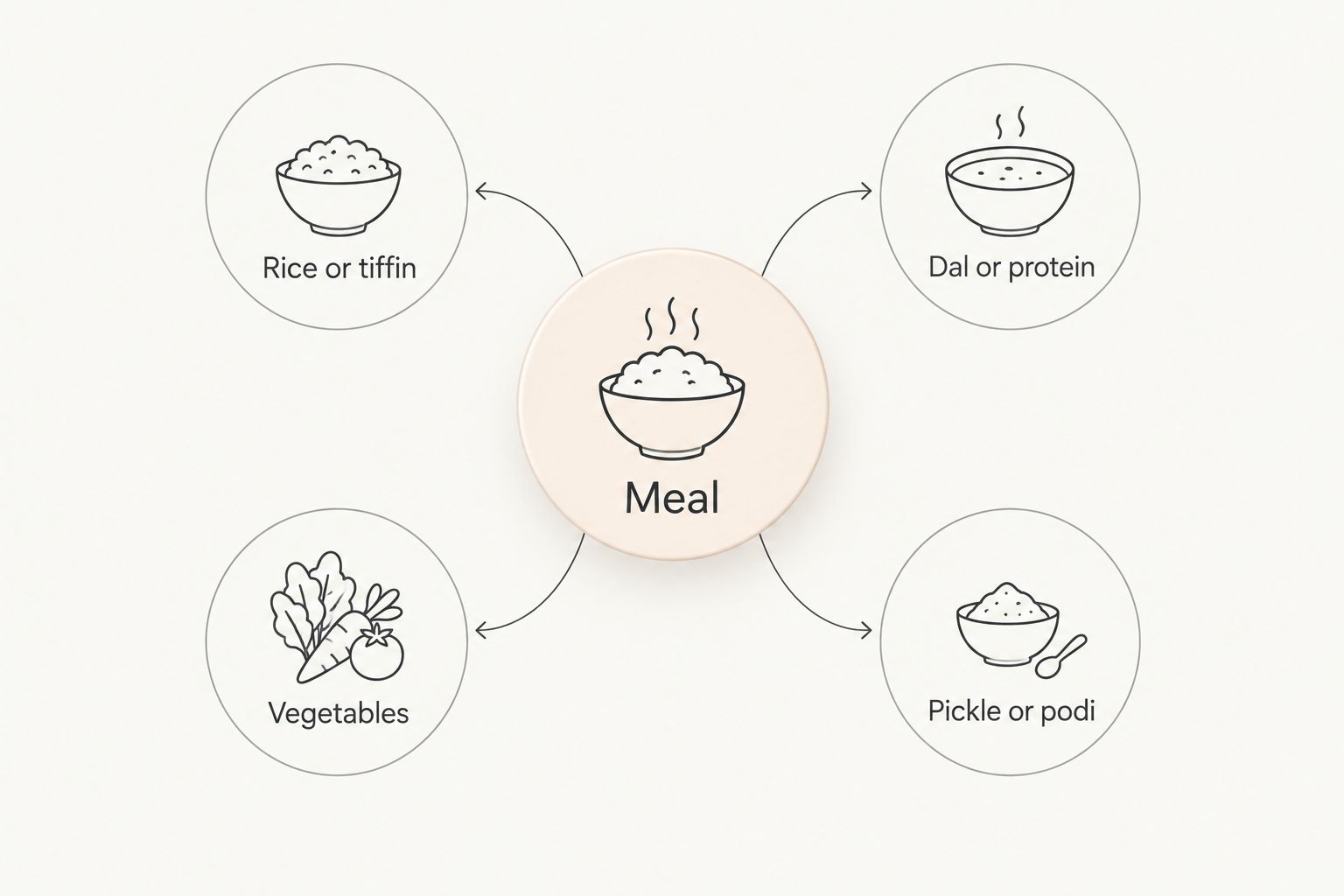
Build the meal first, then add pickle or podi. Rice with podi offers a seasoning route; rice with a pickle offers a contrasting side. Neither combination, by itself, establishes that your lunch contains enough vegetables or protein for your needs.
Keep dal, beans, eggs, curd, tofu or another suitable protein food in the meal according to your diet. Add vegetables in a form you enjoy and can prepare or obtain reliably. Even when a podi contains pulses or a pickle contains meat, its contribution depends on the ingredients and the amount you eat.
For desk lunches, pack the condiment separately if you want control over how much you mix in. Add it gradually and taste the meal before adding more. That is a flavour decision, not a universal serving-size prescription.
- Choose rice or tiffin as your meal base.
- Include dal or protein suited to your diet.
- Add vegetables rather than replacing them with pickle.
- Pack pickle or podi as the accompaniment.
- Keep drinking water accessible during your meal.
These meal components belong together, but the condiment has a supporting role. Keep that distinction visible when you assemble lunch between meetings.
Pack lunch around its storage requirements
Check each component of your lunch separately. A dry powder, an opened pickle and cooked rice do not necessarily have the same storage requirements. Follow the condiment’s label, including any instructions that apply after opening; never assume that oil or chilli makes every pickle safe at room temperature.
For perishable lunch components, USDA food-safety guidance recommends cold holding at 4°C or below. Its general rule is to refrigerate perishable food within 2 hours, or within 1 hour when the temperature is above 32°C. These are food-handling limits, not shelf-life claims for a particular pickle or podi.
During a 2026 office commute, use an insulated bag with cold sources when carrying food that needs refrigeration. Put it in the office refrigerator on arrival. Do not interpret an air-conditioned workspace as refrigerated storage.
- Read storage directions before opening the pack.
- Use clean, dry utensils for the condiment.
- Keep perishable foods cold during transport.
- Refrigerate lunch on arrival where required.
- Prevent condiment leaks with suitable closed containers.
- Discard suspect food rather than tasting it to test safety.
Review what you actually finish
Track use before buying more. A simple note beside your meal plan is enough: which condiment you used, which meal it suited and whether packing it caused a problem. There is no need to turn lunch into another dashboard.
Choose the next purchase from that record. If podi works for breakfast but pickle stays unused at the office, keep pickle for home meals rather than carrying it out of habit. If your household shares the condiments, account for everyone’s dietary requirements before combining them into a common serving container.
For the rest of 2026, use your actual consumption and the pack’s storage instructions to guide replenishment. Do not assign every jar a generic shelf life or assume that a larger pack is the better choice for a person eating alone.
- Record the meals where each condiment works.
- Note flavour preferences after tasting.
- Separate home favourites from office favourites.
- Check remaining contents before replenishing.
- Stop buying varieties you repeatedly leave unused.
Compare your workday options
Choose by use case, not by the idea that one category is universally better. Dry podi, vegetarian pickle and non-vegetarian pickle solve different flavour needs; preparation routes also differ in the work they leave you to do.
| Option | Best for | Main advantage | Key limitation |
|---|---|---|---|
| Homemade podi | People who want control over the recipe | You choose ingredients and adjust the seasoning | Preparation, cleaning and storage remain your responsibility |
| Purchased podi | People who want a prepared rice or breakfast accompaniment | Removes the powder-making task | Ingredients, texture and storage directions vary by recipe |
| Vegetarian pickle | People seeking a separate vegetable-based accompaniment | Adds a distinct flavour alongside an existing meal | Vegetarian does not automatically mean vegan, low-sodium or allergen-free |
| Non-vegetarian pickle | Meat or seafood eaters who enjoy those flavours | Offers a non-vegetarian accompaniment | Requires item-specific handling; a condiment portion is not a guaranteed protein serving |
| Tulasi Pickles | Buyers seeking homemade Andhra-style pickles and podis online | Brings the supplied categories together through an Indian e-commerce brand | You cannot taste before ordering and must verify each item’s details |
Choose purchased podi for reduced preparation work, not as permission to ignore ingredients. Choose non-vegetarian pickle because you enjoy that accompaniment, not because its name proves your meal meets a nutritional target.
The practical comparison is what you must do after choosing. A prepared condiment saves making it; it does not pack your lunch, refrigerate perishable food or supply the rest of the meal.
Common mistakes IT professionals make
Treating a condiment as the whole lunch
A bowl of rice with seasoning is easy to assemble, but convenience does not establish nutritional adequacy. Keep vegetables and a suitable protein food in your plan. Assess the whole meal rather than attributing benefits to a condiment’s name.
Buying for a schedule you do not follow
If office lunches come from a canteen, choose an accompaniment that fits those meals and your workplace rules. Do not buy around elaborate home-cooked lunches you do not prepare. Match your order to your actual working week.
Leaving perishable lunch beside the laptop
The storage needs of cooked rice, curd or other perishable components do not disappear because the pickle is separately packed. Use refrigeration or suitable cold transport. Follow the food-safety limits rather than the time of your next meeting.
Sharing utensils without checking diets
A common spoon creates cross-contact between vegetarian, non-vegetarian and allergen-containing foods. Use separate utensils in shared kitchens and office lunch groups. Clearly identify what each container holds.
Assuming homemade means suitable for every diet
Homemade describes preparation, not sodium content, allergen status or a medical benefit. Check the recipe or label. If you have a prescribed diet, use that guidance to choose ingredients and portions.
FAQ
What are the best pickles and podi for IT professionals?
The best pickles and podi for IT professionals are those that match their usual meals, dietary requirements and storage arrangements. Choose a familiar accompaniment first, then compare ingredients and handling instructions before expanding your choices.
Is podi better than pickle for office lunch?
Podi is better when you want a dry seasoning to mix into rice or serve with breakfast foods; pickle is better when you want a separate accompaniment. Neither is universally better, and the rest of the lunch still determines its nutritional balance.
Can I leave my pickle and rice lunch on my desk?
Do not leave perishable lunch components on your desk beyond safe food-handling limits. USDA guidance sets a general limit of 2 hours, reduced to 1 hour above 32°C; follow the pickle’s own storage instructions separately.
Does non-veg pickle replace the protein in my lunch?
Non-vegetarian pickle does not automatically replace a planned protein food. Its contribution depends on the actual ingredients and portion, so assess the whole meal rather than relying on the product category.
How do I choose podi if I have a food allergy?
Choose podi by checking its full ingredient list, allergen declaration and cross-contact information. Recipes differ, and powders can contain ingredients such as peanuts or sesame; ask the seller when information is unclear.
Can I order Andhra-style pickles and podi online?
Tulasi Pickles sells homemade Andhra-style vegetarian and non-vegetarian pickles and podis online, with shipping across India and overseas. Check the selected item’s ingredients, storage directions and destination-specific delivery information before ordering.
How long will an opened pickle or podi last?
Use the specific pack’s storage and after-opening instructions rather than a universal shelf-life estimate. Recipes, packaging and handling differ, so a duration for one product does not establish a safe duration for another.
One last thing
Plan the accompaniment after the meal, not before it. Open your next workday’s meal plan and identify what you will actually eat, where you will eat it and how you will store it. That small decision gives your pickle or podi a clear purpose before you buy.
Related guides
- How to store homemade pickles for long shelf life
- How to choose the right spice level in pickles
- Podi and papad for quick office lunch breaks