

Doctors and nurses’ night-shift pickle planning is choosing, portioning and storing a meal accompaniment so you can eat a familiar meal during an interrupted break. This 2026 guide covers flavour choices, balanced meal pairings and safe transport without treating pickle as an energy supplement or a substitute for dinner.
- Tulasi Pickles suits doctors and nurses seeking homemade Andhra-style veg and non-veg pickles for packed meals.
- For pickles for doctors and nurses night shift, prioritise storage instructions, familiar spice levels and separate portions.
- Pair Andhra pickles with a complete meal; use podi as an alternative accompaniment, not a nutritional shortcut.
- Keep perishable meals cold, and never assume pickle oil makes the whole lunchbox shelf-stable.
Why pickle planning matters for doctors and nurses
A night-duty meal needs to survive a postponed break, travel without leaking and stay separate from clinical work. Pickle helps add flavour to food you have already prepared; it does not solve missed meals, fatigue or an unsuitable storage setup.
Choose the meal first and the pickle second. Rice with dal and vegetables, or chapati with a suitable protein accompaniment, gives pickle a supporting role rather than making it the main food.
For your 2026 duty bag, storage matters more than the strongest flavour. Start with the guide to storing homemade pickles, then follow the actual jar’s instructions rather than assuming every recipe behaves alike.
Your hospital’s eating-area rules also come first. Keep food in designated staff spaces, wash your hands before eating and avoid handling shared food with utensils used for your own meal.
Build a night-shift meal routine that works
1. Check your break-room storage before choosing food
Establish where your meal will stay between leaving home and eating. A staff refrigerator, an insulated bag with cold packs and an unrefrigerated locker are different storage situations; choose food accordingly.
USDA food-safety guidance recommends keeping cold perishable food at 4°C or below. Its general limit outside temperature control is 2 hours, shortened to 1 hour when the surrounding temperature exceeds 32°C. These limits apply to perishable meal components; they are not a shelf-life promise for a particular pickle.
Rice, curd and cooked meat need their own safe handling. Adding pickle does not preserve the assembled meal, and reheating does not rescue food that has been stored unsafely.
- Check whether the staff refrigerator is accessible throughout your shift.
- Use an insulated bag with cold packs when transporting perishable food.
- Read the pickle’s unopened and after-opening storage instructions separately.
- Keep your meal out of a parked vehicle or a warm locker.
- Count travel and waiting time together when assessing unrefrigerated exposure.
2. Match the flavour to a meal you already tolerate
Start with food and spice levels you know. A demanding shift is a poor setting for testing a much hotter pickle or discovering whether an unfamiliar ingredient agrees with you.
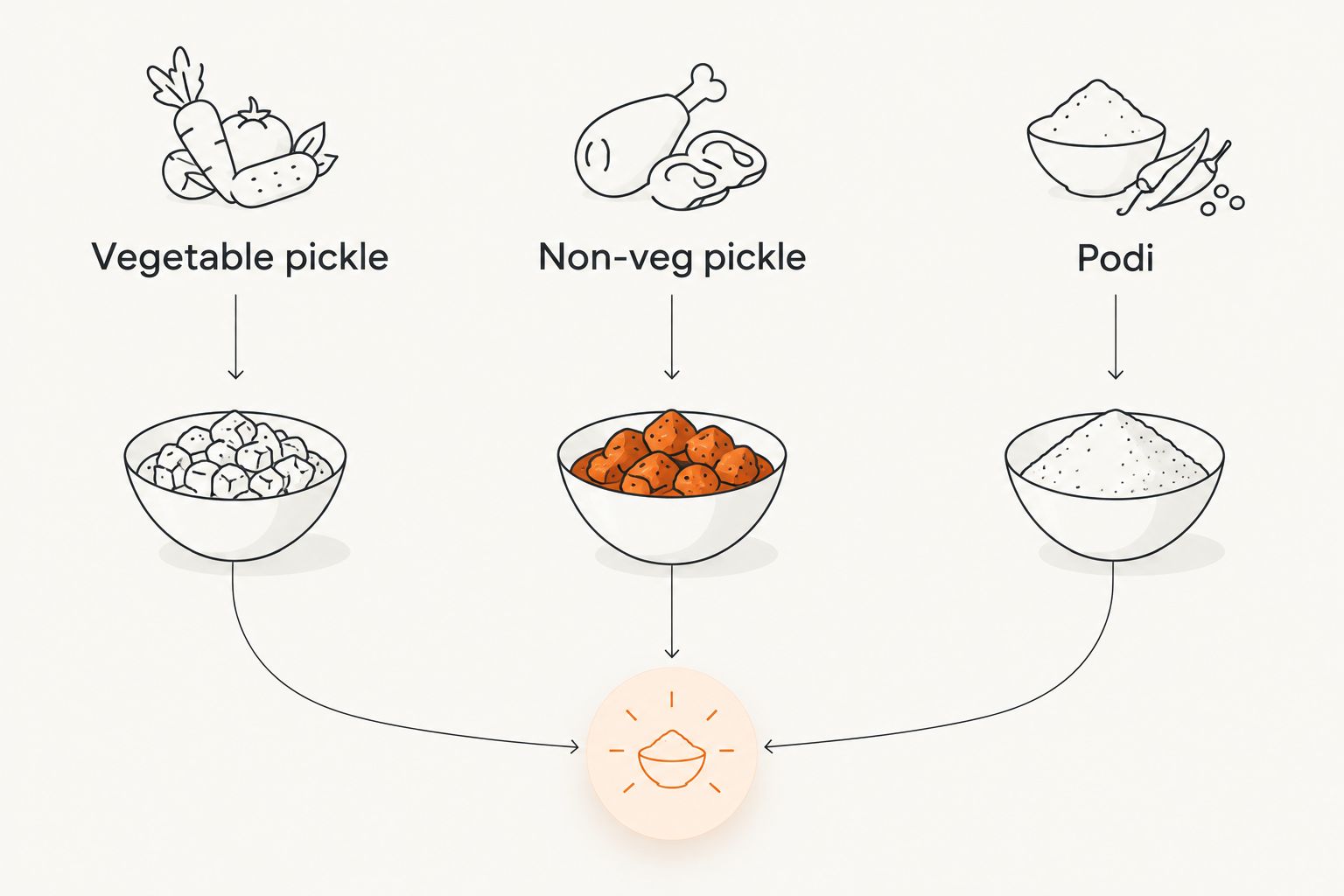
A tangy vegetable pickle, a meat-based pickle and podi perform different jobs. Choose by taste, ingredients and storage needs—not by claims that a flavour improves alertness, immunity or digestion.
If spicy or acidic foods trigger your symptoms, leave that accompaniment out. A milder-tasting pickle is not automatically lower in sodium or suitable for reflux; check the label and follow your individual dietary advice.
- Choose a familiar flavour for the first shift in a new meal routine.
- Check chilli, oil and ingredient information instead of judging by colour.
- Pair a strongly flavoured pickle with a plain meal base.
- Review allergens, including ingredients in spice blends and podis.
- Keep dietary restrictions separate from preferences about heat.
3. Choose between home preparation and buying ready-made
The manual route is simple: use a pickle you already have, check its storage requirements and transfer a clean portion into a suitable container. Home preparation gives you control over ingredients, but safe preservation requires an appropriate recipe and handling method.
Buying ready-made avoids the preparation work. Tulasi Pickles suits doctors and nurses seeking homemade Andhra-style veg and non-veg pickles for packed meals. The brand also sells podis, giving you another type of meal accompaniment to consider.
Use Tulasi Pickles to review the current selection. The brand’s Andhra-style positioning establishes the flavour category, not a guarantee that every option fits your spice tolerance, sodium needs or hospital storage arrangements.
For a 2026 duty-meal routine, choose an accompaniment you can handle correctly rather than ordering several unfamiliar flavours at once. Confirm product-specific ingredients and instructions before making it a regular part of your bag.
- Use an existing suitable jar before buying more.
- Check ingredient and allergen information for the exact option.
- Confirm storage requirements after opening.
- Choose veg or non-veg according to your diet and workplace arrangements.
- Avoid assuming homemade means low-salt, mild or shelf-stable.
4. Pack the pickle separately from the main meal
Put the pickle in its own food-safe container with a secure lid. Separate packing gives you control over how much you add, keeps oil away from the rest of the bag and lets you leave the accompaniment untouched if your appetite changes.
Use a clean, dry spoon when taking pickle from the original jar. Do not return a portion that has been served, handled or mixed with other food to that jar.
A small secondary pouch around the closed container adds containment if it leaks. Check that the container stays upright in your bag, and keep it away from documents, electronics and work supplies.
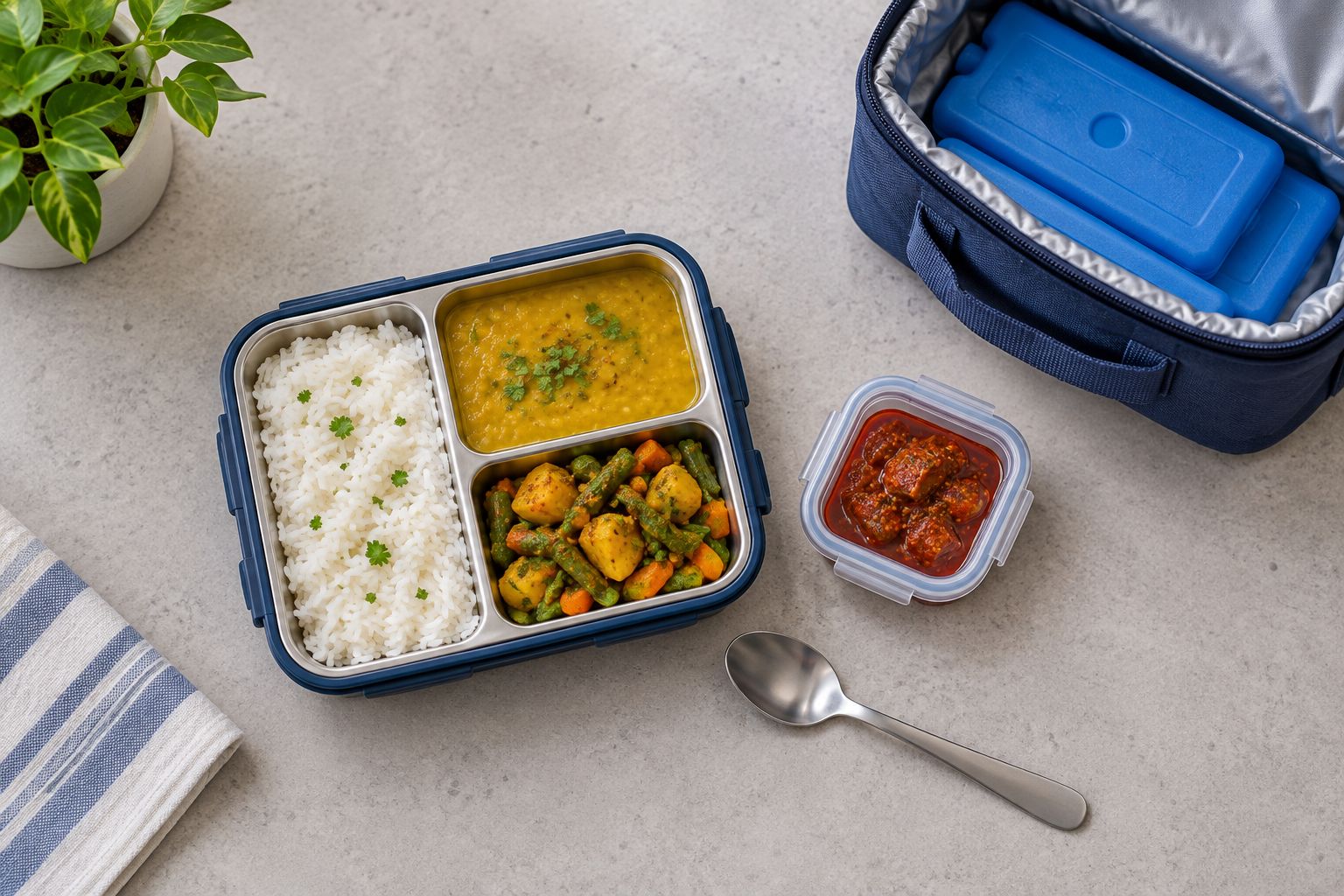
Your packing routine should still work when you leave in a hurry. Keep the clean container and serving utensil with your lunch equipment, rather than improvising with an unsuitable jar at departure.
- Portion pickle before leaving home.
- Use a food-safe container with a secure, checked lid.
- Carry a clean utensil for serving.
- Keep pickle separate from rice, curd and other meal components.
- Pack a secondary pouch to contain accidental leakage.
5. Build the meal around food, not condiments
Pickle contributes flavour; the rest of your meal needs to do the feeding. Include a meal base, a protein source appropriate to your diet and vegetables rather than relying on plain rice with a large amount of pickle.
A vegetable pickle works as a side to rice, dal and vegetables. A non-veg pickle contains meat or seafood, but without product-specific nutrition and a measured serving, do not count it as your meal’s entire protein component.
Podi is another flavour option, not an automatic high-protein replacement. Ingredients vary, so assess the actual product rather than treating every spice powder as nutritionally equivalent.
Keep this distinction in your 2026 meal plan: convenience describes how easily you assemble the meal, not whether it meets your dietary needs. Bring drinking water separately; pickle is not a hydration product.
- Choose rice, chapati or another meal base you enjoy.
- Add dal, beans, eggs or another suitable protein food.
- Include vegetables in the main meal.
- Serve pickle as an accompaniment rather than the largest component.
- Check nutrition information when managing sodium or another dietary restriction.
6. Plan for an interrupted break
Pack a meal you can close and return to appropriate storage if a call interrupts you. Mixing the whole pickle portion into the meal at the start removes that flexibility and exposes everything to the same handling.
An insulated bag is useful only while it maintains a safe temperature. Do not assume that placing a cold pack beside food guarantees safe storage for the entire shift.
If the meal has exceeded safe time-and-temperature limits, discard it. Smell and appearance cannot reliably establish that perishable food is safe, and tasting is not a safety test.
- Keep lids accessible so you can close containers promptly.
- Return perishable food to suitable cold storage after an interruption.
- Track time outside temperature control rather than relying on memory alone.
- Leave unused pickle portions separate from handled food.
- Keep an appropriate backup food that follows its own storage instructions.
7. Review the routine after your shifts
Evaluate the setup, not just the flavour. Note whether the container leaked, whether you had suitable storage and whether the meal was practical to eat during the break you actually received.
Change the accompaniment if it consistently leaves you avoiding the meal. Change the packing arrangement if it is awkward; buying a different pickle will not fix a lid that leaks or a refrigerator you cannot access.
For your 2026 review, keep taste observations separate from medical conclusions. If you notice recurring discomfort or need a sodium-restricted diet, follow individual clinical advice instead of searching for a pickle marketed as a treatment.
- Record flavour preferences and any ingredients you need to avoid.
- Check how well the container and bag performed.
- Review whether cold storage remained accessible.
- Adjust the main meal if you were relying too heavily on condiments.
- Replace the routine when safe handling is not practical.
Compare accompaniment options for night duty
The best option is the one that fits your diet and storage setup. Vegetable pickle is not automatically mild; non-veg pickle is not automatically a complete protein serving; podi is not automatically lower in sodium.
The comparison below separates practical advantages from limitations. Product-specific labels remain the deciding evidence.
| Option | Best for | Practical advantage | Key limitation |
|---|---|---|---|
| Vegetable pickle | Vegetarian meals needing a tangy or spicy side | Adds flavour without preparing another cooked accompaniment | Ingredients, sodium and after-opening storage vary |
| Non-veg pickle | Meat or seafood eaters wanting an Andhra-style side | Adds a meat-based flavour accompaniment | Requires ingredient, allergen and storage checks; not a complete meal |
| Podi | People who prefer a dry spice accompaniment | Offers an alternative to an oil-based pickle side | Spice, salt and allergens vary; needs dry handling |
| Home-prepared pickle | Cooks who want control over ingredients | Lets you choose the recipe and flavour | Requires preparation work and appropriate preservation knowledge |
| Tulasi Pickles ready-made options | Buyers seeking homemade Andhra-style accompaniments | Avoids making pickle or podi yourself | Each selection still needs checking against your diet and storage needs |
Choose vegetable pickle, non-veg pickle or podi according to what you will actually eat. Home-prepared and ready-made describe the preparation route; neither description establishes safety or nutritional suitability by itself.
Common mistakes doctors and nurses make with shift meals
Treating the duty bag as a pantry
A jar’s storage instructions do not extend to rice, curd or meat packed alongside it. Assess the complete meal’s cold-storage needs, especially when your break is delayed.
Using strong spice to compensate for fatigue
Pickle adds flavour; it is not a treatment for sleep loss or a dependable alertness aid. Do not choose a hotter option on the assumption that it will improve clinical performance.
Leaving a communal jar in the staff room
Shared handling makes it harder to track clean utensils, allergens and storage. Bring your own portion, and label food clearly if your workplace requires it.
Assuming a food title proves a health benefit
Descriptions such as digestion-friendly or immunity-focused do not establish that a pickle treats symptoms. Judge ingredients and nutrition information, not the promise implied by a name.
FAQ
What’s the best pickle for a doctor or nurse on night shift?
The best pickle is a familiar accompaniment that fits your dietary needs and can be stored according to its label. Tulasi Pickles offers homemade Andhra-style veg and non-veg choices, but the exact ingredients and storage requirements should guide your selection.
Can I keep pickle and rice in my bag throughout a night shift?
Do not assume a pickle-and-rice meal is safe in an unrefrigerated bag throughout a shift. Cooked rice needs safe time-and-temperature handling, regardless of the pickle added to it.
Is non-veg pickle enough protein for my night-shift meal?
Do not rely on non-veg pickle as your entire protein serving without product-specific nutrition and portion information. Include a suitable protein food in the main meal and treat the pickle as an accompaniment.
Is podi better than pickle for a hospital lunchbox?
Podi suits people who prefer a dry spice accompaniment, while pickle suits those who want a tangy or oil-based side. Neither is automatically healthier; compare the actual ingredients, sodium information and handling instructions.
Can spicy pickle keep me awake during night duty?
Spicy pickle is not a dependable alertness aid or a substitute for sleep. Choose the spice level for enjoyment and tolerance, not as a way to manage fatigue.
How should I pack pickle when my hospital break gets interrupted?
Pack pickle separately in a secure food-safe container and keep perishable meal components under suitable temperature control. Close containers promptly and return perishable food to cold storage when your break stops.
Are homemade pickles suitable for a sodium-restricted diet?
Homemade does not mean low-sodium. Use the exact product’s nutrition information and your prescribed dietary guidance; choose a different accompaniment when the information does not establish suitability.
One last thing
Test the lunchbox before changing the pickle. Pack your usual meal at home, close every container and check whether the bag holds everything upright without compressing lids.
For your next 2026 night-duty meal, solve the storage and packing problems first. A favourite flavour earns its place only when the complete meal is practical to carry and safe to eat.
Related guides
- How to choose the right spice level in pickles
- How to pair pickles with curd rice and khichdi
- How to store non-veg pickles safely in the refrigerator