
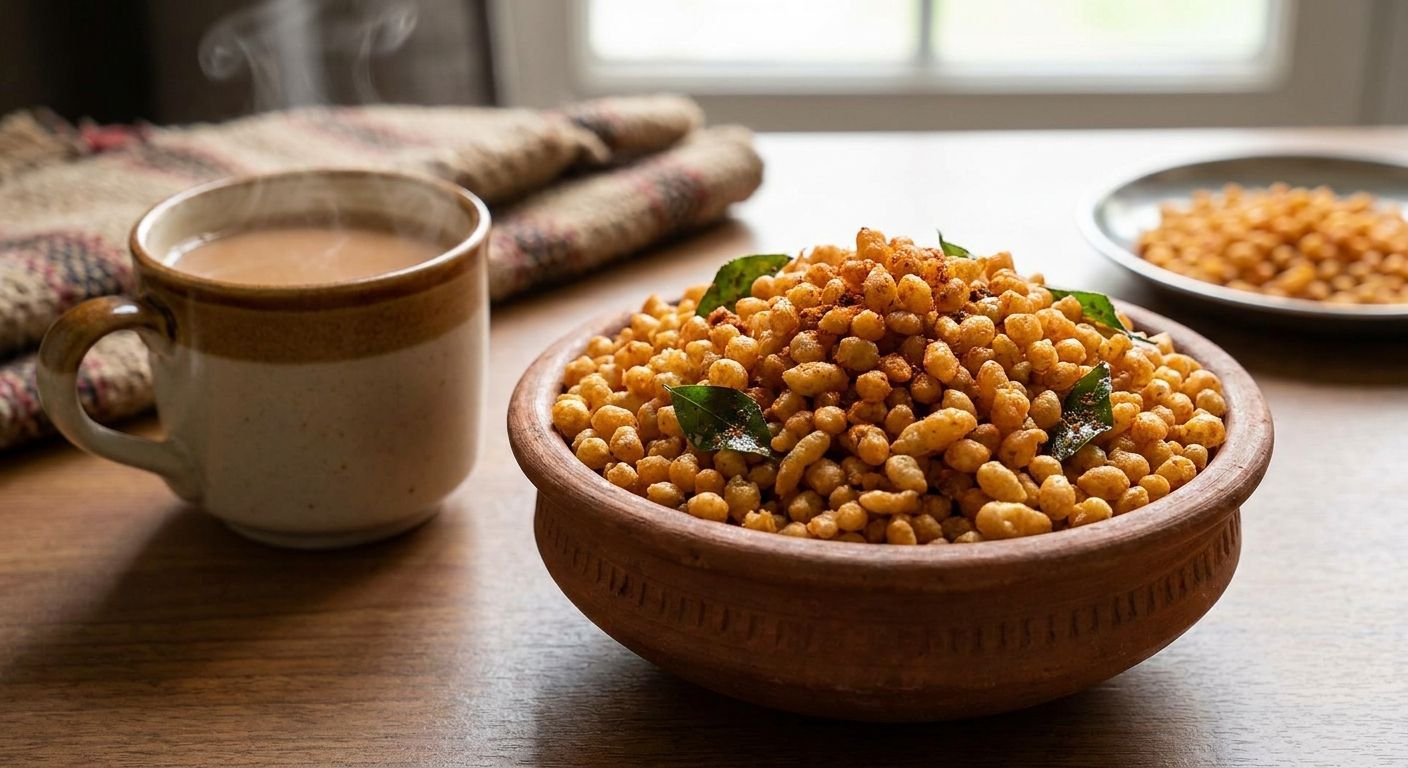
Karam boondi for spicy tea time snacking is a fried gram-flour ball dish tossed in red chilli powder, curry leaves, and roasted spices, built for pairing with evening chai or filter coffee. Tea-time snackers want something crunchy that survives a 20-30 minute sitting on the plate without turning soggy, and that's a different bar than boondi meant for mixing into curd or raita.
- Karam boondi is fried gram-flour boondi tossed in red chilli, curry leaf, and hing seasoning for tea time.
- Fresh karam boondi stays crunchy for 2-3 weeks in an airtight jar away from humidity.
- 180°C oil keeps the boondi from soaking up excess fat and turning limp within hours.
- Karam boondi pairs well with Andhra pickles and podis when you want a spicier tea-time spread.
- Homemade batches beat most packaged versions on freshness but cost more time per plate.
Why karam boondi matters for tea-time snacking
Tea-time snacking in Andhra and Telangana households runs on texture contrast: something crunchy, something spicy, something that doesn't need a fork. Karam boondi checks all three boxes in a way that murukku or plain namkeen often doesn't, because the seasoning coats every bead of fried gram flour instead of sitting on the surface.
Office tea breaks in 2026 run shorter than they did a decade ago, and that's pushed demand toward snacks that need zero prep — open the jar, eat, move on. Karam boondi fits that window better than snacks requiring reheating or plating. Tulasi Pickles sees this same pattern across its tea-time snacks range, where crunchy, spice-forward items consistently outsell sweeter alternatives during evening hours.
The other reason karam boondi matters for this segment: it doesn't compete with meals. Unlike a samosa or a full snack plate, a fistful of karam boondi fits into a five-minute break without derailing dinner plans.
Update your spice ratio
Most home cooks under-season boondi because they're used to sweet boondi ratios. Karam boondi needs a heavier hand.
- Use 1.5-2 teaspoons of red chilli powder per 250 grams of fried boondi
- Add a pinch of asafoetida (hing) for the tea-time aroma that distinguishes karam boondi from plain fried boondi
- Toss in 8-10 curry leaves, fried crisp, per batch
- Salt after frying, never before — pre-salted batter changes the boondi's crispness
- Finish with a few drops of hot oil to help the spice mix stick evenly
Fry at the right temperature
Oil temperature decides whether your karam boondi stays crunchy for days or turns chewy by evening.
- Keep oil at roughly 180°C — a drop of batter should rise immediately without browning too fast
- Fry in small batches so the oil temperature doesn't dip
- Use a boondi ladle with holes slightly larger than a sesame seed for even-sized beads
- Drain on a wire rack, not paper towels, to avoid trapped steam softening the base
- Let the batch cool completely before adding spice powder — warm boondi absorbs oil from the seasoning and turns soft faster
Choose your gram flour correctly
Not all besan behaves the same way once it hits hot oil.
- Pick a fine-ground besan with no lumps for uniform boondi shape
- Sieve the batter twice if you want restaurant-style round beads
- Adjust water content until the batter drips off a spoon in a thin, steady stream
- Avoid adding baking soda — it puffs the boondi but shortens shelf life
Measure your shelf life expectations
Karam boondi doesn't behave like packaged namkeen once it leaves the fryer.
- Store in an airtight glass or steel container, not plastic pouches, for the first week
- Expect 2-3 weeks of crunch in dry weather; humidity cuts that closer to 7-10 days
- Keep the container away from direct sunlight and stove heat
- Add a food-safe silica packet if shipping karam boondi during monsoon months
- Reseal the jar within seconds of scooping out a portion — extended air exposure is the main cause of sogginess
Pair it with the right accompaniments
Tea-time snackers rarely eat karam boondi alone for long; pairing habits matter for repeat purchases.
- Serve alongside a mild pickle to balance the boondi's dry heat
- Mix a spoon of karam podi into leftover boondi for a next-day rice topping
- Offer both karam boondi and sweet boondi laddu on festival trays for guests who want either option
- Keep a jar of pickle nearby if the household skews toward extra-spicy tea-time spreads
If frying at home isn't practical on a weeknight, the faster path is sourcing ready-made tea-time snacks instead of starting from raw besan. Tulasi Pickles ships a rotating selection of crunchy tea-time snacks and spice podis that pair with store-bought boondi when you want the flavor without the frying setup.
Build a spicier tea-time spread
Pair karam boondi with Andhra podis and pickles shipped across India.
Karam boondi: which version fits your tea time
| Option | Best for | Key limitation |
|---|---|---|
| Homemade karam boondi | Households that fry weekly and control spice level exactly | Takes 45-60 minutes including frying and seasoning |
| Store-bought packaged boondi | Quick tea-time fixes with no prep time | Seasoning is often milder and less fresh than a home batch |
| Sweet shop fresh boondi | Occasions needing large quantities same-day | Inconsistent spice level between shops and batches |
| Ready-made spice powder tossed into plain boondi | Bachelors and hostel-goers who buy plain boondi in bulk | Needs a separate spice powder purchase and manual mixing |
Verdict: homemade karam boondi wins on freshness and control, but a ready spice podi tossed into store-bought plain boondi is the fastest weeknight fix for tea-time snacking in 2026.
Common mistakes tea-time snackers make with karam boondi
- Buying boondi and seasoning separately without checking freshness dates — pre-mixed jars lose crunch faster once opened, so date-check before stocking up for the week
- Storing karam boondi in the same jar as sweet snacks — moisture and sugar transfer soften the spicy batch within days
- Assuming all karam boondi is equally spicy — chilli levels vary widely between home kitchens and packaged brands, so taste-test before serving guests
- Reheating karam boondi to "refresh" it — heat draws out residual oil and makes the boondi greasy instead of crisp
- Skipping the pairing step — serving karam boondi alone at tea time misses the balance a mild pickle or podi adds to an all-chilli snack
FAQ
What is karam boondi?
Karam boondi is fried gram-flour boondi tossed in red chilli powder, curry leaves, and hing, made as a spicy tea-time snack rather than a sweet one. It’s distinct from boondi laddu, which uses the same base fried boondi but binds it with jaggery or sugar syrup.
Is karam boondi the same as boondi laddu?
No, both start from the same fried gram-flour beads but karam boondi stays loose and spicy while boondi laddu is bound into balls with sugar syrup. They serve different occasions — karam boondi for daily tea time, boondi laddu for festivals.
How long does karam boondi stay crispy?
Fresh karam boondi stays crunchy for roughly 2-3 weeks in an airtight container in dry weather. Humid conditions or frequent opening cut that window to about 7-10 days.
What spices go into karam boondi seasoning?
Standard karam boondi seasoning includes red chilli powder, salt, curry leaves fried crisp, and a pinch of asafoetida. Some households add a light dusting of roasted cumin or a spoon of karam podi for extra depth.
Can karam boondi be made oil-free?
Traditional karam boondi requires deep frying to get the characteristic crunch, so a fully oil-free version isn’t standard. Baked versions exist but come out denser and less crisp than the fried original.
What is the best way to store karam boondi at home?
Use an airtight glass or steel container kept away from direct sunlight and stove heat. Reseal quickly after each use since prolonged air exposure is the main reason karam boondi turns soft.
Does karam boondi pair well with pickles and podis?
Yes, a mild pickle or a spoon of podi balances the dry heat of karam boondi and rounds out a tea-time spread. Many Andhra households serve boondi alongside pickle jars for exactly this reason.
Is karam boondi good for tea time or only festivals?
Karam boondi works better for daily tea time than festivals, since festival trays usually lean toward the sweet boondi laddu version. Households that snack on it daily typically fry or buy karam boondi in smaller, more frequent batches.
One last thing
The detail most home cooks miss: salting karam boondi immediately after frying, while it's still hot, locks in more spice adhesion than salting after it cools. That single timing change is why some batches taste evenly seasoned through the last handful in the jar while others go bland toward the bottom.
Related guides