
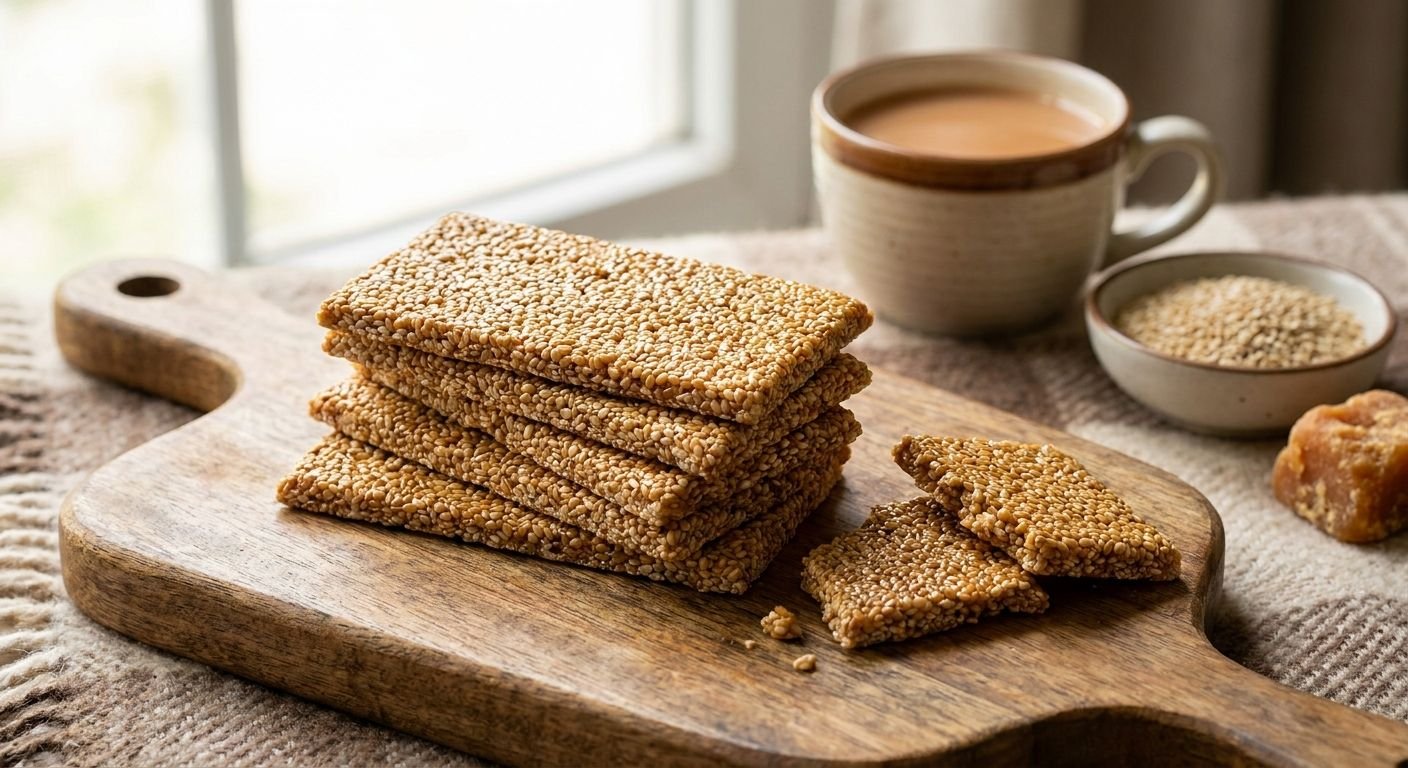
Winter snackers craving til chikki want a crunchy, sesame-jaggery bite that survives cold, dry air and fits neatly into a daily snacking routine, not just a once-a-year festival plate. That's the real difference for this segment in 2026: they're not making a batch for a single Makar Sankranti exchange, they're stocking a jar that has to stay crisp through weeks of winter cravings.
- Til chikki needs sesame roasted to a pale gold and jaggery syrup taken exactly to hard-ball stage, not further.
- Storage failure, not the recipe, is the top reason winter batches of til chikki go soft within days.
- Homemade til chikki wins on ratio control; ready-made Andhra sweets and snacks combos win on time during the 2026 Sankranti rush.
- Black sesame chikki holds crunch slightly longer than white sesame in humid kitchens.
Why til chikki matters for winter snackers
Til chikki is tied to Makar Sankranti, the mid-January festival where sesame (til) and jaggery (gul) are exchanged as a symbol of sweetness overcoming friction, most visibly in Maharashtra's "til gul ghya, god god bola" custom. Both ingredients are considered warming foods in Indian winter eating, which is why the craving for something sesame-and-jaggery-based spikes specifically in the cold months and fades by March.
The same audience that reaches for til chikki in winter usually already knows sesame in other Andhra forms. If you already keep nuvvula podi in the kitchen for rice mixing, chikki is the same base ingredient turned into a standalone snack rather than a condiment. That overlap matters: winter snackers aren't choosing between chikki and podi, they're building a sesame-heavy pantry for the season.
Making til chikki: the step-by-step spine
Pick the right sesame-to-jaggery ratio
Get this wrong and every later step is wasted effort. Most home recipes land close to equal weight, with sesame at or slightly above jaggery by volume.
- Use a 1:1 ratio of roasted sesame to grated jaggery as the starting point.
- Shift to 1.2:1 sesame-to-jaggery if you want a less sweet, more textured bite.
- Choose black sesame for a nuttier flavor and marginally better crunch retention.
- Use white sesame if you want the classic pale-gold chikki color.
- Weigh, don't eyeball — winter humidity already works against you, so ratio errors compound.
Toast the sesame seeds until they pop, not burn
Under-roasted sesame tastes raw and grassy; over-roasted sesame turns bitter and the chikki loses its nutty edge.
- Dry-roast on medium-low heat in a heavy pan, no oil.
- Stir constantly — sesame burns in seconds once it starts browning.
- Stop when seeds turn pale gold and start popping lightly.
- Cool the roasted seeds fully before adding to hot jaggery syrup.
- Roast in small batches of 200-300 grams for even color.
Cook the jaggery syrup to the hard-ball stage
This is where most winter 2026 batches fail. Jaggery syrup has a narrow window between too soft (chikki won't set) and too far (chikki turns into a jawbreaker).
- Melt grated jaggery with a splash of water on low heat, no rushing.
- Test doneness by dropping a bit of syrup into cold water — it should form a firm, non-sticky ball.
- Add a teaspoon of ghee near the end to prevent crystallization.
- Stir in a pinch of cardamom or dry ginger powder for a winter-appropriate warmth.
- Work fast once the syrup hits hard-ball stage — it keeps cooking off the heat.
If jaggery syrup crosses hard-ball stage, the chikki turns stone-hard within a day, and no amount of storage tricks fixes that afterward.
Set and cut the chikki while it's still warm
Once sesame and syrup are combined, the working window is short — a few minutes before the mixture stiffens past the point of cutting cleanly.
- Pour the mix onto a greased steel plate or marble slab immediately.
- Flatten with a greased rolling pin to an even 6-8mm thickness.
- Score cutting lines with a greased knife while still warm and pliable.
- Snap or cut into final pieces only after it cools to room temperature.
- Keep hands lightly ghee-coated to avoid sticking during shaping.
Buy it ready-made when the cooking step is the blocker
Some winter snackers don't want to manage syrup stages at all, especially when gifting is involved during the Sankranti and Makar Sankranti season. That's a fair trade-off — a curated sweets and snacks spread covers the craving without the syrup-stage risk.
Tulasi Pickles' sweets and snacks combo for festive gifting is built around this exact gap: buyers who want a traditional Andhra snack spread on the table for winter 2026 without troubleshooting a jaggery pan. It's not a chikki substitute — it's a way to round out the same craving with other traditional sweets and snacks.
Store it so it survives humidity swings
Til chikki's biggest enemy after cooking is ambient moisture, not heat. Coastal and humid-city winters can undo a perfectly cooked batch within a week if storage is sloppy.
- Store in an airtight glass or steel container, never a loosely closed plastic bag.
- Layer pieces with parchment paper to stop them sticking together.
- Keep the container in a cool, dry cupboard — not the refrigerator, which introduces condensation.
- Add a small silica packet or a few grains of raw rice to absorb stray moisture.
- Finish a batch within 2-3 weeks for peak crunch; beyond that, texture softens even when sealed.
The same moisture-control logic applies to other crisp snacks. If you've ever wondered how to keep papads crispy after opening the pack, the airtight-container-plus-desiccant approach works almost identically for chikki.
Round out your winter snack spread
Curated Andhra sweets and snacks for the 2026 festive season.
Til chikki options compared
| Option | Best for | Verdict | Key limitation |
|---|---|---|---|
| Homemade til chikki | Snackers who want full ratio and sweetness control | Buy the ingredients, make it | Time-consuming; one syrup-stage mistake ruins the whole batch |
| Local sweet shop chikki | A quick, one-off buy during Sankranti week | Hold for occasional treats | Freshness and jaggery quality vary shop to shop |
| Packaged branded chikki | Long shelf life and delivery convenience | Wait unless shelf life is the priority | Often leans on refined sugar over jaggery |
| Curated Andhra sweets and snacks combo | Buyers who want a broader winter spread, not just chikki | Buy as a pairing, not a chikki replacement | Doesn't replace chikki itself — it's a complement |
Common mistakes winter snackers make
- Pushing jaggery syrup past hard-ball stage — it hardens into something closer to a jawbreaker than a snack.
- Sealing chikki while it's still slightly warm — trapped steam softens the texture within 48 hours.
- Storing in a loosely closed jar — even a small gap lets ambient winter moisture in over 2-3 weeks.
- Over-buying festive combo packs during peak Sankranti gifting season — sweets sit too long before they're finished.
- Skipping the sesame roast test — under-roasted seeds leave the whole batch tasting raw no matter how good the jaggery is.
FAQ
What is til chikki made of?
Til chikki is made from roasted sesame seeds bound together with cooked jaggery syrup, usually finished with a little ghee and sometimes cardamom. The two-ingredient base is what makes it a staple winter snack across India.
Is til chikki good for winter health?
Sesame and jaggery are both traditionally treated as warming foods in Indian winter eating, which is why til chikki is associated with the cold season and Makar Sankranti specifically. It’s a calorie-dense snack, so portion size matters more than any single health claim.
How long does til chikki stay fresh?
Properly cooked til chikki stored in an airtight container away from humidity holds its crunch for 2-3 weeks. Beyond that window, even sealed batches start to soften.
What’s the difference between til chikki and gud papdi?
Til chikki is a hard, flat brittle made from sesame and jaggery, while gud papdi is a softer, crumblier sweet usually made with wheat flour, ghee and jaggery. They’re both winter jaggery-based sweets but different textures entirely.
Can til chikki be made without jaggery?
Traditional til chikki relies on jaggery for both sweetness and the syrup stage that sets the brittle. Substituting sugar changes the flavor and the setting behavior, and most recipes built around til chikki assume jaggery.
Why is til chikki eaten during Makar Sankranti?
Makar Sankranti in mid-January marks the sun’s transit and is celebrated with sesame-and-jaggery sweets as a symbol of warmth and sweetness during the coldest part of the year. Til chikki is one of the standard forms this takes alongside til-gul laddus.
How do I stop til chikki from turning soft in humid weather?
Cook the jaggery syrup fully to hard-ball stage, cool the chikki completely before sealing, and store it in an airtight container with a moisture absorber like silica gel or raw rice. Skipping any one of these three steps is usually why chikki softens early.
Is black sesame or white sesame better for chikki?
Black sesame gives a nuttier flavor and holds crunch slightly longer in humid conditions, while white sesame gives the classic pale-gold color most people associate with chikki. Neither is objectively better — it’s a flavor and appearance trade-off.
One last thing
The single biggest variable in whether a 2026 batch of til chikki lasts the season isn't the recipe — it's the container. A perfectly cooked batch sealed loosely goes soft in days; the same batch in a proper airtight jar with a moisture absorber holds crunch for weeks. If cooking syrup to the exact hard-ball stage sounds like more risk than the craving is worth, pairing a store-bought batch with a wider Andhra sweets and snacks spread solves the same winter craving without the syrup-stage gamble.
Related guides