
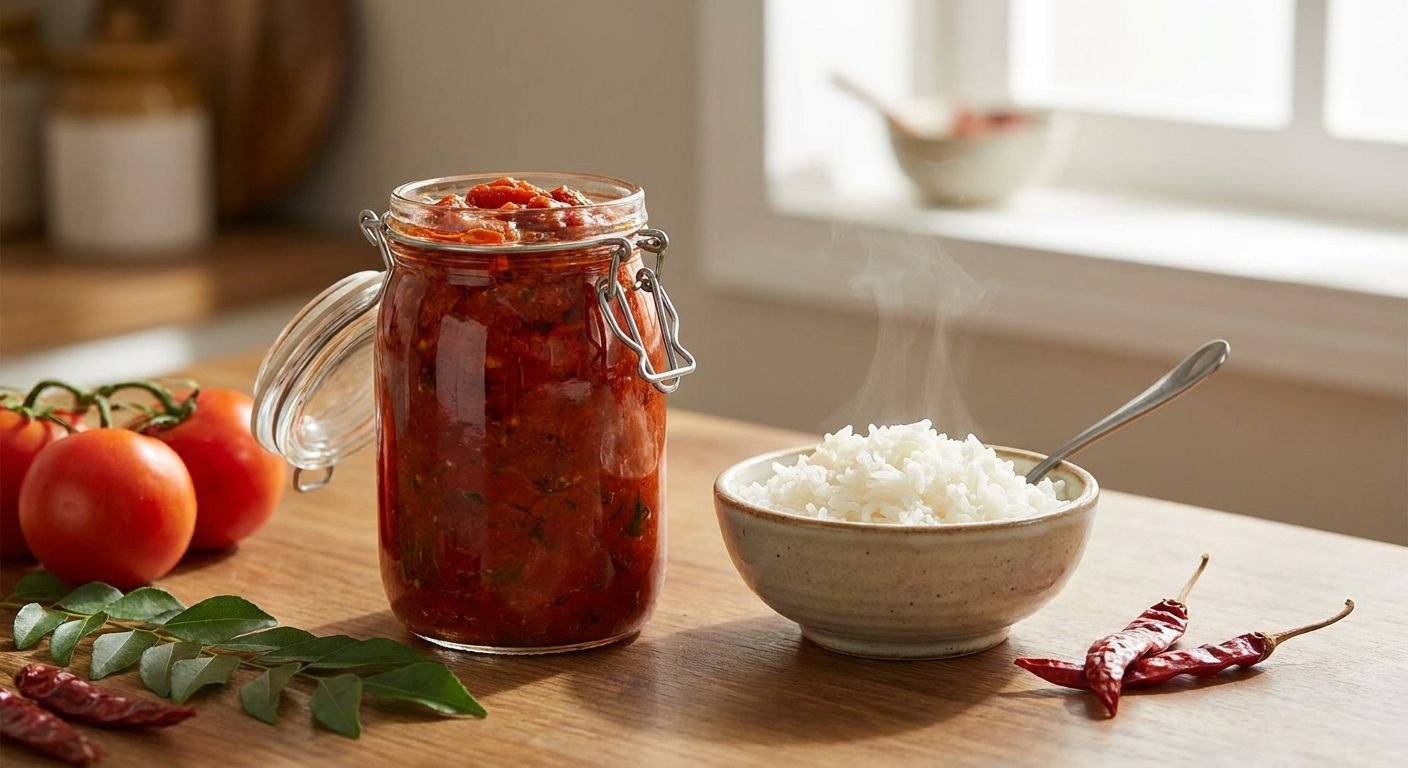
Tomato pickle for quick weekday Andhra meals is a tangy, tamarind-and-tomato pachadi that turns hot rice, curd rice, or idli into a complete meal without a single extra dish on the stove. It solves a specific weekday problem: you're home late, the fridge has half a bowl of rice and nothing else, and a jar of tomato pickle is the difference between skipping dinner and eating something that actually tastes like home.
- Tomato pickle needs zero cooking time — spoon it over rice, curd rice, or idli for a full weekday meal.
- Shelf-stable jars like Tulasi Pickles Tomato Pickle store at room temperature, so no refrigerator planning is needed.
- Adjust oil and chili quantity per serving instead of buying a separate mild or spicy jar.
- A 3-day rotation of tomato pickle, curd rice, and podi covers most weekday lunches with almost no prep.
Why tomato pickle matters for weekday Andhra meals
Andhra households have always leaned on pickles as the backup meal, not the side dish. Tomato pickle sits closer to a chutney in texture than avakaya or gongura, which means it mixes into rice faster and doesn't need the extra minute of mashing that mango or lime pickle sometimes does.
For someone cooking on a weeknight, that's the actual value: tomato pickle is the fastest route from an empty plate to a finished meal, ahead of tempering a fresh chutney or waiting on a curry to reduce. Tulasi Pickles built its tomato pickle around this exact use case — tamarind-forward, oil-preserved, and ready straight out of the jar.
Students in hostels, working professionals eating late, and NRIs craving an Andhra flavor without a full kitchen setup all hit the same wall: no time to cook, but no patience for bland food either. Tomato pickle answers both.
Stock a shelf-stable jar before the week starts
The biggest weekday mistake is running out of pickle on a Tuesday and improvising with ketchup or plain curd. A shelf-stable jar removes that risk entirely, since it doesn't need refrigeration to stay safe through a normal work week.
- Keep one open jar in the kitchen and one sealed backup in the pantry
- Check the jar for a visible oil layer on top — that's the seal keeping air out
- Store away from direct sunlight and stove heat, not inside a warm cabinet
- Use a dry spoon every time; moisture is what shortens shelf life fastest
- Reseal the lid tightly right after each use
Pair it with whatever's already cooked
Tomato pickle doesn't need a matching curry. It works as a flavor booster on food that's already sitting in your fridge from the weekend.
- Hot steamed rice with a spoon of ghee and tomato pickle mixed through
- Curd rice, where the tang of the pickle balances the coolness of the yogurt
- Plain idli or dosa when you don't have chutney made
- Khichdi or plain moong dal, which are otherwise flat on flavor
- Toast or roti in a pinch, for a non-traditional but functional fix
Portion it for grab-and-go lunches
If lunch is packed the night before, pickle needs to travel without leaking oil into the bag or losing its texture by noon.
- Use a small screw-top container, not a flip-lid one, for the commute
- Portion roughly a tablespoon per meal box — enough to coat rice without overpowering it
- Pack it separate from hot rice so the heat doesn't thin the oil out
- Add it just before eating, not the night before, to keep the texture intact
Adjust spice and oil per serving instead of buying two jars
Most people assume they need a mild jar for some days and a spicy one for others. You don't — a single jar handles both if you control the quantity per serving.
- Use half a teaspoon for a lighter, kid-friendly serving
- Go up to a full tablespoon when you want the tomato pickle to carry the whole meal
- Mix in a spoon of ghee to cut heat without diluting flavor
- Add a squeeze of fresh lime if a specific jar runs saltier than expected
If a jar consistently runs too hot for your household, check how to choose the right spice level in pickles before ordering the next batch — it's easier to pick the right heat level upfront than to correct it every meal.
Store it right so a jar lasts the full week
A badly stored jar spoils faster than the label suggests, and that's usually a storage mistake, not a product one.
- Never introduce a wet spoon into the jar
- Keep the lid on tight between uses, even mid-meal
- Store at room temperature away from stove steam
- Move to the fridge only in extreme heat or humidity, and let it come back to room temperature before serving
For a full breakdown, how to store homemade pickles for long shelf life covers jar handling in more detail than a quick checklist can.
Rotate it into a 3-day meal plan instead of a daily default
Eating the same tomato pickle every single day dulls the appetite for it fast. A 3-day rotation keeps it interesting without adding cooking time.
- Day 1: tomato pickle with hot rice and ghee
- Day 2: curd rice with tomato pickle on the side
- Day 3: idli or dosa with tomato pickle instead of chutney
- Repeat, swapping in a podi or a different pickle on day 4 to break the pattern
Know when homemade beats a jar, and when it doesn't
Making tomato pickle from scratch on a weeknight isn't realistic — tamarind reduction and tempering alone take longer than most people have after work. That's the actual gap a jar like Tulasi Pickles Tomato Pickle closes: it delivers the same tamarind-tomato base without the stovetop time on a Tuesday night in 2026.
Comparing weekday tomato pickle options
| Option | Best for | Key limitation |
|---|---|---|
| Homemade fresh tomato chutney | Weekend batch cooking with time to spare | Needs 30+ minutes of prep and tempering, unrealistic on weeknights |
| Store-bought fresh chutney (unpickled) | Same-day use only | Spoils within a day or two without refrigeration |
| Shelf-stable tomato pickle (e.g. Tulasi Pickles Tomato Pickle) | Weekday meals, hostels, travel, overseas shipping | Oil content means it's richer than a fresh chutney, portion control matters |
| Other Andhra pickles (gongura, avakaya) | Households wanting variety across the week | Stronger, more one-dimensional flavor than tomato, less versatile as a daily default |
Verdict: for a weekday Andhra meal with zero cook time, a shelf-stable tomato pickle wins over fresh chutney or a from-scratch batch every time.
Common mistakes weekday Andhra meal cooks make
- Buying one jar and expecting it to last a month of daily use — a single jar disappears fast once it becomes the default lunch fix, plan quantity around actual frequency
- Refrigerating it out of habit — this thickens the oil and dulls the tang; room temperature storage works fine for shelf-stable jars
- Skipping podi and pickle variety — relying only on tomato pickle every day flattens the appetite for it within a week
- Packing pickle into a hot lunch box — the heat separates the oil and changes the texture by the time lunch rolls around
- Ignoring spice level before bulk-ordering — one overly spicy jar wastes an entire week's rotation if nobody in the house can finish it
FAQ
What is tomato pickle best used for on a weekday?
Tomato pickle is best mixed into hot rice, curd rice, or idli for a no-cook weekday meal. A tablespoon over rice with a spoon of ghee makes a complete lunch or dinner in under two minutes.
How is tomato pickle different from gongura or avakaya?
Tomato pickle has a smoother, more chutney-like texture than gongura or avakaya, which makes it mix into rice faster. Gongura and avakaya carry a stronger, more distinct tang and are usually eaten in smaller quantities.
Does tomato pickle need refrigeration?
No, a shelf-stable jar like Tulasi Pickles Tomato Pickle stores at room temperature in a cool, dry spot. Refrigeration is only needed in extreme heat or humidity, and it can thicken the oil layer.
Can tomato pickle replace a curry on busy weeknights?
Yes, tomato pickle works as a full meal component on its own with rice or curd rice, not just as a side. It’s a common weekday substitute in Andhra households when there’s no time to cook a curry.
How much tomato pickle should I use per meal?
Half a teaspoon works for a lighter serving, and up to a full tablespoon carries an entire plate of rice. Start smaller and adjust, since jars vary in salt and heat level.
Is tomato pickle good for students living in hostels?
Yes, tomato pickle is a common hostel staple because it needs no cooking, no refrigeration, and pairs with whatever mess food is available that day. A small jar travels well in a bag or suitcase.
Can tomato pickle be shipped overseas?
Shelf-stable, oil-based tomato pickle is suited to overseas shipping because it doesn’t need refrigeration in transit. Packaging and shipping method still affect how well it holds up over longer distances.
What pairs well with tomato pickle besides rice?
Curd rice, khichdi, plain dal, idli, dosa, and even roti all work with tomato pickle. It’s versatile enough to fill in wherever a meal is missing flavor.
One last thing
The households that get the most out of tomato pickle aren't the ones eating it every single day — they're the ones rotating it with a podi or a second pickle every 3 days, which is the single easiest way to make one jar last the full week without anyone getting tired of it by Thursday.
Related guides