
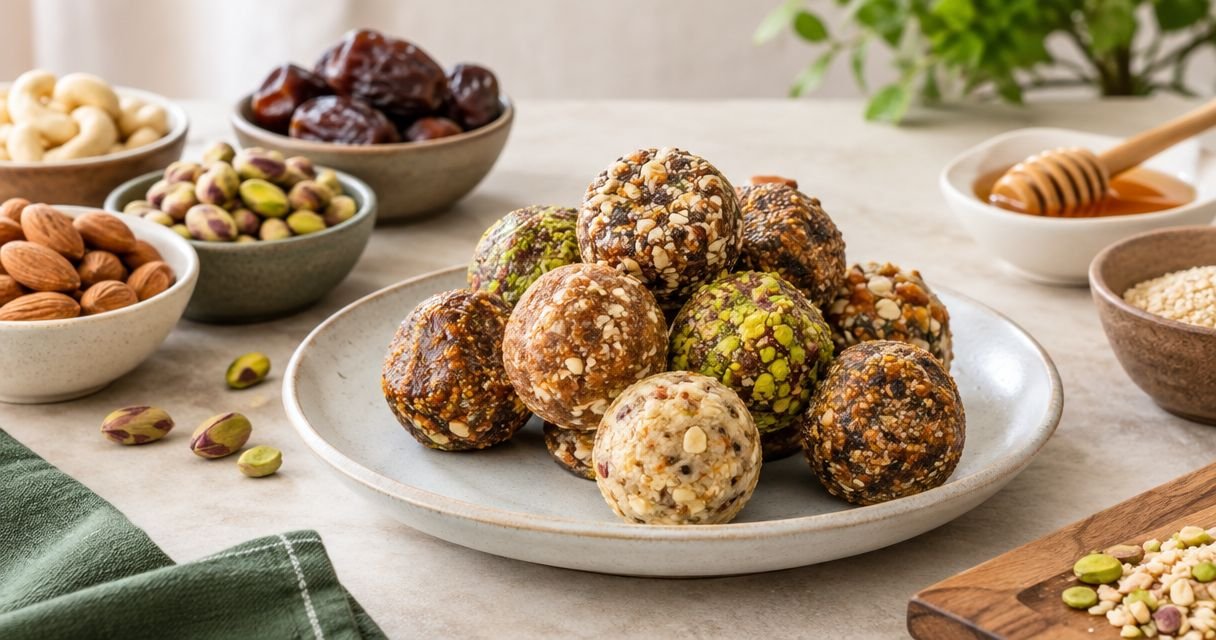
Best overall: the dry fruit laddu with the lowest declared total sugars per 100 g. Best for avoiding added sweeteners: a verified no-added-sugar recipe. Best for portion control: a laddu with a declared piece weight. This 2026 guide explains how to compare dry fruit laddu sugar content without mistaking dates, jaggery or a smaller serving for proof of lower sugar.
- Compare dry fruit laddu sugar content per 100 g before comparing sugar per piece.
- Date-bound laddus contain naturally occurring sugars; no added sugar does not mean sugar-free.
- Jaggery-sweetened and refined-sugar laddus need nutrition labels before either earns a lower-sugar ranking.
- Tulasi Pickles sells Andhra-style sweets; its supplied product details do not establish a lowest-sugar laddu winner.
Why this matters
A dry fruit laddu can combine nuts, dried fruit and an added sweetener in very different proportions. The name describes a sweet, not a fixed recipe. Two laddus with similar ingredients can therefore have different sugar content.
For your 2026 shortlist, separate the occasion from the nutrition decision. Choosing dry fruit laddus for festive gifting is one task; establishing which contains less sugar requires comparable nutrition information. Neither a festive presentation nor a homemade description answers that question.
There is no defensible lowest-sugar brand ranking without product-specific nutrition values. The order below is a recipe-screening priority, not a measured league table: investigate unsweetened nut-forward recipes first, then compare fruit-bound and added-sweetener recipes using their labels.
What makes the best lower-sugar dry fruit laddu?
Use these criteria before accepting a recommendation:
- Total sugars: Compare the same weight of finished product, including naturally occurring and added sugars.
- Added sugars: Identify sugar, jaggery, honey, syrups and other added sweeteners separately from total sugars.
- Ingredient proportions: Look for declared nut and dried-fruit percentages rather than judging the product by its name.
- Piece weight: Establish how much one laddu weighs before comparing per-piece values.
- Total carbohydrate: Check this alongside sugars, especially when following a diabetes meal plan.
- Clear disclosure: Prefer readable nutrition and ingredient information over unsupported wellness claims.
A product can win on one criterion and lose on another. A smaller laddu can deliver less sugar per piece while containing more sugar per equal weight.
Dry fruit laddu options at a glance
These are recipe types to investigate, not named products with verified sugar measurements. No recipe type automatically wins the total-sugar comparison.
| Screening order | Recipe type | Best for | Standout distinction | Key limitation |
|---|---|---|---|---|
| 1 | Nut-forward, no added sweetener | Buyers investigating less-sweet recipes | Focuses attention on the nut-to-fruit balance | Nut-forward wording does not establish sugar content |
| 2 | Date-bound, no added sugar | Buyers avoiding added sweeteners | Dates supply sweetness and help bind ingredients | Dates still contribute naturally occurring sugars |
| 3 | Jaggery-sweetened | Buyers who prefer jaggery flavour | Makes the chosen added sweetener explicit | Jaggery does not establish a lower-sugar result |
| 4 | Refined-sugar-sweetened | Buyers who prefer a conventional sweet | Can be compared directly when nutrition is declared | A clear sweetener name says nothing about quantity |
1. Nut-forward: best for investigating less-sweet recipes
A nut-forward dry fruit laddu places nuts at the centre of the recipe. For sugar-conscious shopping, investigate versions without added sweeteners and check how much dried fruit they contain. The ingredient proportions matter more than the description.
Do not confuse this screening priority with a nutritional guarantee. Nuts contribute fat and energy, while any dates, raisins or figs contribute sugars.
Nut-forward laddu pros:
- Declared nut percentages help you understand the recipe.
- An unsweetened version avoids an added sweetener.
- A complete label supports an equal-weight comparison.
Nut-forward laddu cons:
- Nut-forward is not a numeric sugar claim.
- Less sugar does not automatically mean fewer calories.
- Nuts require an allergen check.
Best for: You want to investigate less-sweet recipes and can check the full composition.
Verdict: Hold until total sugars and ingredient proportions are clear; buy only if the label meets your needs.
2. Date-bound: best for avoiding added sweeteners
Dates can provide both sweetness and binding in a dry fruit laddu. A recipe made without added sweeteners can still contain substantial naturally occurring sugar; the exact amount depends on its composition.
Read the complete ingredient list. A date-based description does not rule out an additional sweetener elsewhere in the recipe.
Date-bound laddu pros:
- Dates can bind nuts without a separate sugar syrup.
- A verified recipe can meet your preference to avoid added sweeteners.
- Declared fruit proportions make the sweetness source clearer.
Date-bound laddu cons:
- Naturally occurring sugars still count towards total sugars.
- A fruit-heavy recipe does not automatically beat another laddu.
- Piece size can obscure the comparison.
Best for: You prefer fruit-sweetened sweets rather than sweets with added sugar, jaggery or syrup.
Verdict: Buy for a verified no-added-sugar preference; skip the assumption that date-bound means sugar-free.
3. Jaggery-sweetened: best for jaggery flavour
Jaggery is an added sweetener, not a way to remove sugar from a laddu. Choose this recipe because you enjoy its flavour, then check total and added sugars as you would for any other sweet.
A jaggery laddu can only outrank a refined-sugar laddu when comparable nutrition values support that result. Replacing the sweetener name is not enough.
Jaggery-sweetened laddu pros:
- The recipe identifies the preferred sweetener.
- It suits buyers seeking jaggery flavour.
- A full label allows a direct comparison with other recipes.
Jaggery-sweetened laddu cons:
- Jaggery contributes added sugars.
- Traditional preparation does not establish lower sugar.
- Ingredient proportions remain essential.
Best for: You want jaggery flavour and will treat the laddu as a sweet.
Verdict: Buy for taste; skip any lower-sugar claim based solely on jaggery.
4. Refined-sugar-sweetened: best for a conventional sweet
A refined-sugar recipe deserves the same label-based assessment as every other option. Its sweetener is explicit, but the amount used still determines part of the finished product's sugar content.
Do not place a clearly labelled laddu below an unlabelled fruit-bound version simply because its ingredient list includes sugar. Transparency makes comparison possible; it does not make the product worse.
Refined-sugar laddu pros:
- The added sweetener is easy to identify.
- Declared nutrition supports portion planning.
- It suits buyers who prefer this style of sweet.
Refined-sugar laddu cons:
- It contains added sugar.
- A small piece does not establish a lower-sugar recipe.
- Nutrition disclosure is still needed to rank it.
Best for: You want a conventional sweet with enough information to plan your portion.
Verdict: Buy for preference and label clarity; hold if sugar information is absent.
How this 2026 ranking works
The screening order prioritises recipe questions, not assumed sugar quantities. Nut-forward recipes come first for investigation, date-bound recipes address an added-sweetener preference, and the remaining options separate jaggery from refined sugar without declaring either nutritionally better.
The actual sugar ranking must follow declared total sugars per equal weight. If a jaggery-sweetened product has a lower verified value than a date-bound product, the jaggery product ranks ahead on total sugar. That result says nothing by itself about allergens, flavour or overall dietary suitability.
Dried fruit changes the sugar question
Removing water from fruit concentrates its components by weight. That is why a laddu containing dried fruit needs its own nutrition assessment rather than inheriting the reputation of fresh fruit.
The distinction between concentration and added sweetening also matters when assessing sugar in freeze-dried fruit: water removal and adding sugar are different processes. For laddus, read both the fruit ingredients and any separate sweeteners instead of treating all sweetness as the same recipe choice.
Dried fruit also plays a structural role. A sticky fruit paste can hold chopped nuts together, so reducing it changes more than taste. You cannot infer the finished sugar value from the presence of nuts or dates alone.
How to compare dry fruit laddu sugar content in 2026
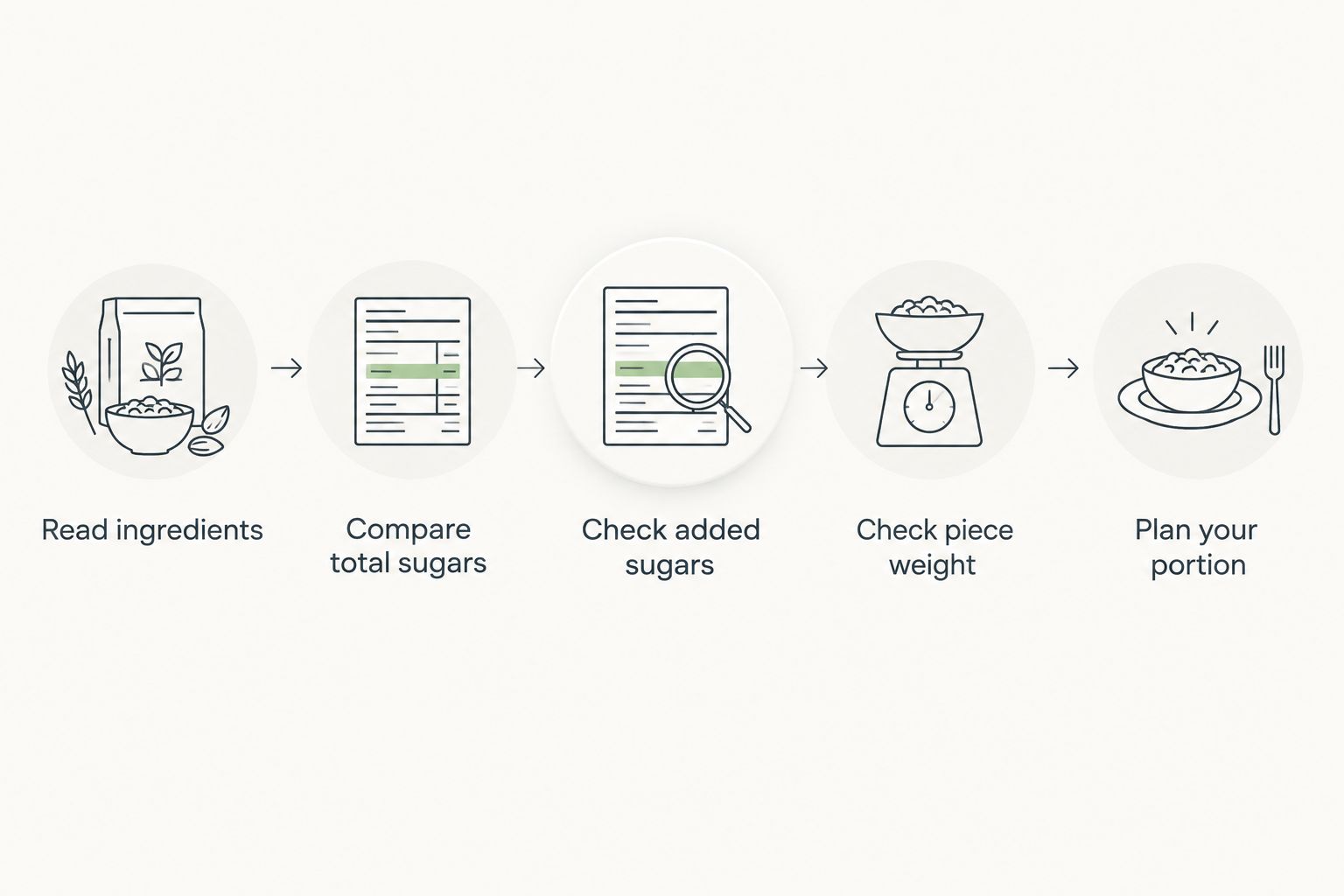
Use this sequence on each packet or product listing. Keep the comparison on the same basis until you reach the portion decision.
- Read ingredients. Identify nuts, dried fruit and every added sweetener. Use declared percentages where provided.
- Compare total sugars. Start with grams of total sugars per 100 g of finished product.
- Check added sugars. Use this separate figure to assess your preference about added sweeteners, not as a substitute for total sugars.
- Check piece weight. Establish the weight of one laddu and the number of pieces you intend to eat.
- Plan your portion. Compare the sugar and carbohydrate in that actual portion.
The calculation is straightforward: sugar per piece equals sugar per 100 g multiplied by piece weight in grams, divided by 100. Use values from the actual product, not an estimate borrowed from a different laddu.
For energy context, 1 g of sugar supplies approximately 4 kcal under standard nutrition energy calculations. That does not measure the laddu's total energy: fat, protein and other carbohydrates also contribute. A lower-sugar label is therefore not a complete weight-management assessment.
What to ask before ordering sweets
Ask the seller for a readable ingredient list, total sugars, added sugars, total carbohydrate and piece weight. Request the information for the exact product you intend to order. A nutrition panel from another sweet is not interchangeable.
Tulasi Pickles sells traditional sweets alongside its Andhra-style pickle range. The supplied descriptions identify Dry Fruit Byte and Dry Fruit Putharekulu, but neither establishes a nutrition value for dry fruit laddus. A dry-fruit product name is not evidence of a low-sugar laddu.
For your 2026 order, keep recipe preference and dietary suitability separate. If you need to manage blood glucose, use the product's carbohydrate information and your clinician's meal-planning advice rather than a sugar-free-sounding name.
Which dry fruit laddu should you choose?
Choose the product with the lowest declared total sugars per 100 g, then check the portion you will actually eat. That is the default for an undecided buyer whose main priority is sugar content.
If avoiding added sweeteners matters more, choose a verified no-added-sugar recipe while still checking total sugars. If flavour is the priority, choose dates, jaggery or refined sugar on taste without turning that preference into a nutrition claim.
Tulasi Pickles suits shoppers seeking Andhra-style pickles and traditional sweets; a lower-sugar laddu choice still requires its own nutrition label. Brand familiarity cannot replace that comparison.
FAQ
What’s the best dry fruit laddu for lower sugar?
The best choice is the product with the lowest declared total sugars per 100 g, followed by a portion-size check. Neither dates nor jaggery establishes a lower-sugar winner without comparable nutrition values.
How much sugar is in one dry fruit laddu?
The amount depends on the recipe and the laddu’s weight. Calculate it from the product’s total sugars per 100 g and the weight of one piece rather than using a universal estimate.
Are date laddus sugar-free?
No, date laddus contain naturally occurring sugars from dates. A recipe without added sweeteners can be no-added-sugar without being sugar-free.
Is a jaggery dry fruit laddu lower in sugar?
Jaggery does not establish a lower-sugar laddu. Compare the finished products’ total sugars on an equal-weight basis; jaggery contributes added sugars.
Can someone with diabetes eat dry fruit laddus?
Suitability depends on the person’s meal plan, the product’s carbohydrate content and the portion. Do not treat a no-added-sugar claim as medical clearance; follow individual clinical advice.
Should I compare sugar per laddu or per 100 g?
Compare per 100 g first to assess the recipes fairly. Then compare sugar in your intended portion, because different-sized laddus can reverse a per-piece comparison.
Does Tulasi Pickles have a verified lowest-sugar dry fruit laddu?
The supplied Tulasi Pickles product information does not establish a verified lowest-sugar dry fruit laddu. A defensible ranking requires product-specific nutrition values and piece weights.
One last thing
Photograph the nutrition panel before discarding the wrapper. It preserves the exact information behind your choice and gives you a reliable starting point when comparing your next purchase. In 2026, the strongest sugar-conscious buying habit is still simple: compare the label, then decide the portion.
Related guides
- Sugar-free sweets for festive gifting
- Dry fruit and nut mixes ranked by protein
- Premium cashews for festive snacking and gifts
- Andhra sweets for festival celebrations