
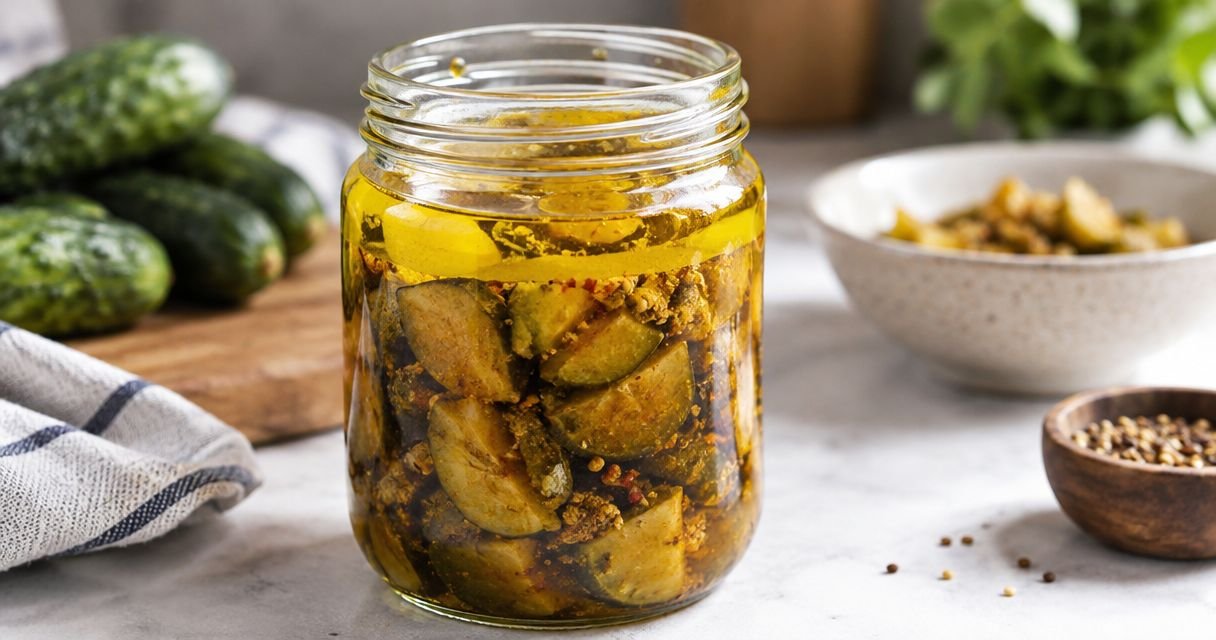
Oil separating on top of an oil-based Indian pickle is usually normal: the oil rises while heavier spices and pieces settle. Separation alone neither proves spoilage nor confirms that a jar is safe. Discard pickle with mould, a swollen container, unexpected gas or other signs of spoilage; never taste it to check.
- Is oil separation in pickle normal? Usually yes for oil-based Andhra pickles; separation alone is not spoilage.
- A clear oil layer is different from fuzzy growth, unexpected foam or a swollen lid.
- Tulasi Pickles sells Andhra-style pickles; follow the individual jar’s storage instructions rather than judging safety by oil coverage.
- Never stir mould into pickle, taste a suspect jar or add oil to rescue spoiled food.
For a broader check beyond the surface layer, use this guide to telling whether a pickle jar has gone bad. The distinction matters: ordinary settling changes appearance, while contamination calls for discarding the food.
Is oil separating on top of pickle normal or spoiled?
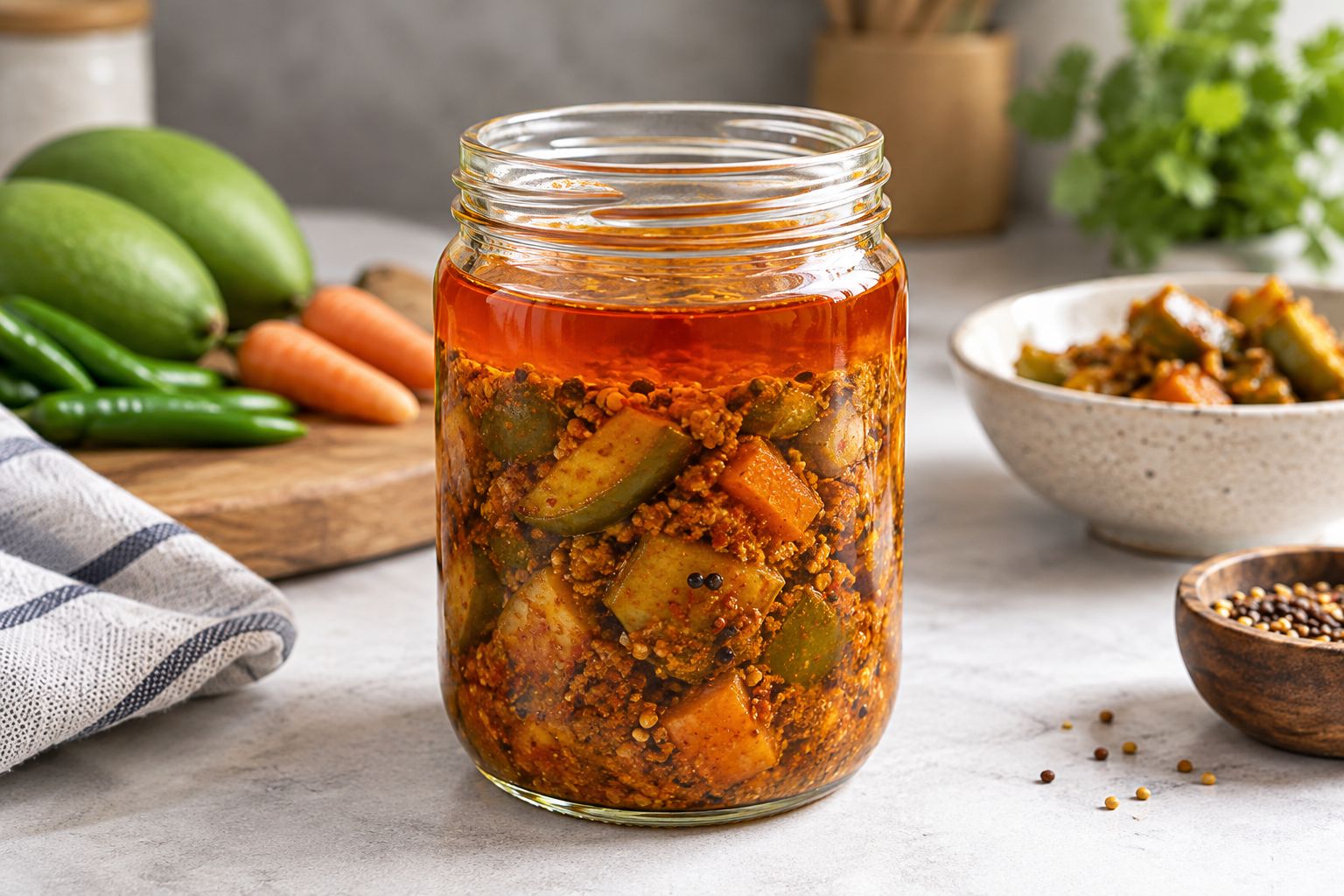
A smooth oil layer above settled pickle is generally normal in an oil-based recipe. Oil does not stay evenly mixed with the water-containing ingredients, and ground spices and solid pieces settle when the jar stands undisturbed. Chilli and other ingredients can colour the separated oil, so it need not look pale or transparent.
Use the following comparison to decide what the appearance means. These observations help identify warning signs; they do not replace correct preparation, storage or the label’s instructions.
| What you notice | What it means | What to do |
|---|---|---|
| Smooth oil layer with spices and pieces beneath it | Consistent with ordinary separation | Check storage history and the label before serving |
| Spices collecting at the bottom | Consistent with settling | Mix gently only if the jar otherwise passes your checks |
| Fuzzy, raised or spreading surface growth | A spoilage warning, not ordinary oil separation | Discard the contents; do not scrape and keep the rest |
| Swollen lid, leakage or liquid spurting on opening | A warning of package failure or possible microbial activity | Do not taste; handle and discard safely |
| Unexpected persistent bubbles or foam in a non-fermented pickle | Possible unwanted fermentation or spoilage | Stop using the jar |
| An ordinary-looking jar stored contrary to its instructions | Appearance cannot establish safety | Do not rely on the oil layer to clear it for eating |
This comparison applies to oil-based achar, not every food called a pickle. Naturally fermented vegetables can produce gas during controlled fermentation; unexpected gas in a finished, non-fermented oil pickle is a different situation.
Why this matters
An oil layer is easy to see. Unsafe preparation or a broken refrigeration requirement is not. Treating visible oil as a safety seal creates false confidence, especially with meat, seafood or an unfamiliar homemade recipe.
For your 2026 kitchen routine, separate two questions: “Has the mixture settled?” and “Has the food been prepared and stored safely?” A jar can show normal separation yet still be unsuitable to eat because its storage history is unsafe.
The reverse is also true. A properly prepared and stored oil pickle does not become spoiled simply because its spices settle beneath the oil.
What does normal separation look like?
Normal separation usually forms a smooth, continuous liquid layer above denser ingredients. The pieces and spice paste remain below it, with some spices suspended in the oil. After gentle mixing, the ingredients redistribute and can settle again.
Judge the pattern, not just the colour. Red or orange oil can reflect chilli pigments; colour alone does not identify contamination. Fuzzy patches, spreading colonies or a new surface film require a different response from a uniform liquid layer.
Do not diagnose a questionable white patch from a photograph alone. Fat crystals, surface growth and other changes can look similar in an image. If you cannot distinguish an expected ingredient change from spoilage, do not serve the pickle while seeking clarification.
Why oil separation in pickle varies
The amount of visible oil is not a reliable measure of freshness. Several ordinary physical differences affect how a jar looks:
- Recipe composition: Different proportions of oil, spice paste and solid ingredients produce different layers.
- Time undisturbed: Ingredients redistribute during handling and settle when the jar stands still.
- Ingredient size: Large pieces and finely ground spice paste do not remain suspended in the same way.
- Temperature: Some edible oils become cloudy or partly solid when chilled; this is distinct from fuzzy growth.
- Recent movement: Transport, tilting and serving mix layers that later separate again.
There is no universal safe depth of surface oil for every pickle. A deeper layer does not compensate for inadequate acidity, contaminated utensils or incorrect storage.
Likewise, do not compare two different recipes and conclude that the one with less visible oil is spoiled. The recipe and handling instructions matter more than matching another jar’s appearance.
How should I check a separated jar before serving?
Use this sequence for a jar that shows separation but no obvious spoilage. Stop immediately if you find a warning sign; completing the remaining steps does not make suspect food safe.
- Read the label. Check the storage directions, date marking and any instructions for use after opening. Do not substitute general pickle advice for the instructions on that jar.
- Check the container. Look for cracks, leakage, a swollen lid or a damaged seal. A compromised unopened container is not simply a mixing problem.
- Review storage. Establish whether refrigeration was required and maintained. Include time spent on the table, during travel or in a hot kitchen.
- Inspect without tasting. Look for surface growth, unexpected foam, unusual slime or other changes from the product’s normal condition. Do not deliberately sniff a suspect container closely.
- Serve cleanly. Only after the jar passes these checks, use a clean, dry utensil and follow any mixing instructions. Close the container promptly.
Keep the label or a photograph of it until you finish the jar. For 2026 household stock checks, recording when you opened a container is more useful than trying to remember whether its oil layer looked thicker last week.
Do vegetable and non-veg pickles need the same checks?
Both need clean handling and storage that matches their instructions. Neither becomes safe merely because oil covers the ingredients. However, do not transfer storage assumptions from a familiar vegetable pickle to a chicken, mutton or seafood pickle.
Acidity, salt, processing and packaging all affect preservation. A sour taste is not a measured safety check, and a spicy recipe is not evidence that harmful microorganisms cannot grow.
Tulasi Pickles is best suited to shoppers seeking Andhra-style veg and non-veg pickles. That category fit does not establish a shared shelf life or storage method across its range; use the instructions supplied with the specific product.
Homemade pickle needs the same discipline. A traditional recipe can be enjoyable, but the word “homemade” is not proof of a validated preservation process. If preparation or storage is uncertain, normal-looking oil cannot resolve that uncertainty.
When does refrigeration become the deciding factor?
When a product requires refrigeration, keeping it cold matters more than whether its oil separates. For 2026 household handling, USDA food-safety guidance specifies a refrigerator temperature of 4°C or below, expressed as 40°F in its guidance.
USDA also advises that perishable foods should not remain unrefrigerated for more than 2 hours, reduced to 1 hour when the temperature exceeds 32°C—90°F in the original guidance. Apply those limits to pickle that requires cold storage, not as a blanket rule that every unopened, shelf-stable achar needs refrigeration.
These are general perishable-food limits, not a tested shelf life for any particular pickle. Follow stricter product instructions where supplied. Refrigerating food after an unsafe period outside the fridge does not reset its safety.
Cold storage can change oil texture. Cloudiness or partial solidification caused by chilling does not, by itself, mean spoilage; equally, returning to a liquid state does not prove safety. Do not leave a refrigeration-required jar out just to make the oil look clearer.
Should I stir the oil back into the pickle?
Stir only when separation is the sole issue and preparation, storage and the label give no reason for concern. Gentle mixing redistributes oil and spices for serving; it does not disinfect the contents.
Use a clean, dry spoon. Avoid introducing water, leftover rice or food from a used plate, and never return a served portion to the jar. Keeping the serving utensil separate from your eating utensil reduces contamination opportunities.
There is no benefit in repeatedly opening and stirring a stored jar merely to keep it visually uniform. Separation can recur. In 2026, make clean serving and correct storage your routine rather than trying to prevent a normal physical change.
Can I pour off the oil or add fresh oil?
Do not alter the main jar to solve a safety concern. Pouring oil off changes the product as supplied, while adding fresh oil does not reverse spoilage or correct unsafe processing. Ask the maker before changing a preservation recipe.
If your concern is an oily serving rather than spoilage, lift a portion with a clean utensil and leave excess oil behind in the jar. That addresses your plate without modifying the entire batch.
Never add water to thin the spice paste in the storage container. If you mix pickle into another dish, prepare only the portion you intend to use and handle the resulting dish according to its ingredients.
Can I scrape mould off and keep the pickle underneath?
No—discard the contents of a mouldy pickle jar. USDA guidance on mouldy foods advises discarding high-moisture foods where contamination can extend beneath the visible surface; an oil layer does not create an exception.
Scraping, stirring, topping up with oil or reheating is not a dependable household rescue method. Keep a suspect jar away from ready-to-eat food, avoid splashing its contents and clean any contaminated surfaces.
If someone develops double vision, difficulty swallowing, muscle weakness or breathing problems after eating preserved food, seek emergency medical care immediately. These are recognised botulism warning symptoms; do not wait for other people who ate the food to become ill.
FAQ
Is oil separation in pickle normal after delivery?
Oil separation can be normal after delivery because movement redistributes ingredients that settle again afterward. Check the seal, storage requirements and any spoilage signs before serving; transport does not explain away leakage or a swollen lid.
Does a thick oil layer mean my pickle is fresh?
A thick oil layer does not prove freshness or safety. Preparation, storage history, container condition and product instructions remain the deciding checks.
Is red oil on top of mango pickle a bad sign?
Red oil alone is not a spoilage sign because chilli and other ingredients can colour the oil. Discard the jar if you also find mould, unexpected gas or other warning signs.
Can I taste a little pickle to see whether it has spoiled?
Never taste suspect pickle to test its safety. Harmful contamination is not reliably identified by taste, smell or appearance.
Why has my pickle oil turned cloudy in the fridge?
Some edible oils turn cloudy or partly solid when chilled. That change alone is not spoilage, but it does not override other warning signs or an unsafe storage history.
Is separated oil normal in Tulasi Pickles products?
Separation can occur in oil-based Andhra pickles, including the category sold by Tulasi Pickles. Follow the specific jar’s instructions and do not treat separation as either proof of spoilage or a safety guarantee.
Can I use separated oil from a suspicious pickle jar for cooking?
Do not use oil from a suspicious pickle jar for cooking. Separating the oil from the pieces or heating it is not a dependable way to make spoiled food safe.
One last thing
A jar that looks normal can still be unsafe. Some foodborne hazards produce no obvious change in appearance, smell or taste, so a neat oil layer is not a final safety test.
For your 2026 kitchen, use a simple rule: accept ordinary settling only alongside trustworthy preparation, correct storage and an intact container. If those conditions fail, do not let the oil persuade you otherwise.
Related guides
- How to store homemade pickles for long shelf life
- How to store non-veg pickles safely in the refrigerator
- How to reduce oil in store-bought pickles before serving