
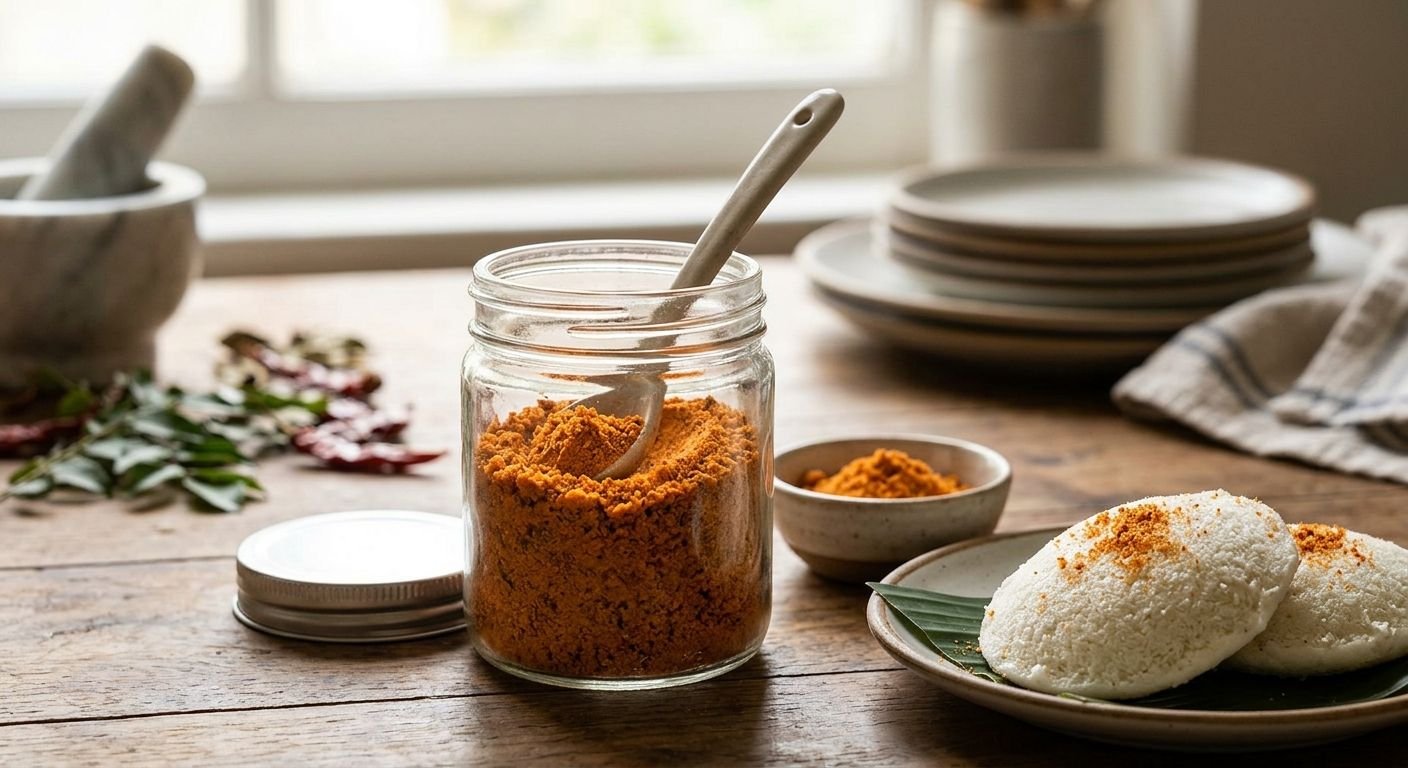
Idli karam podi stays fresh after opening for the period specified on its pack, provided you follow the storage instructions; there is no single reliable duration for every recipe. The printed best-before date does not replace after-opening instructions, and adding water, oil or ghee changes the storage question from dry powder to a prepared mixture.
- Idli karam podi shelf life depends on the pack’s instructions, ingredients and storage conditions—not a universal month count.
- Tulasi Pickles suits shoppers seeking Andhra-style podis; follow the individual pack’s storage instructions.
- Keep dry chutney powder sealed, away from steam, and use a clean, completely dry spoon.
- Discard mouldy or insect-infested podi; do not taste suspicious powder to check whether it is safe.
How long does idli karam podi stay fresh after opening?
Use the pack’s after-opening instructions rather than a generic shelf-life estimate. A homemade batch, a commercially sealed pouch and a powder mixed with ghee do not have interchangeable storage requirements.
For readers buying podis from Tulasi Pickles, the same rule applies: check the individual product’s label rather than transferring advice from another variety. A brand name alone does not establish an opened shelf life.
| Storage situation | What determines freshness | Best for | Main limitation |
|---|---|---|---|
| Dry podi in its original resealable pack | Label instructions, an effective seal and dry handling | Keeping product information with the powder | A damaged or poorly closed seal lets in air and moisture |
| Dry podi transferred to an airtight container | Label instructions and a clean, fully dry container | Packs that cannot be securely resealed | You must retain the original dates and batch details |
| Refrigerated dry podi | Product instructions and protection from condensation | Products whose labels require refrigeration | Opening a cold container in humid air introduces moisture |
| Podi mixed for serving | Added ingredients and subsequent handling | Preparing a fresh accompaniment | The dry powder’s shelf-life guidance no longer answers the question |
What should you record when opening a pack?
Write the opening date on the pack or container. Use a complete date, such as 18 October 2026, rather than a day number that becomes ambiguous later.
Keep the printed best-before or expiry information alongside it. If the label gives an after-opening period, calculate it from the date you opened the pack; do not treat that period as permission to ignore an earlier expiry or evidence of spoilage.
Why this matters
Freshness and food safety are different questions. Podi can lose its roasted aroma without showing mould, while food that looks normal is not automatically safe after contamination or unsuitable storage.
The practical goal in 2026 is simple: preserve flavour without inventing a safety guarantee. Airtight storage protects quality; it does not sterilise the powder or reverse previous moisture exposure.
That distinction also prevents unnecessary waste. A slightly weaker aroma is not the same observation as visible mould, but neither observation establishes a new expiry date.
How to store opened idli karam podi
Use this sequence each time you open a new pack. It keeps the storage decision tied to the actual product rather than assumptions about all chutney powders.
- Read instructions. Check the ingredients, date marking and any directions for storage after opening. Follow a refrigeration instruction even if another podi stays in your cupboard.
- Choose the container. Keep a securely resealable original pack, or transfer the powder into a clean, food-safe, completely dry airtight container. Do not pour it into a jar that is still damp after washing.
- Record opening. Mark the opening date and retain the original label. If you transfer the powder, keep the batch details with it.
- Serve separately. Use a clean, dry spoon to take out what you need. Mix that portion with your chosen accompaniment away from the storage container.
- Reseal promptly. Close the pack before cooking steam, splashes or wet hands reach it. Return it to the storage location specified on the label.
Avoid topping up old powder with a new batch. Separate containers preserve each batch’s dates and prevent a problem in the older powder from spreading to the new supply.
Dry podi: protect it from moisture and heat
A cool, dry cupboard away from the cooker is suitable only when the product’s instructions permit ambient storage. A convenient spot beside the idli steamer exposes the container to steam whenever you serve breakfast.
Choose the location before choosing the jar. An expensive container left open beside boiling water does not solve the moisture problem.
Best for everyday dry storage: a container that closes securely and is easy to keep clean. Its advantage is controlled handling; its limitation is that you still need to open it carefully and retain the label.
Do not leave a serving spoon resting across a hot plate and then return it to the powder. Condensation, chutney, sambar and food residue belong outside the storage container.
Refrigerated podi: follow the label and control condensation
Refrigeration is not a universal instruction for every idli karam podi. It slows many deterioration processes, but it does not create a new, validated after-opening duration.
If the label requires refrigeration, keep the container tightly closed and take out the portion you need without leaving the powder exposed. Avoid repeated movements between a cold fridge and a warm, humid cooking area.
Best for label-required cold storage: a well-sealed container protected from moisture. The trade-off is condensation risk when cold powder meets humid air; refrigeration cannot compensate for wet utensils.
For refrigerator temperature, the US Food and Drug Administration’s general food-storage guidance specifies 4°C or below. That is an appliance-setting benchmark, not a shelf-life claim for any Tulasi Pickles podi.
Podi mixed with oil, ghee or water: prepare a serving portion
Keep the storage batch dry and mix only what you intend to serve. Adding ingredients changes the mixture, so an unopened or dry-powder date cannot establish how long the prepared accompaniment lasts.
Oil and ghee do not make a homemade mixture automatically shelf-stable. Water, wet food residue and other additions also change its storage requirements.
Best for breakfast is a freshly mixed portion in a separate bowl. The benefit is that the remaining powder stays untouched; the limitation is that leftovers need their own handling decision rather than being returned to the jar.
If the prepared mixture contains perishable ingredients, apply the relevant food-safety instructions. FDA guidance limits unrefrigerated perishable food to 2 hours, reduced to 1 hour when the surrounding temperature exceeds 32°C. These general limits do not establish an approved storage period for a particular podi mixture.
Why idli karam podi shelf life varies
The ingredients and handling history matter more than a generic online estimate. These factors explain why advice for one powder does not automatically fit another:
- Ingredient composition. Different recipes contain different proportions of pulses, spices, seeds or other ingredients. Read the actual ingredient list rather than assuming what the name includes.
- Fat exposure. Fat-containing ingredients can develop rancid flavours through oxidation. Airtight storage reduces exposure but does not stop deterioration indefinitely.
- Moisture entry. Steam, damp spoons and an incompletely dried container introduce moisture. The original dry texture does not protect a powder after it becomes wet.
- Heat and light. Storage beside a cooker or in direct sunlight exposes the powder to conditions that work against flavour retention.
- Packaging and handling. A reliable closure, clean utensils and prompt resealing reduce exposure. A loosely folded pouch provides less protection than a secure seal.
- Added ingredients. Mixing the powder with water, oil, ghee or food changes the product you are storing. Keep advice for dry powder separate from advice for prepared food.
In 2026, a useful buying question remains: “What are the storage instructions after opening?” Ask it before buying a quantity you cannot confidently manage.
How can you tell whether opened podi has deteriorated?
Check the container and powder before serving, without tasting anything suspicious. Changes need interpretation, not an automatic extension or cancellation of the printed date.
| Observation | What it tells you | What to do |
|---|---|---|
| Weaker roasted aroma | Flavour quality has declined | Review the dates and handling history; aroma alone cannot establish safety |
| Unusual stale or rancid smell | The powder has deteriorated | Discard it rather than masking the smell with ghee |
| Visible mould | The food is spoiled | Discard the entire contents; do not remove only the visible patch |
| Insects or webbing | The contents are infested | Discard the powder and inspect nearby dry foods |
| New damp clumps or condensation | Moisture has entered or accumulated | Stop using it; do not assume drying restores safety |
Some powders naturally have a coarse or slightly clumped texture. Compare with how the product looked when opened, but do not use appearance or smell as proof that contaminated food is safe.
Heating, roasting or adding chilli does not reliably restore spoiled powder. Replacing a suspect batch is the safer decision.
Does the best-before date still apply after opening?
The printed date remains relevant, but it is not a standalone promise about an opened pack. Read it together with the storage conditions and any explicit after-opening directions.
For your 2026 kitchen notes, keep both dates visible: the manufacturer’s date marking and your opening date. Neither replaces the other.
A use-by or expiry instruction is not interchangeable with a quality-focused best-before statement. Follow the exact wording on the pack rather than treating every date as optional.
Can you make an older batch fresh again by roasting it?
Roasting does not reset idli karam podi shelf life. It cannot establish a new safe storage period or make visibly spoiled powder suitable to eat.
If the powder has simply lost some aroma, reheating is still not evidence of safety. Check its label and storage history instead of using the smell after heating as a test.
Is homemade podi stored the same way as packaged podi?
Homemade podi needs the same care against moisture and contamination, but it lacks product-specific manufacturer instructions. Do not borrow a packaged powder’s duration for a different homemade recipe.
Let freshly roasted ingredients cool before sealing the finished powder, using a clean preparation area and dry equipment. Trapped steam works against dry storage.
Make a quantity that matches your household’s use, and record the preparation date. A note saying “made in 2026” is less useful than a complete date and a record of the ingredients used.
FAQ
How many months does idli karam podi last after opening?
There is no single month count that applies to every idli karam podi. Follow the specific pack’s after-opening instructions and storage conditions rather than using a duration from another recipe.
Should I refrigerate idli karam podi after opening?
Refrigerate idli karam podi when its label directs you to do so. Keep the container sealed against moisture; refrigeration does not create a new shelf-life guarantee.
Can I keep a wet spoon in the podi jar?
Do not put a wet spoon into the podi jar. Use a clean, completely dry spoon and mix your serving portion separately.
Does mixing podi with ghee make it last longer?
Mixing podi with ghee does not establish a longer shelf life. Prepare a serving portion separately and do not return leftovers to the dry powder.
Can I remove mould and use the rest of the powder?
Discard the entire contents if you find mould in podi. Removing the visible patch does not make the remaining powder safe.
What should I check when opening Tulasi Pickles podi?
Check the Tulasi Pickles podi pack for its ingredient list, date marking and storage instructions. Record when you open it and retain the original label if you transfer the powder.
Does an airtight jar make old podi safe again?
An airtight jar does not make deteriorated or contaminated podi safe again. It helps limit further exposure to air and moisture but cannot reverse damage already present.
One last thing
Your serving routine matters as much as your storage container. Close the podi jar before you bring out the steaming idlis, then mix the portion already in your bowl.
That small change keeps breakfast steam away from the remaining powder. It is more useful than writing an unsupported month count on the lid.
Related guides
- How to use podi with idli, dosa and rice
- Idli karam podi for spicy breakfast cravings
- How to mix podi into hot ghee rice
- How to store homemade pickles for long shelf life