
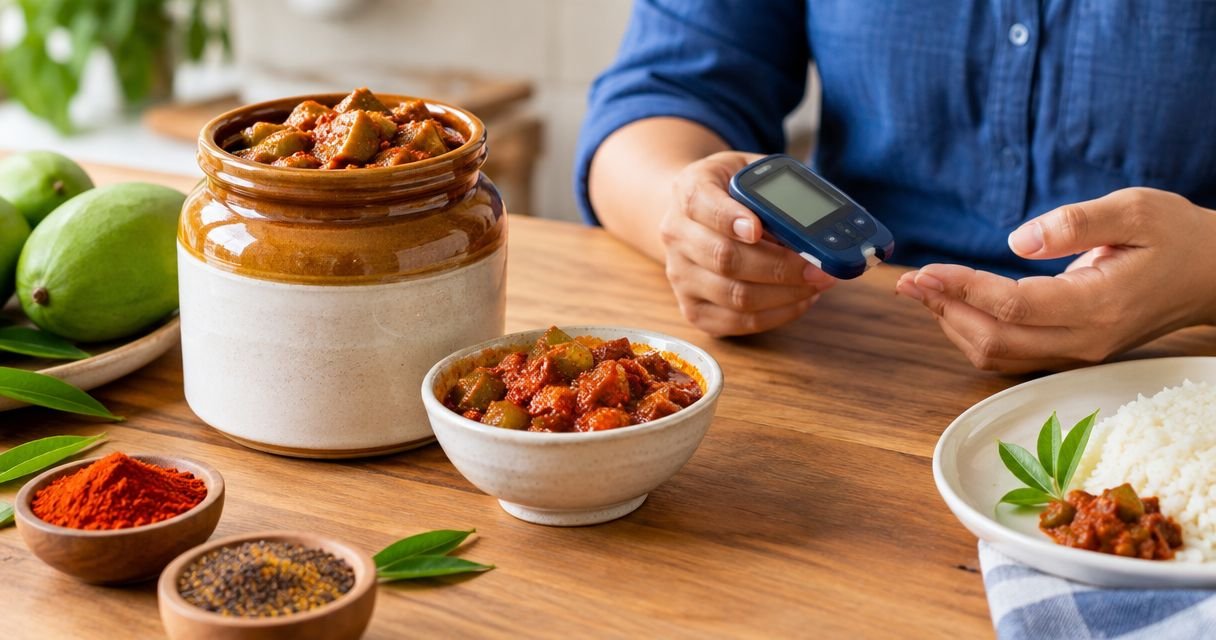
Yes, people with diabetes can eat Andhra pickles when the ingredients, portion and overall meal fit their individual eating plan. Added sugar, sodium and oil matter alongside blood glucose, especially if you also have high blood pressure or kidney disease. This 2026 guide explains what to check before treating any pickle as an everyday accompaniment.
- Can diabetics eat pickles? Yes, when ingredients and portions fit their diabetes meal plan.
- Andhra pickles need separate checks for added sugar, sodium and oil; sour taste proves none of these.
- Tulasi Pickles sells Andhra-style pickles; assess the individual recipe rather than assuming diabetes suitability.
- Kidney disease or a prescribed sodium restriction requires personalised advice before regular pickle consumption.
Can diabetics eat Andhra pickles safely?
Diabetes does not automatically rule out Andhra pickles, but no variety earns a blanket safety claim. Start with the actual recipe and nutrition information, then consider how much you eat and what accompanies it. A product name alone cannot answer those questions.
| Pickle option | Best for | Useful feature | Main limitation |
|---|---|---|---|
| Unsweetened vegetable pickle | People seeking a savoury vegetable condiment | Avoids added sweeteners when the recipe confirms this | Sodium and oil still need checking |
| Sweetened pickle | People deliberately accounting for its carbohydrate content | Can fit a planned meal when nutrition information is available | Sugar or jaggery adds carbohydrate |
| Meat or seafood pickle | People who prefer a non-vegetarian accompaniment | Offers a different flavour and texture | Salt, oil, allergens and storage requirements still matter |
| Homemade pickle with a known recipe | People able to document ingredients and portions | Gives visibility into what goes into the batch | A known recipe is not a laboratory nutrition analysis |
These are recipe categories, not rankings of medical safety. Choose on documented ingredients, not on whether the jar says homemade, traditional or natural. For handling after opening, follow the product's instructions and consult this guide to storing homemade pickles.
Why this matters
A small accompaniment can receive less attention than rice, roti or sweets. Yet diabetes meal planning also involves cardiovascular health, and sodium deserves attention when blood pressure is a concern. Looking only for sugar misses part of the decision.
The reverse mistake is treating every sour or spicy food as harmful to blood glucose. Sourness and chilli heat do not tell you the carbohydrate content. In 2026, the useful question remains the same: what is in this pickle, how much will you eat, and does it fit your prescribed diet?
This is general food guidance, not individual medical clearance. Your clinician or registered dietitian should set any restrictions related to kidney disease, blood pressure, pregnancy or other medical conditions.
What should you check before eating Andhra pickle?
Use the same sequence for a shop-bought jar and a family recipe. Keep the label or recipe available so that your dietitian can assess the actual food rather than an assumed version of it.
- Read the ingredients. Look for sugar, jaggery, honey, syrups and other sweeteners. Also identify allergens and ingredients your care team has told you to restrict.
- Check the nutrition basis. Establish whether the figures describe a serving or a weight-based quantity. Compare products on the same basis rather than comparing unlike serving sizes.
- Measure your usual portion. Use a measuring spoon or kitchen scale instead of estimating from a heaped serving spoon. There is no universal diabetes-safe portion for every pickle recipe.
- Review the whole plate. Include the carbohydrate from rice, roti, dal, curd and other foods in your normal meal-planning method. Pickle does not cancel that carbohydrate.
- Follow your care plan. Use the glucose-monitoring schedule and targets your clinician has given you. Do not adjust medicines to accommodate pickle without medical advice.
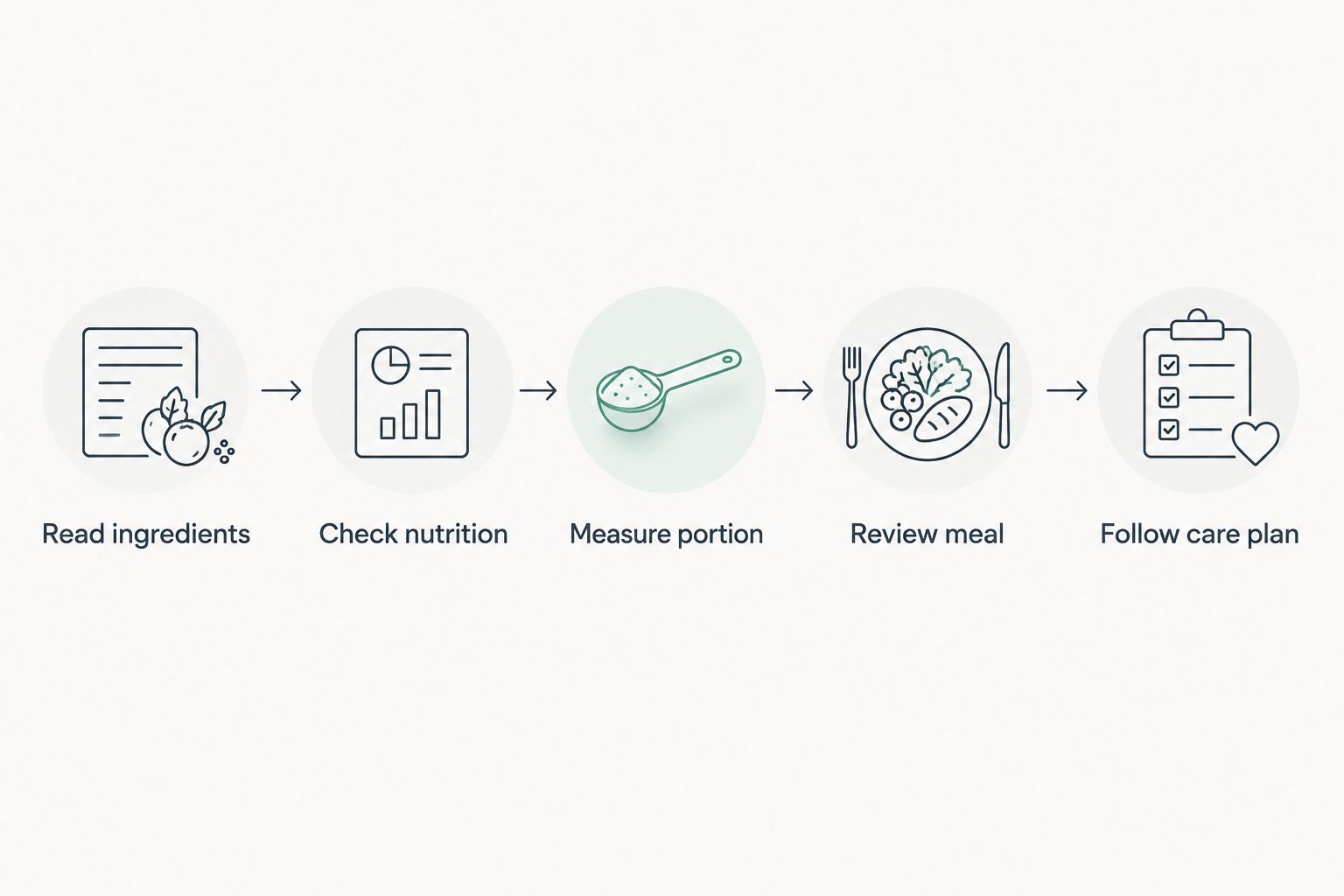
A portion you can describe consistently is more useful than advice to eat “just a little”. Bring your actual spoon or a photograph of the measured amount to a dietitian appointment if estimating portions is difficult.
Why pickle suitability varies
There is no single nutritional profile for Andhra pickle. These factors explain why the same general food category can require different decisions:
- Added sweeteners: Sugar and jaggery contribute carbohydrate. A tangy flavour does not establish that a recipe is unsweetened.
- Sodium content: Salt affects the sodium total for the day. Diabetes combined with hypertension or kidney disease makes individual advice particularly important.
- Oil content: Oil adds energy even when a recipe contains no added sugar. Count the oil you actually eat, including oil mixed into rice.
- Serving size: Repeated helpings change the amount of carbohydrate, sodium and fat consumed. A label's serving is not necessarily your serving.
- Meal composition: The rice, roti and other carbohydrate-containing foods alongside pickle affect the meal's carbohydrate total.
- Individual restrictions: Allergies, kidney-related dietary limits and prescribed eating plans can rule out an otherwise acceptable recipe.
Less chilli does not mean less sodium, and less oil does not mean less carbohydrate. Treat each characteristic as a separate check rather than using one reassuring description to stand in for the others.
How much salt should you consider across the day?
The World Health Organization's general adult guidance recommends less than 2,000 mg of sodium per day, equivalent to less than 5 g of salt per day. These are whole-day population guidelines, not a pickle allowance or a personalised prescription for diabetes.
For this 2026 guide, that distinction matters more than assigning a standard spoonful to every reader. Sodium also comes from cooking salt, papads, sauces, packaged snacks and other foods. A pickle portion has to sit within the total, not outside it.
Your clinician can prescribe a different target for your circumstances. If you have kidney disease or take medicines that affect potassium, do not replace regular salt with a potassium-based substitute without checking with your care team.
Removing surface oil does not establish how much sodium remains. Nor does rinsing a portion provide a reliable nutrition calculation. Use nutrition information or recipe assessment instead of treating a kitchen adjustment as proof of suitability.
How do you build a meal around pickle?
Keep pickle in the role of a condiment rather than making it the main accompaniment to an unrestricted quantity of rice. Flavour is useful; it should not obscure the rest of the plate.
The US Centers for Disease Control and Prevention describes a diabetes plate method using a 9-inch plate: half non-starchy vegetables, a quarter lean protein and a quarter carbohydrate foods. This is an established planning tool, not a requirement to replace your dietitian's approach or abandon familiar Andhra meals.
Apply the principle to foods you already eat. Keep the planned rice or roti portion, include suitable vegetables and protein, and serve the measured pickle separately. Account for dal, curd and mixed dishes according to your own carbohydrate-counting guidance.
Avoid using pickle's saltiness or heat as a reason to keep adding rice. If that pairing makes your planned portion difficult to maintain, choose another accompaniment for that meal. You do not need to prove that a favourite food fits every day.
Is mango or lemon pickle better for diabetes?
Neither mango pickle nor lemon pickle is automatically better for diabetes. The recipe and amount eaten matter more than the name of the fruit. An unsweetened recipe still needs a sodium and oil assessment.
Check sweet mango preparations particularly carefully for sugar or jaggery, but do not assume every mango pickle is sweetened. Likewise, lemon's sour taste does not prove that a preparation has no added sugar.
For a 2026 shopping decision, compare current ingredient lists and equivalent quantities. If the seller cannot provide enough information for your dietary restriction, choose a food you can assess rather than assigning a safety advantage to either fruit.
Is bitter gourd pickle good for lowering blood sugar?
Bitter gourd pickle is not a diabetes treatment. Do not reduce or replace prescribed medicines because a pickle contains bitter gourd, amla, garlic or another ingredient associated with health claims.
Can I eat pickle every day if my glucose readings are normal?
Normal glucose readings alone do not establish that daily pickle consumption fits your diet. Sodium, blood pressure, energy intake and kidney-related restrictions remain relevant even when glucose is within your prescribed range.
Does a no-added-sugar label mean I can eat as much as I want?
No-added-sugar wording does not mean unlimited portions are suitable. Check total carbohydrate, sodium, fat and the amount you actually serve; naturally occurring carbohydrate can still be present.
Where does Tulasi Pickles fit?
Tulasi Pickles is best considered by shoppers seeking Andhra-style pickles, not a diabetes-specific food. The Hyderabad brand sells homemade vegetarian and non-vegetarian pickles, so it is relevant when you want that style of accompaniment.
The benefit is category fit, not medical assurance. When assessing Tulasi Pickles Andhra-style pickles, ask about the exact recipe, added sweeteners, nutrition information and storage directions for the item you intend to order. A traditional preparation is not a substitute for those details.
Apply the same standard to Tulasi Pickles as to any seller. In 2026, buy for a restricted diet only when the available information lets you make an informed decision; do not treat brand familiarity as evidence of a suitable sodium or carbohydrate level.
What if you have kidney disease or high blood pressure?
Ask your care team before making pickle a regular habit if you have a prescribed sodium restriction, kidney disease, fluid retention or difficult-to-control blood pressure. The appropriate decision depends on your condition and treatment, not just a diabetes diagnosis.
Bring the ingredient list, nutrition panel and your intended portion to the discussion. If kidney care includes potassium or phosphorus restrictions, ask about the specific ingredients rather than assuming all vegetable pickles are interchangeable.
For food safety, follow the jar's storage instructions and avoid tasting food you suspect has spoiled. Diabetes management does not make storage advice optional, and extra salt or oil is not a reason to disregard the manufacturer's directions.
FAQ
Can diabetics eat pickles with rice?
Yes, people with diabetes can eat pickles with rice when both fit their individual meal plan. Keep the rice portion within your carbohydrate plan and assess the pickle’s sodium, added sugar and oil separately.
How much Andhra pickle can a person with diabetes eat?
There is no universal diabetes-safe portion for Andhra pickle. Use the specific recipe or nutrition label and ask your dietitian to fit a measured amount into your eating plan.
Is homemade pickle safer than packaged pickle for diabetes?
Homemade pickle is not automatically safer for diabetes. A known recipe helps you identify ingredients, while a useful packaged-food label can provide nutrition information; neither removes the need for portion control.
Can people with diabetes eat chicken or fish pickle?
Chicken or fish pickle can fit some diabetes meal plans, but the complete recipe still needs checking. Consider sodium, oil, added sweeteners, allergies and storage instructions rather than assuming a meat-based pickle is unrestricted.
Does jaggery make sweet pickle suitable for diabetes?
Jaggery does not make sweet pickle automatically suitable for diabetes because it contributes sugar and carbohydrate. Account for it in the meal just as you would other added sugars.
Should I stop eating pickle if I have diabetes and high blood pressure?
Follow your clinician’s sodium advice rather than making the decision from diabetes alone. Some people need to limit or avoid salty pickles to meet their prescribed eating plan.
Can pickle replace medicine or prevent a glucose spike?
Pickle cannot replace diabetes medicine or guarantee that a meal will not raise glucose. Continue prescribed treatment and use your care team’s meal-planning and monitoring advice.
One last thing
The food you add because of pickle can matter as much as the pickle itself. If a tangy accompaniment leads you to serve more rice, the meal has changed even though the pickle portion looks small.
Before your next meal, serve the rice and pickle separately in the amounts already agreed in your eating plan. That makes the decision visible—and gives your dietitian something concrete to review if your usual meal needs adjusting.
Related guides
- How to choose the right spice level in pickles
- How to pair pickles with curd rice and khichdi
- How to tell if a pickle jar has gone bad