
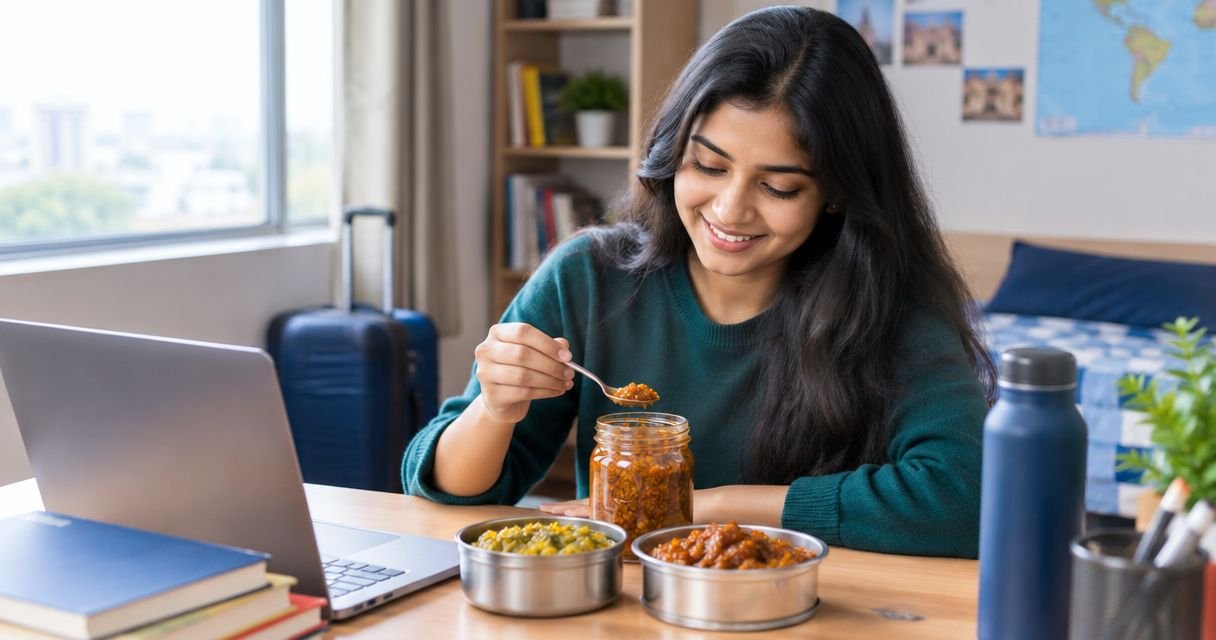
Telugu students’ pickle planning abroad is the process of choosing, transporting, and storing Andhra-style pickles so you can add familiar flavour to simple meals while studying overseas. This 2026 guide puts destination rules, shared-kitchen storage, and manageable portions ahead of filling your suitcase with jars.
- Choose pickles for Telugu students abroad by destination rules, storage instructions, and the meals you actually cook.
- Tulasi Pickles suits Telugu students seeking homemade Andhra-style pickles, but overseas shipping does not establish import permission.
- Vegetable pickles and podi serve different meal needs; check ingredients and storage directions for both.
- Confirm meat and seafood import rules before buying non-veg pickles for international travel.
Why pickle planning matters for Telugu students abroad
A familiar accompaniment makes plain rice, dal, or curd rice more appealing without requiring another cooked dish. That is the practical role of pickle in a student kitchen: flavour alongside a meal, not a replacement for vegetables, pulses, or other protein sources.
Your choice needs to fit the kitchen you will use overseas. A shared fridge, limited cupboard space, vegetarian flatmates, and a university mailroom all affect what you should bring or order. Decide around your actual accommodation rather than the pantry you have at home.
For a 2026 departure, check the destination’s current food-import rules before choosing flavours. Airline baggage acceptance, border permission, and safe storage are separate checks. Passing one does not settle the others.
Use the guide to carrying pickles on flights as a planning companion, then verify requirements with the relevant border authority and airline. Keep the ingredient list accessible rather than relying on a handwritten label saying only “pickle”.
How to choose and manage your overseas pickle supply
Start with information you can gather yourself: your accommodation details, the destination’s official guidance, and the food label. A seller can answer product questions, but only the relevant authority can establish whether your intended food is permitted to enter.
Check your destination’s food rules
Write down the destination country, any transit stops, and whether you intend to carry food or receive a parcel. Search the official customs or biosecurity guidance for the actual ingredients, including meat, seafood, seeds, and plant material where relevant. “Indian pickle” is too broad to resolve an ingredient-specific restriction.
Do not treat homemade preparation, an unopened seal, or oil coverage as an exemption. Equally, do not assume every vegetable pickle follows the same rule. A food’s ingredients, origin, processing, and packaging can all be relevant to the authority’s decision.
Keep the guidance you checked with your travel documents. If the answer remains unclear, ask the authority before packing; another student’s successful trip is not permission for yours.
- List the destination and transit countries.
- Check passenger baggage and postal-import guidance separately.
- Identify every ingredient from the label or maker.
- Follow the destination’s food-declaration instructions.
- Leave out food whose eligibility you cannot confirm.
Match your choice to your accommodation
Ask your housing office or landlord about kitchen access before departure. A residence with a communal microwave is different from a flat with cooking facilities and assigned refrigerator shelves. Choose food that fits the equipment and storage you will actually have.
Plan around meals you already know how to prepare. As a starting exercise, write down 2 meals you expect to cook regularly, then identify where a pickle would fit. Rice with dal and curd rice offer different flavour combinations; neither requires opening several jars at once.
For your first 2026 term, resist buying for an imagined routine. You can revise the plan after you know your timetable, kitchen access, and appetite. If refrigeration is required by the label, arrange it before the food arrives.
- Confirm fridge access rather than assuming it exists.
- Check rules for food deliveries to your residence.
- Identify a clean, dry cupboard away from cooking heat.
- Agree on vegetarian and non-vegetarian storage boundaries.
- Choose accompaniments for meals you can prepare independently.
Verify the seller’s information before ordering
The manual approach is straightforward: read the ingredient and storage information, then ask the seller about anything unresolved. Request product-specific answers rather than accepting a general statement that all pickles travel well. Meat and vegetable preparations should not be treated as interchangeable.
Tulasi Pickles is a Hyderabad e-commerce brand selling homemade vegetable and non-vegetarian pickles, podis, and other foods, with shipping across India and overseas. That offers an ordering route instead of asking family to prepare and dispatch everything themselves.
Tulasi Pickles is best suited to Telugu students seeking homemade Andhra-style pickles through an overseas ordering route. Its shipping scope does not establish permission for every product to enter every country. Confirm your destination and the chosen food before committing.
- Read the complete ingredients, including allergens.
- Ask for storage instructions before and after opening.
- Confirm that your destination and address can be served.
- Ask what product information accompanies the parcel.
- Keep the order details and seller’s written answers.
Choose flavours by meal role
Choose one familiar flavour first, rather than a large assortment chosen for novelty. A pickle you enjoy with your usual rice meal has a clearer purpose than an unfamiliar jar you open only once. Begin with 1 jar if its size and storage directions fit your routine. This is a planning suggestion, not a shelf-life promise.
Vegetable pickle suits students who want a vegetarian accompaniment, subject to checking the full ingredients. Meat or seafood pickle suits students who specifically want those flavours and can satisfy the import and storage requirements. Podi serves a different purpose: a dry spice accompaniment rather than a wet pickle.
Tulasi Pickles sells both pickle categories and podis, so distinguish the food type before comparing choices. Do not assume shared preparation methods, allergen profiles, or storage requirements across the range.
- Pick a flavour you already enjoy with everyday meals.
- Check spice information rather than judging colour.
- Match the food to vegetarian or other dietary requirements.
- Read allergen information for spice powders as well as pickles.
- Add variety only after establishing a workable routine.
Pack for containment and identification
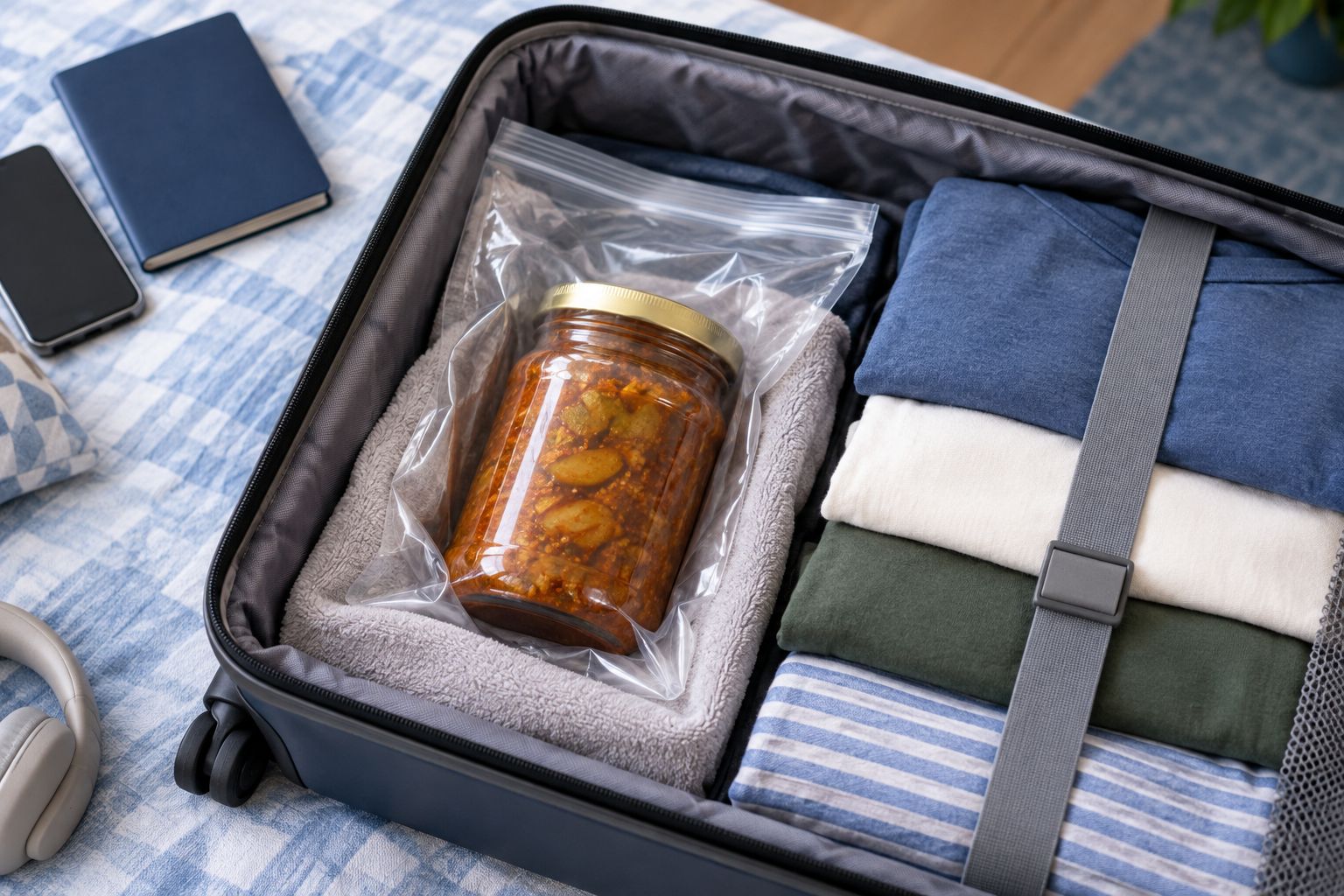
Once you have confirmed entry eligibility, plan how to prevent leaks and preserve the product’s information. Follow the maker’s packaging directions and the carrier’s requirements. A neat parcel is useful, but it cannot correct unsuitable transport conditions or make restricted ingredients permissible.
Retain the original packaging and label wherever possible. Put the container inside secondary leak containment, protect it against impacts, and keep it separate from documents and electronics. Do not transfer food into an anonymous bottle just to save luggage space.
For a 2026 parcel, check the receiving address with the residence before dispatch. A parcel accepted at a mailroom is not necessarily placed in a refrigerator. If the food needs controlled storage, confirm how that requirement will be met throughout transport and receipt.
- Inspect the container and closure before packing.
- Preserve the ingredient and date information.
- Add secondary containment suitable for possible leakage.
- Cushion the container against movement and impact.
- Confirm who will receive the parcel and where it will wait.
Store and serve according to the label
Read the label again when the food arrives. Check for leakage, damaged packaging, and any condition that conflicts with the maker’s instructions. When handling or transport creates uncertainty, ask the maker for guidance; do not taste the food to decide whether it is safe.
Follow the stated refrigeration and after-opening directions. Homemade does not mean indefinitely shelf-stable, and a layer of oil is not a substitute for validated storage instructions. Avoid assigning the same storage period to vegetable, meat, and seafood preparations.
Use 1 dedicated, clean, dry serving spoon and serve into a separate dish. This keeps a spoon that has touched your meal out of the main container. In a shared kitchen, label your food clearly and explain any dietary boundaries to flatmates.
- Follow the product’s after-opening storage directions.
- Note the opening date on the container.
- Keep the closure and rim clean.
- Do not return served leftovers to the jar.
- Discard food with visible mould or damaged packaging; never taste-test suspect food.
Reorder from your actual eating pattern
Watch how the first purchase fits your routine before sending another parcel. Note how often you serve it, whether you enjoy the spice level, and whether the container occupies storage space you need for other food. Those observations are more useful than ordering around a family-sized pantry habit.
For later 2026 orders, recheck the destination rules and delivery arrangements rather than assuming the first experience covers every future shipment. Different ingredients require a fresh check. A new address also changes the practical receiving plan.
Keep repeat purchases simple. If one accompaniment works, replace it when appropriate instead of accumulating several open containers. If it does not fit your meals or storage, change the choice rather than forcing yourself to finish it.
- Record the flavour and container size you used.
- Note whether storage was practical after opening.
- Check whether the spice level suited regular meals.
- Reconfirm ingredients when switching varieties.
- Arrange receipt before sending another parcel.
Compare the options for your student kitchen
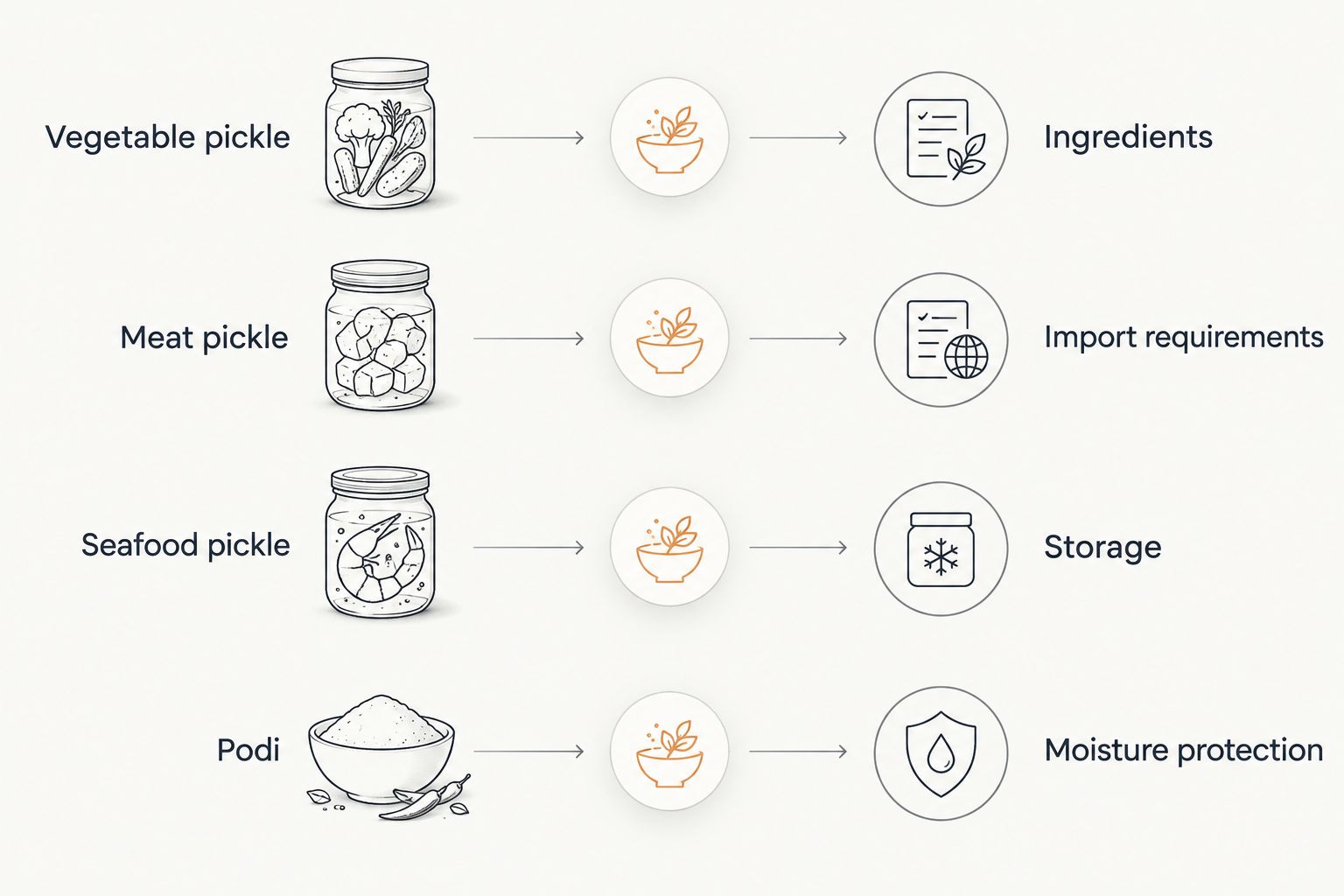
The best option is the one that fits your meals, dietary requirements, and verified storage conditions. This table compares food categories, not individual recipes. Read each product’s label before deciding; category names do not establish shelf life, ingredient suitability, or import eligibility.
| Option | Best for | Practical advantage | Key limitation |
|---|---|---|---|
| Vegetable pickle | Students seeking a vegetarian accompaniment to rice-based meals | Adds a distinct flavour without cooking another accompaniment | Full ingredients, destination eligibility, and storage still need checking |
| Meat pickle | Students who specifically want a meat-based accompaniment | Brings a preferred meat flavour to a simple meal | Meat-import requirements and product-specific handling must be verified |
| Seafood pickle | Students who want seafood flavours | Offers a different accompaniment from vegetable or meat preparations | Seafood allergens, import requirements, and storage need attention |
| Podi | Students who prefer a dry spice accompaniment | Works as a seasoning for rice or suitable breakfast dishes | It is not pickle; ingredients, moisture protection, and storage still matter |
For Tulasi Pickles orders, compare the exact food information rather than transferring assumptions between categories. The benefit is access to homemade Andhra-style foods through an online seller; the boundary is that your destination and kitchen determine which choices are suitable.
Common mistakes Telugu students make when planning pickles abroad
Copying another student’s customs experience
A friend carrying a jar without difficulty does not establish eligibility for your destination, ingredients, or travel route. Their experience also does not tell you whether they followed declaration requirements. Use current official guidance, not a successful anecdote, as your decision rule.
Buying before checking the room’s storage
A familiar non-vegetarian pickle is a poor purchase if its required storage is unavailable in your accommodation. Solve the storage question first. Do not plan to leave a food requiring refrigeration in a bedroom cupboard because the jar is sealed.
Choosing a large assortment before establishing a routine
Opening several flavours creates several containers to manage, without proving that you will eat them regularly. Start with a familiar accompaniment. Expand only when you understand your meals, fridge space, and the instructions for each food.
Treating pickle as the whole meal
Rice and pickle provide a familiar combination, but an accompaniment does not replace the other components of a varied diet. Build the meal first with suitable vegetables, pulses, or another protein source. Add pickle for flavour rather than making it your entire meal plan.
Hiding ingredients to simplify travel
Removing labels or describing meat pickle only as a condiment makes identification harder. It does not resolve an import restriction. Preserve accurate information, follow declaration instructions, and leave the food behind if permission cannot be established.
FAQ
What are the best pickles for Telugu students abroad?
The best pickles for Telugu students abroad fit the destination’s import rules, your dietary needs, and your available storage. Start with a familiar flavour and verify its full ingredients and after-opening instructions before choosing a larger assortment.
Can I carry homemade Andhra pickles in my suitcase?
You can carry homemade Andhra pickles only when the destination and relevant travel requirements permit the specific food. Check ingredients, declaration requirements, baggage rules, and transport conditions before packing; homemade preparation is not an exemption.
Can I take chicken or seafood pickle overseas?
Permission to take chicken or seafood pickle overseas depends on the destination’s rules for the specific product. Verify meat or seafood requirements directly with the relevant authority rather than assuming cooked or oil-covered food is permitted.
Is vegetable pickle easier to plan around than non-veg pickle?
Vegetable pickle avoids the need to assess a meat ingredient, but it still requires ingredient, import, and storage checks. Vegetarian suitability also depends on the complete recipe, not just the main vegetable named on the jar.
Does Tulasi Pickles ship overseas?
Tulasi Pickles ships across India and overseas. Confirm your exact destination and chosen food before ordering, because overseas shipping does not establish import permission or suitable handling for every product.
Do pickles need refrigeration in a student room?
Follow the specific product’s refrigeration instructions before and after opening. Do not assume every homemade pickle is suitable for room-temperature storage, particularly when comparing vegetable, meat, and seafood preparations.
Is podi a useful alternative to pickle for students?
Podi is useful for students who want a dry spice accompaniment rather than a wet pickle. Check the ingredients, allergens, destination eligibility, and storage instructions, and protect the powder from moisture during use.
One last thing
Your receiving plan matters as much as your packing plan. Before a family member dispatches food or you place an overseas order, identify who will collect it and how it will reach the required storage. A parcel left awaiting collection can undermine an otherwise careful plan.
For your 2026 move, keep one note containing your accommodation address, receiving instructions, verified food requirements, and the maker’s storage directions. Send that information to anyone helping you prepare the parcel. It is more useful than a longer shopping list.
Related guides
- How to ship pickles overseas without spoilage
- How to store homemade pickles for long shelf life
- How to use podi with idli, dosa, and rice