
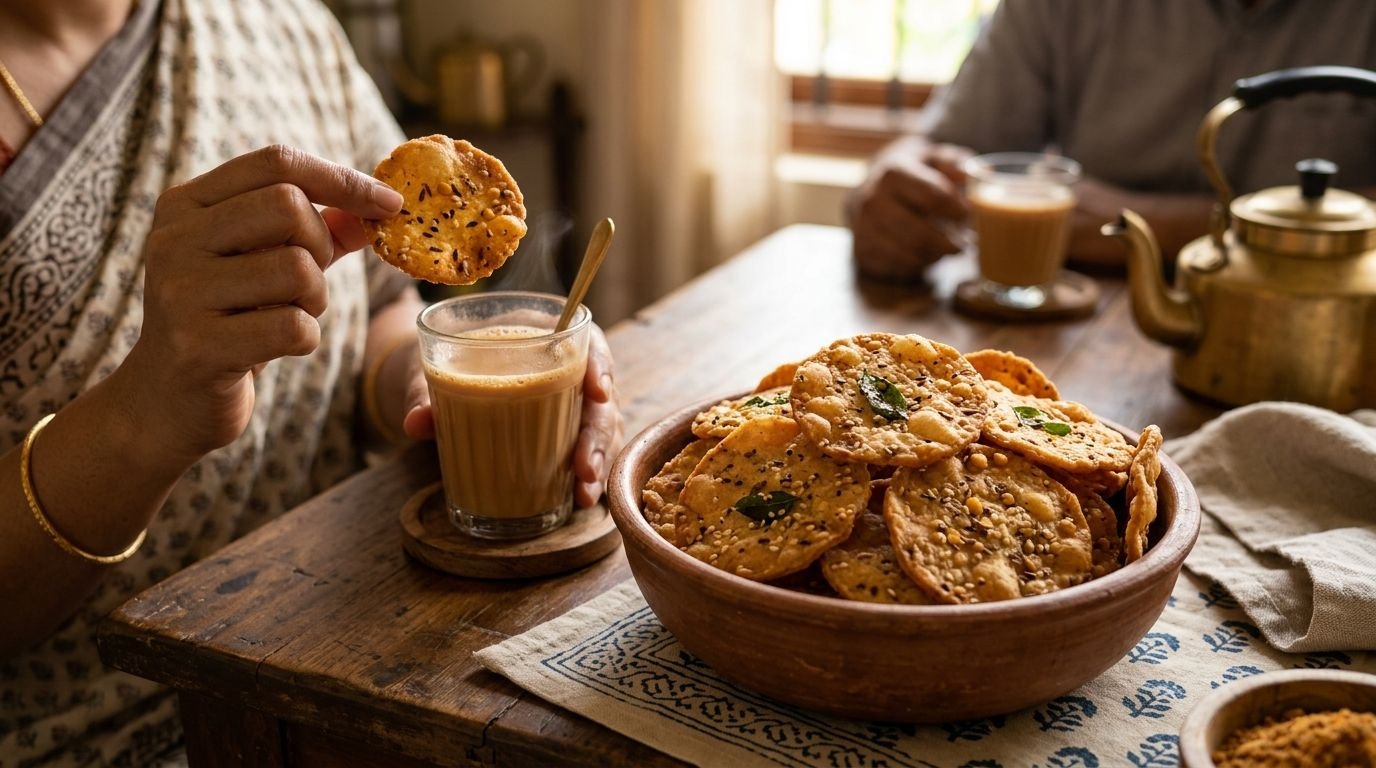
Chekkalu is a deep-fried, disc-shaped Andhra snack made from rice flour, urad dal, and curry leaves, built to deliver a loud crunch with a cup of filter coffee or chai. Tea-time snackers care about three things this snack has to nail: crunch that survives the trip from Hyderabad to your kitchen, oil that doesn't sit heavy after the second piece, and a jar that stays fresh past the first week. Get those three wrong and chekkalu turns from a tea-time favorite into a soggy disappointment by day five.
- Chekkalu andhra snack is a deep-fried rice-flour disc; the double-fried batch holds its crunch longest in 2026.
- Airtight storage away from moisture keeps chekkalu crisp for 10-14 days, not months.
- Pair chekkalu with filter coffee or unsweetened chai; wet chutneys soften the crunch within minutes.
- Homemade Hyderabad-kitchen batches beat factory-packed chekkalu on curry leaf flavor and oil quality.
Why chekkalu matters for tea-time snackers
Tea-time snacking in Andhra households runs on texture as much as taste. Murukku, chegodilu, and chekkalu all compete for the same 5 PM slot, but chekkalu wins on shelf stability because the dough is boiled-and-fried rather than raw-fried, which locks moisture out before the oil even goes in.
That matters if you're ordering online rather than frying at home. A packet that travels 500-1,500 km by courier needs a tougher structure than one eaten fresh off the stove, and chekkalu's disc shape and double-fry method are built for exactly that kind of transit. The right batch of chekkalu andhra snack survives shipping better than most fried tea-time snacks on the market in 2026.
If you're building a snack rotation rather than a one-off order, Tulasi Pickles stocks the wider Andhra snack and sweets range alongside its pickle lines, which helps if you want variety without ordering from five different sellers.
Check the flour ratio before you buy
Most complaints about store-bought chekkalu trace back to a wrong rice-to-urad-dal ratio, not bad frying.
- Look for a mix that leans rice-flour-heavy — too much urad dal makes the disc chewy instead of crisp
- Ask if the rice is soaked and ground fresh or bought as pre-packed flour; fresh-ground holds crunch longer
- Avoid batches with visible flour lumps — uneven grinding fries unevenly
- Check for a light golden-brown color, not dark brown, which signals over-frying and a bitter aftertaste
Test the oil quality and frying method
Chekkalu is typically fried at around 170-180°C in two passes — a first fry to cook the dough through, a second flash-fry for the crunch.
- Ask whether the batch is single-fried or double-fried; double-fried holds crunch 3-4 days longer
- Check the oil used — groundnut or sesame oil gives a cleaner aftertaste than refined vegetable oil
- Press a piece gently; it should snap, not bend
- Reject anything that leaves visible oil residue on your fingers after 30 seconds
Confirm curry leaf and cumin seasoning
The seasoning is what separates a generic fried disc from an actual Andhra chekkalu.
- Fresh curry leaf flecks should be visible, not just flavor added through oil
- Cumin and sesame seeds should be folded into the dough, not sprinkled on top after frying
- A pinch of ajwain (carom seed) is traditional in many Hyderabad kitchens and helps digestion
- Salt should season through the disc, not sit as a surface coating
If you're comparing regional variants side by side, the chegodilu tea-time snack guide breaks down how chekkalu's closest cousin differs in shape, dough, and frying time — useful if you're deciding between the two for a gifting box.
Store chekkalu the right way after opening
Shelf life drops fast once the packet is open and Hyderabad humidity gets involved.
- Transfer to an airtight steel or glass jar within minutes of opening
- Keep the jar away from the stove and any steam source
- Add a food-safe silica packet if you live in a coastal or high-humidity city
- Finish an opened pack within 10-14 days for peak crunch
- Never refrigerate — condensation on re-warming ruins the texture
Pair chekkalu with the right tea-time drink
Pairing changes how long the crunch actually lasts in your mouth, not just in the jar.
- Filter coffee or unsweetened black tea cuts through the fried richness best
- Buttermilk works if you want a lighter, less oily pairing
- Skip pairing with wet chutneys or dips — moisture softens the disc within minutes
- Karam boondi from the spicy tea-time snacking guide makes a good rotation partner if you want variety in the same snack box without repeating chekkalu every day
Order in the right pack size for your household
Pack sizing decides whether chekkalu stays crisp through the whole quantity or goes stale in the back half of the jar.
- A small household of 2-3 people should order smaller, more frequent batches over one large one
- Joint families or shared offices benefit from a single larger pack split into 2-3 airtight jars on arrival
- Overseas orders need the tightest packaging — ask specifically about moisture-barrier packing before shipping internationally
- Gifting quantities should be pre-divided into small jars, not one shared tin, so recipients open a fresh seal each time
Order Andhra snacks from Hyderabad
Browse the full pickle, podi, and tea-time snack range from Tulasi Pickles.
How the options compare for chekkalu lovers
| Option | Best for | Key limitation |
|---|---|---|
| Homemade chekkalu from Hyderabad kitchens | Buyers who want fresh curry leaf flavor and controlled oil quality | Shorter shelf life than factory-sealed packets if not stored airtight |
| Factory-packed branded chekkalu | Buyers who need long shelf life without refrigeration | Often single-fried, softer crunch, heavier on refined oil |
| Restaurant or bakery counter chekkalu | Same-day eating, no shipping involved | Not built for transit; goes soft within 2-3 days |
| DIY at-home frying | Full control over ingredients and spice level | Time-intensive; needs practice to get the double-fry crunch right |
Verdict: homemade Hyderabad-kitchen chekkalu wins on flavor and freshness for anyone ordering online in 2026, provided it ships in airtight, moisture-barrier packaging. Factory packets win only when shelf life matters more than taste.
Common mistakes tea-time snackers make with chekkalu
- Leaving the jar half-open between snacking sessions — even a loose lid lets in enough moisture to soften a batch within 48 hours
- Buying the biggest pack available — a large tin that takes three weeks to finish will taste noticeably staler by the last handful
- Storing chekkalu near papads or podis in the same cabinet — cross-humidity from a poorly sealed podi jar affects nearby snacks
- Assuming all chekkalu tastes the same — curry leaf sourcing, oil type, and frying method change the flavor more than most buyers expect
- Ordering once and never rotating — pairing chekkalu with other tea-time snacks like murukku keeps the rotation interesting and stretches out the freshness window since nothing sits half-eaten for weeks
FAQ
What is chekkalu made of?
Chekkalu is made from rice flour, urad dal, curry leaves, cumin, and sesame seeds, shaped into discs and deep-fried, usually in two passes for extra crunch. It’s a staple Andhra tea-time snack alongside murukku and chegodilu.
How long does chekkalu stay fresh after opening?
Chekkalu stays crisp for about 10-14 days in an airtight jar kept away from moisture and heat. Humid climates or coastal cities shorten that window, so smaller, frequent orders work better than one large pack.
Is chekkalu the same as chegodilu?
No, chekkalu and chegodilu are closely related but differ in shape and dough texture; chegodilu tends to be thicker and denser while chekkalu is thinner and shatters more on the bite. Both are traditional Andhra tea-time snacks fried in similar oil.
Can chekkalu be shipped overseas without going stale?
Chekkalu can travel well overseas if it’s double-fried and packed in moisture-barrier packaging, since the frying method already removes most surface moisture. Ask specifically about international packing before ordering if you’re shipping outside India.
What’s the best drink to pair with chekkalu?
Filter coffee or unsweetened black tea pairs best with chekkalu because the bitterness cuts through the fried richness. Buttermilk is a lighter alternative for those who want less oil in the pairing.
Why does my chekkalu go soft quickly?
Chekkalu goes soft quickly when the jar isn’t airtight, when it’s stored near steam or a stove, or when it was single-fried rather than double-fried at the source. Refrigeration also ruins the texture through condensation.
Is homemade chekkalu healthier than store-bought?
Homemade chekkalu from a known Hyderabad kitchen typically uses less refined oil and no preservatives compared to mass-market packets, though both are deep-fried and should be eaten in moderation. Checking the oil type used is the fastest way to judge quality.
What size pack of chekkalu should I order for a family?
A household of 2-3 people is better off with smaller, more frequent orders than one large tin, since chekkalu tastes best within the first 10-14 days of opening. Larger families can split one bigger order into multiple airtight jars on arrival.
One last thing
The single biggest factor in chekkalu quality isn't the recipe — it's whether the batch was double-fried. Single-fried discs look identical on a shelf but soften within 3-4 days regardless of how airtight your jar is, because the first fry alone doesn't drive out enough internal moisture. Ask that one question before you order in 2026, and skip anyone who can't answer it directly.
Related guides