
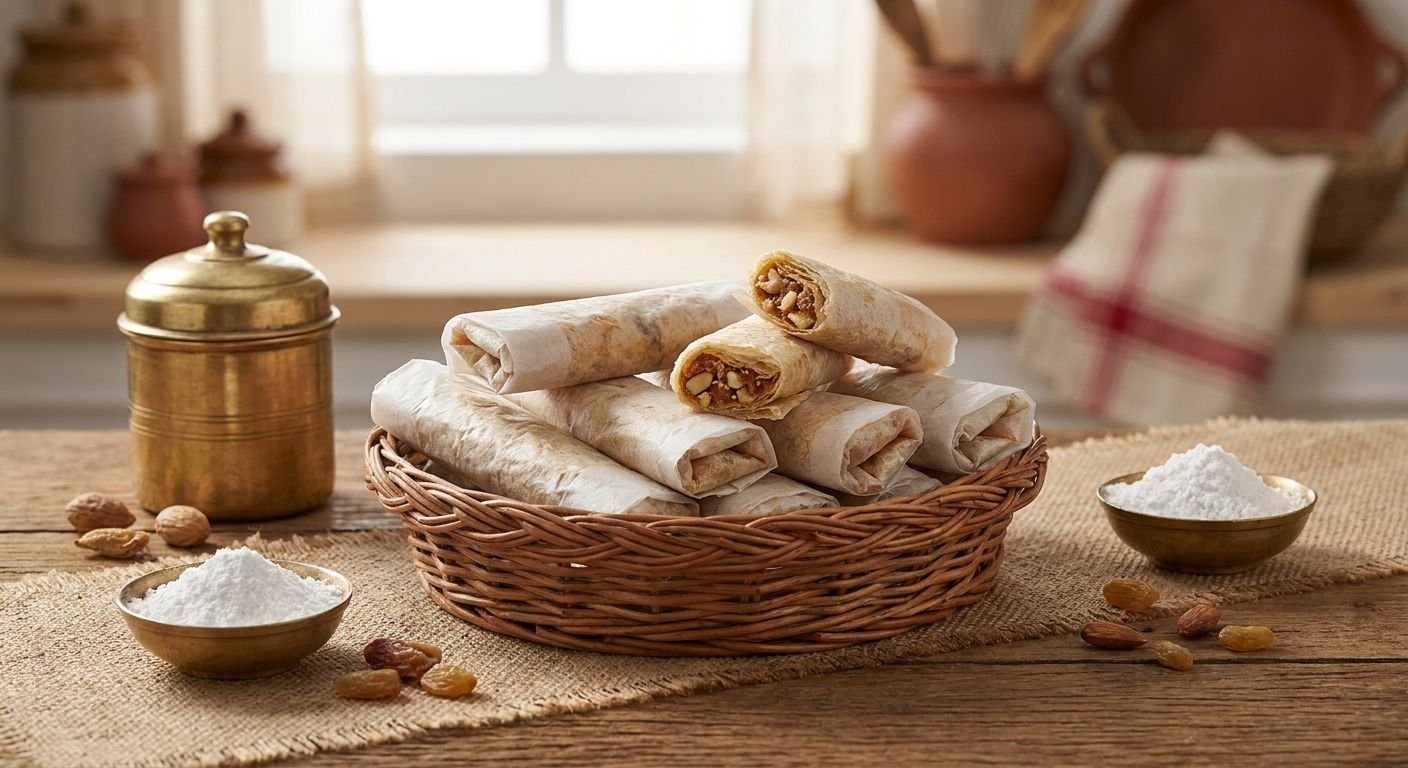
Pootharekulu for gift buyers is a paper-thin rice-starch sheet sweet, layered with ghee and sugar or dry fruit filling, chosen for festival, corporate and NRI gifting because it reads as a distinctly Andhra gesture rather than a generic sweet box. Unlike a buyer picking pootharekulu for personal snacking, a gift buyer is optimizing for three things a snacker doesn't care about: how the box looks when opened, whether the sheets survive a courier run, and whether the occasion (Diwali, Rakhi, a client hamper, a Hyderabad-to-US shipment) matches the packaging format on offer.
- Pootharekulu is a rice-paper sweet from Atreyapuram, Andhra Pradesh, layered with ghee and sugar or dry fruit filling.
- Gift buyers should confirm handmade sheet thickness and ghee content before ordering in 2026 — thicker, mass-produced sheets don’t shatter the same way.
- Corporate and festival gifting needs individually wrapped pieces, not loose stacks, to survive transit and multi-hand distribution.
- Overseas and NRI orders need vacuum-style or layered packaging since pootharekulu sheets are moisture-sensitive and brittle.
- Combo boxes pairing pootharekulu with podis or pickles read as more complete gifts than a single-item sweet box.
Why pootharekulu gifting is different from everyday sweet buying
A gift buyer isn't comparing pootharekulu to jalebi or laddu on taste alone — they're comparing it on how it presents. Pootharekulu's origin story does the selling: the sweet comes from Atreyapuram, a town near Rajahmundry in Andhra Pradesh, where the rice sheets are hand-rolled thin enough to see through. That heritage detail is what makes it land as a gift rather than a snack — it signals the sender picked something specific to Andhra Pradesh, not a generic sweet-shop box.
The catch is fragility. A sheet that's too thick survives shipping but loses the shatter-and-melt texture that makes pootharekulu recognizable; a sheet that's authentically thin can crack into shards if it's packed loose in transit. Gift buyers who don't know this end up either disappointed by a rubbery version or frustrated by a box of broken pieces. Getting the sourcing and packaging right up front solves both problems before the box ships.
Confirm the sheet is hand-rolled, not machine-pressed
Most of what separates a gifting-worthy pootharekulu from a filler version is in the sheet itself.
- Ask whether the rice sheets are hand-rolled — machine-pressed sheets are thicker and don't shatter the same way on the tongue.
- Check the filling ratio: authentic pootharekulu uses a visible layer of ghee and powdered sugar or jaggery between sheets, not a thin dusting.
- Look for dry fruit variants (cashew, almond) as a signal of a fuller recipe, not a shortcut.
- Avoid stock that looks uniformly glossy or plastic-wrapped in a single sheet — that usually means preservatives were added to extend shelf life at the cost of texture.
Match the variety to the occasion
Pootharekulu isn't one product — plain ghee-sugar, dry fruit, and jaggery-based versions each suit a different gifting context.
- Pick the classic ghee-sugar version for traditional festival gifting where recipients expect the original recipe.
- Choose dry fruit variants for corporate hampers or premium gifting, since the visible cashew or almond layer reads as a step up.
- Reserve jaggery-based versions for health-conscious relatives or older recipients who avoid refined sugar.
- Pair pootharekulu with Andhra sweets for festival celebrations when the recipient's household already stocks pickles and podis, so the box feels complete rather than a single sweet dropped in.
Check the packaging format before you commit to a quantity
Loose-stacked pootharekulu in a single box is the single most common damage complaint in gifting.
- Confirm individual sheet wrapping or tray-separated packing, not a single stack.
- Ask if the box includes a moisture barrier — rice sheets absorb humidity fast and turn chewy instead of crisp.
- Request rigid outer boxing for any hamper going by courier, not a soft pouch.
- Order a small trial batch first if you're buying for a large distribution (weddings, office hampers) and haven't tested the seller's packaging before.
Time the order against the shipping distance
Pootharekulu doesn't have the shelf stability of a pickle or podi — treat the order date as a countdown, not a formality.
- Order closer to the event date for local Hyderabad delivery than you would for pickles or dry fruits.
- Build in extra lead time for outstation shipping across India, since transit handling adds risk to brittle sheets.
- For overseas gifting to NRI recipients, confirm the seller has shipped this specific sweet internationally before — not every seller that ships pickles overseas has solved the packaging problem for a sheet sweet.
- Avoid placing pootharekulu orders during peak festival weeks (Diwali, Sankranti) without confirming dispatch slots, since demand spikes strain packing capacity.
Decide between single-item boxes and combo hampers
A single box of pootharekulu is a smaller gesture than a combo that pairs it with pickles, podis, or dry fruits.
- Choose a single-item box for close family who'll appreciate the sweet on its own.
- Choose a combo for corporate gifting to clients and employees where a broader hamper signals more effort per recipient.
- Add a podi or pickle jar alongside pootharekulu when gifting to households that cook daily, since a sweet-only box gets consumed once and forgotten.
- Check if the seller offers festival-specific hamper assembly rather than a generic mixed box — a pickle gift hampers for Diwali gifting format built around a specific occasion tends to hold together better as a single gift than items bundled at random.
Verify the seller can actually ship it, not just sell it
A seller listing pootharekulu online isn't the same as a seller who has solved shipping it intact.
- Ask directly whether they've shipped pootharekulu outstation or overseas before, and what packaging they used.
- Request photos of the actual shipping box, not just the product photo.
- Confirm whether the seller ships pootharekulu separately from heavier items like pickle jars, since jars shifting in transit crush sheet sweets.
- Check for a replacement or reshipment policy specifically for damaged sweet items, since pickle jars and sweets don't damage the same way in transit.
Comparing pootharekulu gifting formats
| Format | Best for | Key limitation |
|---|---|---|
| Single-item box, plain ghee-sugar | Traditional family gifting | No dry fruit visual upgrade for premium hampers |
| Dry fruit pootharekulu box | Corporate and premium gifting | Higher fragility from added filling weight |
| Combo hamper (pootharekulu + pickle/podi) | Festival and NRI gifting | Needs careful packing to separate jars from sheets |
| Jaggery-based pootharekulu | Health-conscious or older recipients | Shorter shelf appeal, softer texture than classic version |
Verdict: a dry fruit pootharekulu box inside a combo hamper is the strongest single choice for corporate and festival gifting in 2026 — it upgrades the visual and taste profile without requiring the recipient to do anything with it beyond opening the box.
Gifting boxes built around a full dessert experience follow the same layering logic elsewhere too — pairing a rice-sheet sweet with complementary textures and flavors is the same principle behind dessert boxes for celebrations, where the box works because nothing in it competes with the centerpiece item.
"If the sheet doesn't shatter like dry paper before it melts on the tongue, it's not real pootharekulu."
Browse the full sweets and gifting range
See pootharekulu alongside podis, papads and pickle hampers for 2026 gifting.
Common mistakes gift buyers make with pootharekulu
- Ordering too early or too late. Pootharekulu isn't a pickle — it doesn't hold for weeks. Buyers who order a month ahead for a Diwali hamper often end up with stale sheets by the event date.
- Skipping the packaging question entirely. Buyers assume any sweet-shop packing survives courier transit; brittle rice sheets need specific handling that plain sweet boxes don't provide.
- Mixing pootharekulu with heavy jars in one box. A pickle jar shifting against a stack of sheets during a multi-day shipment is the single most common cause of arrival damage.
- Choosing the cheapest option without checking sheet thickness. A thicker, machine-pressed sheet survives shipping better but loses the texture that makes the gift recognizable as pootharekulu in the first place.
- Treating it as a standalone gift for households that don't eat sweets often. A combo with a podi or pickle gets used daily; a sweet-only box gets eaten once.
FAQ
What is pootharekulu made of?
Pootharekulu is made from paper-thin rice starch sheets layered with ghee and powdered sugar or jaggery, sometimes with a dry fruit filling. The sheets originate from Atreyapuram in Andhra Pradesh’s East Godavari region.
Is pootharekulu the same as paper sweet?
Yes, pootharekulu is commonly called paper sweet in English because the rice sheets are rolled thin enough to be translucent. Both names refer to the same Andhra Pradesh sweet.
How should pootharekulu be packed for gifting?
Individual sheet wrapping or tray-separated packing with a moisture barrier protects pootharekulu best for gifting. Loose-stacked pieces in a single box are the most common cause of damage during transit.
Can pootharekulu be shipped overseas to NRI recipients?
Pootharekulu can be shipped overseas, but it needs specific brittle-sweet packaging separate from heavier items like pickle jars. Confirm the seller has shipped this exact sweet internationally before ordering for an NRI recipient.
What’s the difference between plain and dry fruit pootharekulu?
Plain pootharekulu uses only ghee and powdered sugar between rice sheets, while the dry fruit version adds cashew or almond pieces to the filling. The dry fruit version suits premium or corporate gifting better.
Is pootharekulu a good corporate gift?
Pootharekulu works well as a corporate gift when paired with pickles or podis in a combo hamper rather than sent alone. On its own it’s a smaller gesture that gets consumed once and forgotten.
How far in advance should pootharekulu be ordered for a festival?
Order pootharekulu closer to the event date than you would pickles or dry fruits, since the sheets don’t hold texture for weeks. Local Hyderabad orders need less lead time than outstation or overseas shipments.
One last thing
The detail most gift buyers miss in 2026 is that pootharekulu's fragility is actually the authenticity signal, not a flaw to engineer away — a sheet thick enough to survive rough handling has already lost the shatter-and-melt texture that makes the sweet worth gifting in the first place. Buy from a seller who solves that with packaging, not by thickening the sheet.
Related guides