
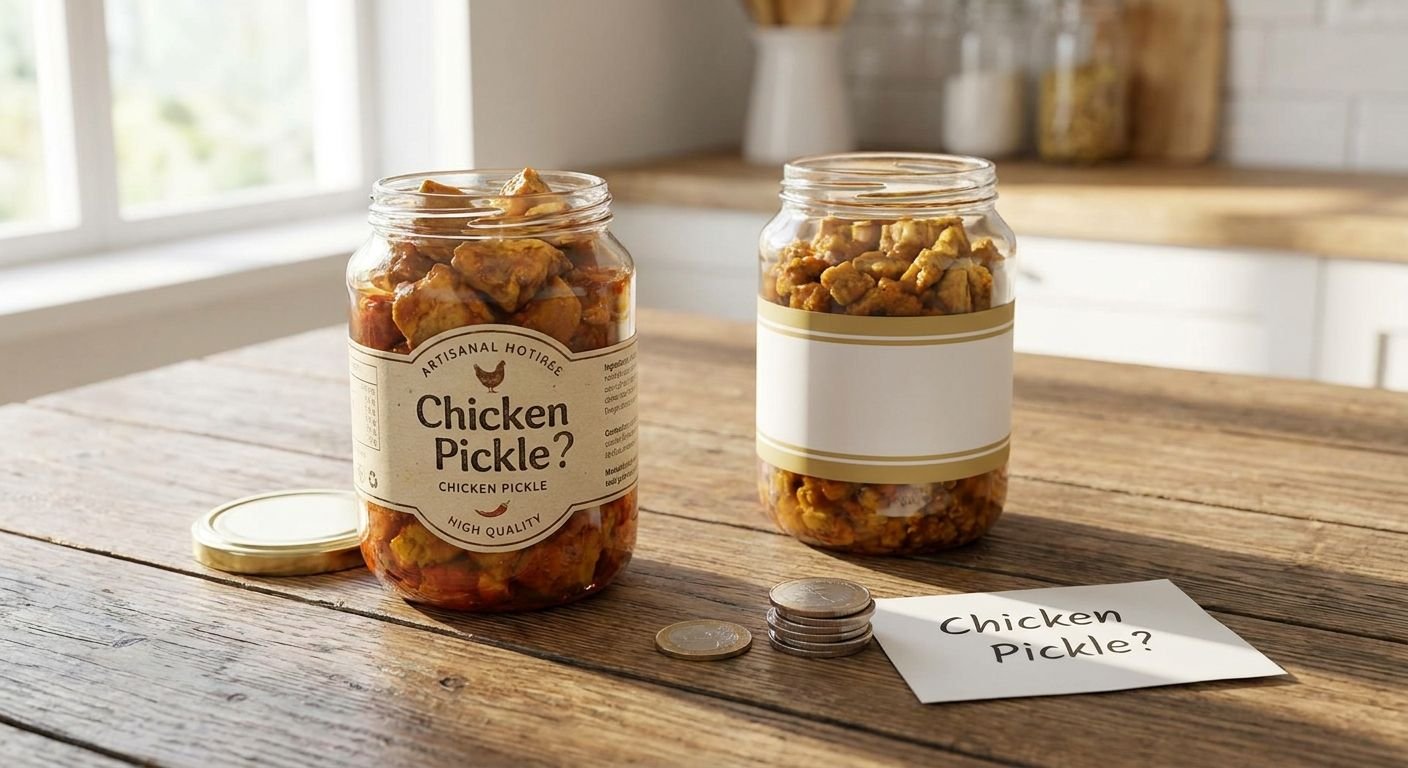
Chicken pickle price varies more than any other pickle category because meat quality, oil ratio, and shipping distance all move the number — this guide breaks down exactly what you're paying for so a 300 rupee jar and a 550 rupee jar make sense side by side in 2026.
- Chicken pickle price runs higher than veg pickle because of meat cost, oil-cure time, and cold-chain packing — budget accordingly in 2026.
- Use per-100g cost, not jar price, to compare chicken pickle across sellers fairly.
- Oil floating on top is normal for slow-cured non-veg pickle, not a defect — do not judge quality by that alone.
- Overseas orders add packing and freight cost on top of the base chicken pickle price, so factor that in before comparing domestic listings.
- Tulasi Pickles veg pickle range (Rs 150 to Rs 220 for 250g) is a useful price anchor when judging whether a non-veg listing is fair.
Why this matters
Most buyers compare chicken pickle price the same way they compare veg pickle price — by looking at the number on the jar. That's the wrong comparison. Meat-based pickles cost more to make, need tighter cold-chain handling, and don't scale the same way spice powders or papads do. Tulasi Pickles sells across this full range — veg, non-veg, podis, papads, sweets — which makes it a useful reference point for building a fair budget before you order chicken pickle from anyone.
Get the comparison wrong and you either overpay for a jar padded with filler oil, or underpay for something with barely any meat in it. Both mistakes are avoidable if you know what to check before you click buy.
What you'll need
- A target budget per 250g or 500g jar, not a total order budget
- Your spice tolerance (mild, medium, Andhra-hot)
- Delivery address — domestic India or overseas changes the real cost
- 10 minutes to read ingredient lists on 2-3 sellers before deciding
- A cold, dry storage spot once the jar arrives
The steps
1. Set your per-100g benchmark, not a jar-price benchmark
Jar sizes differ across sellers — 200g, 250g, 500g — so comparing raw prices misleads you every time. Divide the listed price by the weight in grams, multiply by 100, and you get a true per-100g chicken pickle price you can compare across five different sellers in under a minute. A jar that looks expensive at Rs 450 for 500g is actually cheaper per gram than a Rs 280 jar at 250g. Skipping this step is the single biggest reason buyers feel ripped off after the fact.
2. Check the oil-to-meat ratio before you buy
Oil is a preservative in traditional Andhra pickle-making, not a filler — but the ratio still tells you what you're paying for. Read the ingredient order on the listing; if oil or masala is listed before chicken, meat content is lower and the price should reflect that. Expect oil to rise to the top when the jar sits — that's the cure working, not spoilage. Buyers who mistake floating oil for a defect end up returning perfectly good jars.
3. Match spice level to how fast you'll finish the jar
Andhra-style chicken pickle skews toward high chili and oil content specifically because that combination extends shelf stability without refrigeration in transit. If you eat pickle slowly — a spoon every few days — go for the spicier, more oil-heavy version, since it holds up longer once opened. If you finish jars fast, a milder version won't cost you anything in shelf life. This single decision affects both taste satisfaction and whether you feel the chicken pickle price was worth it three weeks later.
4. Compare jar sizes across at least three sellers
Don't anchor on the first listing you see. Pull up two or three non-veg pickle sellers, apply the per-100g math from step 1, and rank them. This takes five extra minutes and routinely surfaces a 15-20% price gap between listings that looked identical on the surface. Andhra-style pickle sellers, Tulasi Pickles among them, price veg jars in the Rs 150 to Rs 220 band for 250g — treat that as your reference floor when judging whether a chicken pickle listing is priced fairly above it.
5. Verify make date and shipping method before overseas orders
Chicken pickle price for overseas delivery includes freight, customs documentation, and packing reinforcement that domestic orders don't need — expect a meaningfully higher landed cost than the India price. Ask the seller how recently the batch was made and how it's packed for transit. A jar made weeks before shipping and sealed properly survives international transit far better than one packed loosely the same day it's ordered. Skipping this check is the top cause of overseas pickle complaints in 2026.
6. Read for preservatives and additives, not just spice list
Homemade-style Andhra pickle traditionally relies on oil, salt, and chili as the preservation system — no added chemical preservatives needed if the cure is done right. If a listing's ingredient panel includes preservative codes you don't recognize, that changes both the price logic and the shelf-life expectation. This step takes 30 seconds and prevents buying something marketed as homemade that isn't cured the traditional way.
7. Order a smaller jar first if you're new to a seller
Don't commit to a 1kg family jar on your first order from any seller, no matter how good the chicken pickle price looks. Start with the smallest available size, taste it, and reorder in bulk only after you've confirmed the spice level and meat quality match what you expected. The two or three days you lose testing a small jar first save you from a wasted large order.
8. Calculate total landed cost before comparing final numbers
Shipping charges on a single small jar often exceed the jar's price itself, especially for one-off orders. Compare the landed cost — product plus shipping — not the sticker price, when deciding if a chicken pickle price is competitive. Combining a chicken pickle order with other items from the same seller, like podis or papads, spreads the shipping cost and usually brings your effective per-jar price down.
Troubleshooting
The price feels high compared to veg pickle. That's expected — meat cost, tighter cold-chain packing, and shorter safe-eating windows all push non-veg pickle above veg pickle pricing industry-wide in 2026.
Oil separates or floats after a few days. Normal for oil-cured pickle; stir gently before serving. It's not a sign the batch has gone bad.
Pickle tastes saltier than expected. Salt levels vary batch to batch in homemade-style pickle. Mix a spoon into rice or curd to balance it rather than eating it straight for the first jar.
Overseas delivery took longer than the domestic estimate. Customs clearance timing is outside any seller's direct control. Build in extra days when ordering internationally, especially around festival periods.
Small jar felt overpriced for the quantity. Small jars carry a fixed packing and shipping cost regardless of size, so the per-100g price is always higher than a bulk jar. Reorder in a larger size once you've confirmed you like the batch.
Unsure if the spice level matches what you want before buying. Check the seller's description for heat level language (mild, Andhra-hot) and cross-reference with a smaller test jar before committing to a large order.
Tools and resources
- Per-100g price calculator (any calculator app works — price divided by weight times 100)
- Ingredient panel on the product listing before checkout
- A reference guide to regional Andhra pickle styles if you're unfamiliar with what separates one pickle style from another
- A kitchen scale, if you want to verify jar weight after delivery
- Cold, dry pantry storage once the jar arrives
What to do next
Once you've settled on a fair chicken pickle price using the per-100g method, apply the same math the next time you order veg pickle, podi, or papad — the logic doesn't change by category. The per-100g habit is the one skill that carries across every pickle category you'll ever buy in 2026.

FAQ
What is a fair chicken pickle price in 2026?
A fair chicken pickle price depends on jar size, but comparing per-100g cost against veg pickle benchmarks (Rs 150 to Rs 220 for 250g in 2026) gives you a reasonable floor to judge non-veg listings against, since meat and cold-chain handling push the number higher.
Why is chicken pickle more expensive than veg pickle?
Chicken pickle costs more because of raw meat price, tighter cold-chain packing requirements, and shorter safe-eating windows compared to oil-cured veg pickle, which can hold quality for longer without the same handling needs.
Is oil floating on top of chicken pickle a bad sign?
No, oil rising to the surface is normal in traditionally cured non-veg pickle and is part of how the cure preserves the meat. It’s not spoilage unless paired with an off smell or visible mold.
How much does shipping add to chicken pickle price for overseas orders?
Overseas shipping adds meaningfully more than domestic delivery because of freight, customs documentation, and reinforced packing, so compare landed cost, not just the listed jar price, before ordering internationally.
Should I buy a small jar or a large jar first?
Buy the smallest available jar first from any new seller to confirm spice level and meat quality before committing to a bulk order, even though the per-100g cost is higher on small jars.
How do I compare chicken pickle price across different sellers fairly?
Divide each seller’s price by the jar weight in grams and multiply by 100 to get a true per-100g figure, then rank listings on that number instead of the raw jar price.
Does a higher chicken pickle price always mean better quality?
Not always — price differences often come down to jar size, oil-to-meat ratio, and packing method rather than ingredient quality, so check the ingredient list before assuming a higher price means a better jar.
What should I check before ordering chicken pickle for the first time?
Check the ingredient order, jar weight, make date, and shipping method before your first order, and start with a small jar size to confirm the batch matches your spice preference.
One last thing
The detail most buyers miss: the per-100g price gap between the cheapest and priciest chicken pickle listing you'll find in 2026 is usually explained entirely by jar size and shipping method, not meat quality — do the per-100g math before you assume the expensive jar is automatically better.
Related guides