
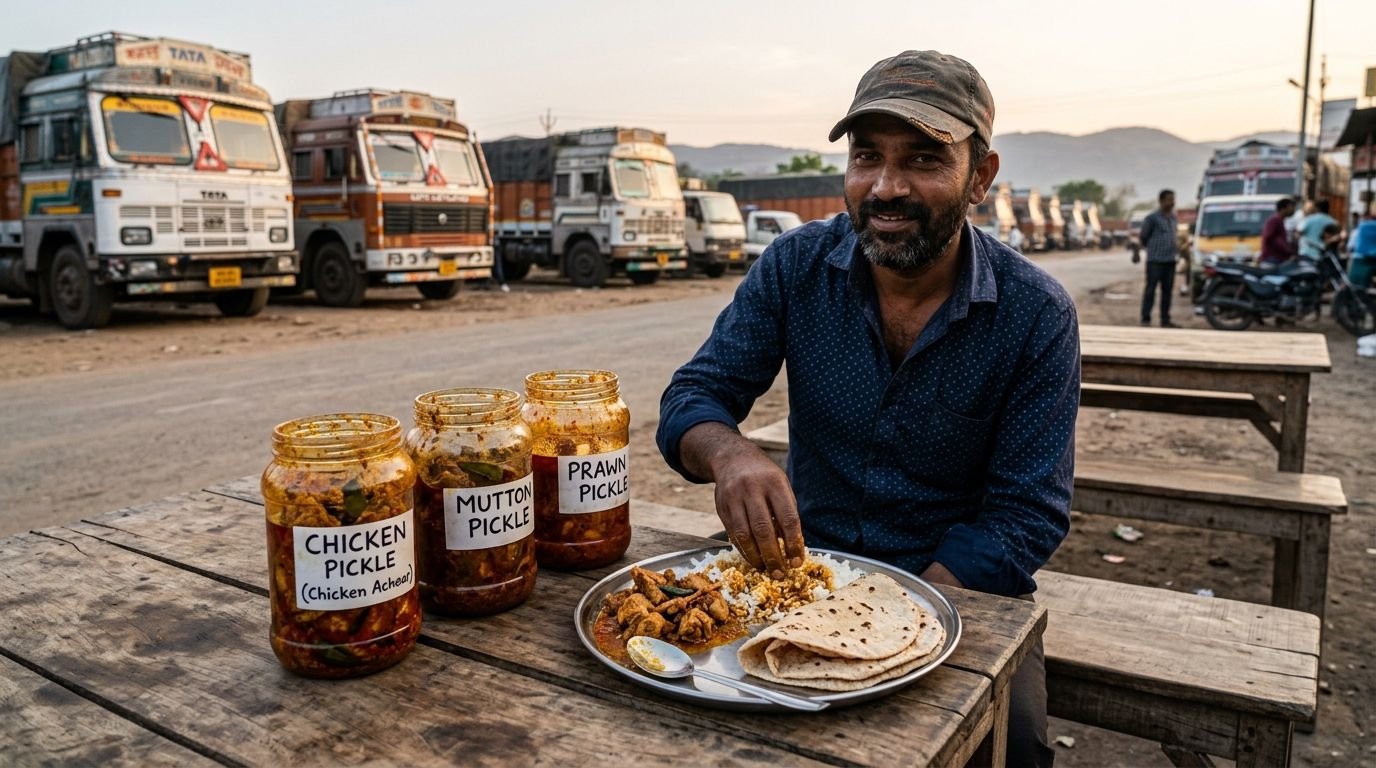
Non veg pickles for truck drivers and long-haul travelers means shelf-stable, oil-cured chicken, mutton, or fish pickle that survives 8+ hours of highway heat, needs no refrigeration, and turns two rotis into a full meal at a dhaba stop. Long-haul driving strips away kitchen time and fridge access, so this segment needs pickle that travels in a jar without spoiling, spicing up plain food fast when there's no time to cook.
- Non veg pickles for truck drivers work best as oil-cured, boneless jars that need zero refrigeration on multi-day 2026 routes.
- Tulasi Pickles’ boneless chicken and mutton pickle stay shelf-stable for weeks once opened, unlike gravy-style non-veg curries.
- Vacuum-sealed jars beat loose packets for handling truck vibration and cabin heat above 40°C.
- Mixed variety packs solve the biggest complaint from drivers: eating the same pickle for five days straight.
Why non veg pickles matter for truck drivers
A driver on a Hyderabad-to-Mumbai or Hyderabad-to-Chennai run doesn't stop to cook. The cab has no fridge, the dhaba food is inconsistent, and plain rice or roti gets old by day two. A jar of travel-friendly pickle packs solves this without a stove: open the jar, mix with rice or bread, done.
Oil-based non-veg pickle is the only meat product that sits safely at cabin temperature for weeks. Fresh cooked meat spoils in hours without cold storage; a properly oil-sealed pickle does not, because the oil layer blocks air and moisture from reaching the meat underneath. That single fact is why non-veg pickle, not fresh curry, is the category built for this segment.
Drivers also eat under time pressure — a 15-20 minute dhaba stop, not a sit-down meal. A spoonable, ready-to-eat pickle beats anything that needs reheating, and that's the exact use case Tulasi Pickles built its boneless jars around.
Update your pickle selection for the road
Most drivers default to whatever jar is cheapest at a highway stop, without checking whether it's built for travel. Fix that before the next trip.
- Choose oil-cured pickle over water-based or vinegar-based varieties — oil doesn't leak or ferment further in heat
- Skip pickles with visible gravy or liquid masala; they spill inside a moving cab
- Prefer boneless cuts (chicken or mutton) — no bone disposal, no choking risk while eating one-handed
- Read the label for "refrigerate after opening" — some brands need cold storage that a truck cabin can't provide
- Buy from a seller that ships pan-India, so the same jar is available on the next trip regardless of city
Check shelf life before you load the cab
Most non-veg pickle spoilage complaints trace back to one mistake: loading a jar without checking how it's stored, not how it's made. Storage instructions are on the label — read them before the jar sits in a hot cabin for 12 hours.
- Confirm the jar is factory-sealed, not an open container from a local shop
- Check for an oil layer covering the meat fully — exposed pieces spoil first
- Ask the seller how long the pickle lasts once opened, not just the unopened shelf life
- A guide on long shelf life pickles covers the exact storage window for homemade Andhra-style jars in 2026 conditions
- Avoid buying loose, unlabeled non-veg pickle from roadside stalls — no way to verify how long it's been sitting
Pick jars that survive vibration and heat
A truck cabin isn't a kitchen shelf. Jars get shaken for hours and can sit near 45°C in summer months across central India.
- Glass jars with tight lids hold up better than thin plastic pouches that crack under vibration
- Vacuum-sealed packs reduce air exposure, which slows oxidation of the oil layer
- Smaller 250g-style jars finish faster, reducing the days a half-used jar sits in heat
- Wrap the jar in cloth or keep it in a closed box, not loose on the dashboard in direct sun
- Tulasi Pickles ships jars sealed for transit, built to handle exactly this kind of multi-day movement
Match spice level to your driving stamina
High spice feels great at the dhaba table and terrible two hours into a night drive with limited water access. Pace it.
- Start with a medium-spice boneless chicken pickle rather than the hottest option on the shelf
- Keep water or buttermilk on hand — Andhra-style pickle runs hotter than most regional curries
- Save the extra-spicy jars (Guntur-style heat) for daytime stretches with easy stop access
- Rotate between a milder mutton or fish pickle and a hotter chicken pickle across a week-long trip
- If acidity bothers you on long drives, ask for a lower-oil batch rather than skipping non-veg pickle entirely
Stock a mixed variety pack for multi-day hauls
The single biggest complaint from long-haul drivers isn't spoilage — it's boredom. Five days of the same jar gets old fast.
- Carry two or three smaller jars instead of one large one: chicken, mutton, and a lighter option like egg or fish
- A boneless chicken pickle works well as the daily default — easy to eat, easy to portion
- Rotate flavors every 1-2 days to avoid palate fatigue on week-long routes
- Check chicken pickle picks by budget if you're stocking for a full month of runs, not just one trip
- Keep one smaller jar as backup in case the main jar runs out mid-route with no shop nearby
Pair the pickle with a no-cook meal base
A jar alone isn't dinner. The fastest combination for a dhaba stop or cabin meal skips cooking entirely.
- Curd rice plus a spoon of non-veg pickle is the fastest complete meal on the road
- Plain rotis from any dhaba work with pickle as the only side needed
- Carry pre-cooked rice packs or instant khichdi mixes that only need hot water
- Buttermilk with a small amount of pickle oil mixed in settles the stomach after a spicy jar
- Avoid pairing very spicy pickle with an empty stomach first thing in the morning — eat something plain first
Stock pickle jars for your next route
Order boneless non-veg pickle jars built for travel and multi-day storage.
Store the jar correctly inside the cab
Once opened, a jar's shelf life depends entirely on how it's handled in the cabin, not just what's in it.
- Reseal the lid tightly after every use — air exposure is the main cause of early spoilage
- Use a clean, dry spoon every time; a wet or used spoon introduces moisture that speeds up mold growth
- Keep the jar out of direct sunlight even though it doesn't need refrigeration
- If a cooler box is available, use it — not required, but it extends usable life on hotter routes
- Finish an opened jar within the window stated on the label rather than stretching it across an entire month-long haul
Non-veg pickle options for truck drivers compared
| Option | Best For | Handling | Key Limitation |
|---|---|---|---|
| Boneless chicken pickle | Daily default, one-handed eating | No bone waste, easy portioning | Needs a clean dry spoon each use to avoid spoilage |
| Boneless mutton pickle | Drivers wanting a richer, heavier flavor | Holds up well across multi-day heat | Higher oil content, pace it with water |
| Chicken pickle with bone | Drivers who prefer traditional Andhra style | Full flavor, classic preparation | Bone disposal is inconvenient inside a moving cab |
| Egg pickle | Lighter protein option between meat days | Quick to eat, easy to rotate in | Shorter shelf life once opened than meat-based jars |
| Fish pickle | Coastal-route drivers wanting variety | Strong flavor in small portions | Stronger smell inside a closed cabin space |
Verdict: boneless chicken or mutton pickle from Tulasi Pickles is the best default for long-haul drivers in 2026 — no bones, no fridge, and a shelf life built for a week on the road, not a single meal.
Common mistakes truck drivers make with non-veg pickle
- Buying loose roadside pickle instead of a sealed, labeled jar — no way to verify how long it's been sitting out
- Carrying only one flavor for a week-long trip and abandoning it halfway from palate fatigue
- Reusing a wet or dirty spoon across days, which introduces moisture and shortens shelf life fast
- Ignoring the storage instructions on the label and assuming all pickle behaves the same in heat
- Choosing gravy-style non-veg curry over oil-cured pickle for road trips, then dealing with spillage and quick spoilage
FAQ
Do non-veg pickles need refrigeration during a road trip?
No, properly oil-cured non-veg pickle like boneless chicken or mutton pickle stays safe at cabin temperature for weeks once sealed. Refrigeration extends life further but isn’t required for a factory-sealed jar in transit.
What’s the best non-veg pickle for truck drivers in 2026?
Boneless chicken pickle is the best default for long-haul drivers because it needs no bone disposal, portions easily one-handed, and holds up across multi-day heat. Boneless mutton pickle is the best second option for drivers wanting a heavier flavor.
How long does an opened jar of non-veg pickle last in a truck cabin?
Shelf life depends on the label instructions, but a resealed, properly stored oil-based jar typically outlasts fresh cooked meat by weeks, not days. Check the specific storage guidance printed on each jar before assuming a fixed number.
Is chicken pickle or mutton pickle better for long drives?
Chicken pickle is lighter and easier to eat daily across a long haul; mutton pickle carries a richer, heavier flavor better suited to occasional meals. Most drivers rotate both to avoid palate fatigue on week-long routes.
Can non-veg pickle spill or leak inside a moving vehicle?
Oil-based pickle in a tightly sealed glass jar rarely leaks, unlike gravy-style curries with loose liquid. Wrapping the jar in cloth or keeping it in a closed box adds an extra layer of protection against vibration.
What non-veg pickle works best for vegetarians traveling with a mixed group?
Groups traveling together often carry both a non-veg jar and a vegetarian option side by side. A vegetarian pickle pairing keeps everyone covered without needing separate cooking on the road.
How spicy should road-trip pickle be?
Medium spice is safer for long stretches with limited water access; extreme heat like Guntur-style chicken pickle is better saved for daytime stops where water and food are easy to reach.
Where can truck drivers buy authentic Andhra-style non-veg pickle for travel?
Tulasi Pickles, based in Hyderabad, ships homemade boneless chicken and mutton pickle across India, sealed for transit and built to handle multi-day road conditions without refrigeration.
One last thing
The detail most drivers miss isn't the spice level — it's the spoon. A single wet or dirty spoon reused across a five-day trip introduces more moisture into a jar than heat or vibration ever does, and that's what actually triggers early spoilage on the road, not the truck cabin's temperature.
Related guides
- Non-veg pickles for bachelors who love spicy food
- Boneless mutton pickle for traditional Andhra taste
- Best chicken pickle brands for authentic Andhra taste
- How to serve non-veg pickle as a side dish