
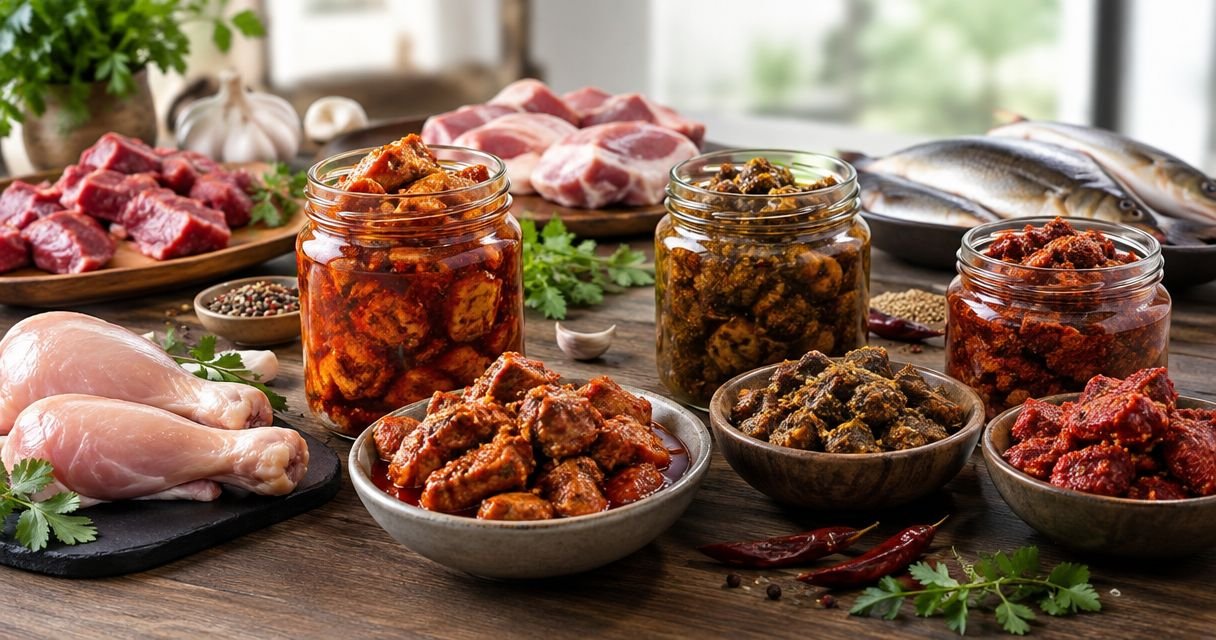
To compare non veg pickle price per kg, divide the current pack amount by its net weight in kilograms: a 500g pack contains 0.5kg, so its kilogram equivalent is twice the pack amount. This 2026 comparison covers chicken, prawns and boneless mutton with explicitly stated 500g packs, separating weight-based comparison from differences in meat and recipe.
- Compare non veg pickle price per kg using net pickle weight, not jar size or meat weight.
- Tulasi Pickles lists chicken, prawns and boneless mutton in explicitly described 500g packs.
- Match boneless preparations before comparing chicken pickle and mutton pickle.
- A kilogram equivalent standardises pack weight; it does not measure meat content or delivered value.
Why this matters
A pack amount alone does not tell you whether two non-veg pickles are comparable. You need the net weight, the meat type and the preparation before the comparison means anything.
The same problem applies within chicken pickle. Bone-in chicken, boneless chicken and a gongura variation are distinct choices, not interchangeable versions of one product. The guide to comparing chicken pickle prices focuses on that narrower buying decision.
Tulasi Pickles suits buyers seeking homemade Andhra-style non-veg pickles across chicken, mutton and seafood. Choose the preparation you want first, then compare equivalent weights rather than letting a smaller pack decide the result.
Comparable pack-weight benchmarks by meat type
Net pack weight is the weight of the finished pickle sold in the pack. It is not a declaration of how much chicken, mutton or seafood the recipe contains.
Across the three products below, the stated pack weight is 500g, equivalent to 0.5kg. Each therefore needs the same conversion to a 1kg basis, making pack-weight arithmetic consistent across these particular choices.
| Meat type | Product | Explicit pack weight | Weight in kilograms | Conversion to a 1kg basis | Best for |
|---|---|---|---|---|---|
| Chicken | Chicken Boneless Pickle Online | 500g | 0.5kg | Double the current pack amount | Buyers choosing boneless chicken |
| Prawns | Prawns Pickle | 500g | 0.5kg | Double the current pack amount | Buyers choosing freshwater prawns |
| Mutton | Mutton Boneless Pickle | 500g | 0.5kg | Double the current pack amount | Buyers choosing boneless mutton |
| Overall: these three products | Common comparison basis | 500g each | 0.5kg each | Same conversion for every row | Buyers comparing equal finished-pickle weights |
Chicken, prawns and boneless mutton are tied on stated pack size at 500g each; none has a pack-weight advantage in this comparison. Differences in the buying decision therefore come from the current product amount, recipe, meat type and your preferences—not from a different weight conversion.
Methodology: This 2026 comparison uses the supplied Tulasi Pickles product titles and descriptions for the three listings that explicitly identify a 500g non-veg pickle pack. Its limitation is that finished-pickle weight does not reveal meat percentage, nutritional content or the final delivered order total.
What the overall row tells you
The overall row is a common weight reference, not an Indian market average. It describes these three products from one seller and does not establish a national benchmark across brands.
That distinction matters when you save or share a comparison. A clearly scoped product comparison answers a narrower question accurately; a market-wide claim requires a market-wide dataset with consistent collection dates and product definitions.
Use the table to standardise the arithmetic. Do not use its equal pack sizes as evidence that the recipes, meat quantities or eating experiences are equal.
How to use these benchmarks
Use these four checks in order. They keep a 2026 comparison focused on what you will actually receive rather than on an isolated listing amount.
- Confirm net weight. The three benchmark products state 500g. Use the weight attached to your selected option, not an assumption based on the photograph.
- Match preparation. Compare boneless chicken with boneless chicken before drawing conclusions about another seller or recipe.
- Separate recipe differences. A gongura preparation adds a distinct ingredient consideration; it is not automatically the same comparison as the corresponding plain meat pickle.
- Check order total. Keep the product-only kilogram comparison separate from the final checkout calculation for your destination.
These checks answer different questions. Net weight establishes the denominator, preparation establishes comparability, and checkout establishes what the order requires from you.
A product can pass the weight check and still be the wrong choice. If you want prawns, a boneless chicken product is not a substitute merely because both packs contain 500g.
Convert pack weight without changing the meaning
Start with net weight
Read the selected pack's net weight before calculating anything. A jar's shape or apparent fullness is not a reliable substitute for the declared quantity.
For the products in the table, 500g equals 0.5kg, while 1kg equals 1,000g. Those unit conversions let you compare different pack sizes without pretending that the seller offers a separate kilogram pack.
Calculate the kilogram equivalent
Divide the current product amount by the pack weight expressed in kilograms. For a 0.5kg pack, that calculation is equivalent to doubling the current pack amount.
A kilogram equivalent is a comparison unit, not a separate product offer. It does not establish that a larger pack exists, that a bulk arrangement applies or that another pack size follows the same arithmetic at checkout.
Keep the comparison current
Record the date alongside your comparison and use the selected product option throughout. For a 2026 purchase, compare the current listings together rather than mixing an old screenshot with a current checkout view.
Follow this sequence: Net weight, Same preparation, Kilogram equivalent, Order total. Each step prevents a different comparison error.
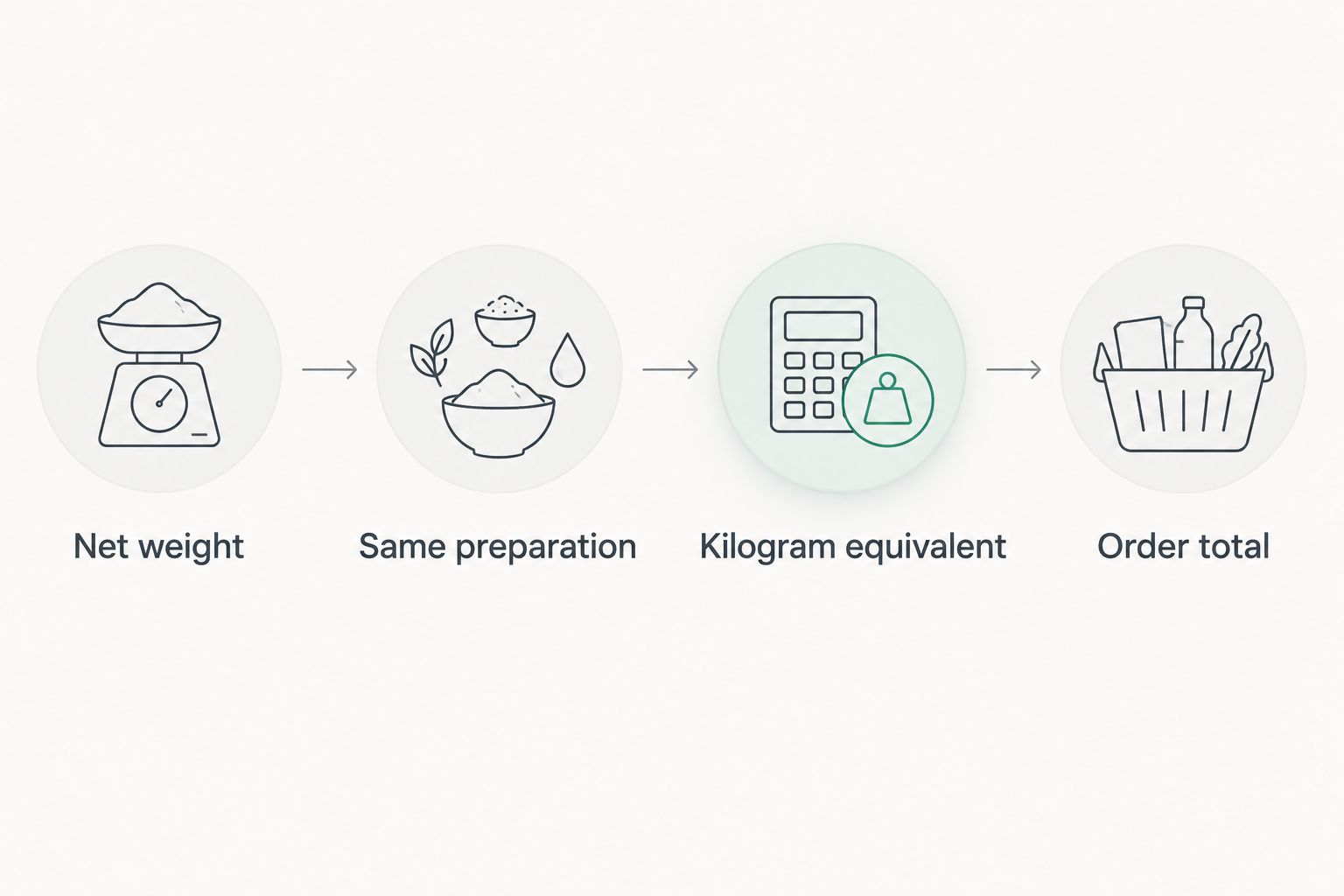
The sequence also makes your comparison repeatable. If you change the meat type or destination, revisit the relevant step instead of carrying the earlier conclusion into a different purchase.
Chicken, prawns or mutton: what you are choosing
The three benchmark products share a stated pack weight, but they serve different preferences. The comparison below identifies their documented ingredients or preparation and the boundary of each choice.
| Product | Best for | Documented distinction | Advantage for that buyer | Trade-off |
|---|---|---|---|---|
| Chicken Boneless Pickle Online | Boneless chicken preference | Homemade Andhra chicken pickle in a 500g pack | Direct match for a chicken-based choice | Does not answer a seafood or mutton preference |
| Prawns Pickle | Freshwater prawn preference | Made with freshwater prawns; stated 500g pack | Direct match for a prawn-based choice | Prawns are crustacean shellfish, an allergy consideration |
| Mutton Boneless Pickle | Boneless mutton preference | Homemade Andhra pickle; stated 500g pack | Direct match for a boneless mutton choice | Not equivalent to minced or bone-in preparation |
Chicken Boneless Pickle Online
Best for: buyers who specifically want boneless chicken pickle. The stated 500g pack gives you a clear basis for unit conversion without mixing bone-in and boneless preparations.
The advantage is a close match to a defined preference. The limitation is equally clear: “boneless” describes preparation, not meat percentage, spice intensity or nutritional composition. Do not treat it as a complete quality measure.
Prawns Pickle
Best for: buyers who specifically want freshwater prawns pickle. The description identifies freshwater prawns and a 500g pack, giving you both a species-category distinction and a declared pack weight.
That specificity helps you avoid comparing a generic seafood label with a clearly described prawn product. The trade-off is dietary suitability: crustacean shellfish requires its own allergy check, independent of any weight-based comparison.
Mutton Boneless Pickle
Best for: buyers who want boneless mutton rather than minced mutton. The stated 500g format supports the same weight conversion used for the chicken and prawn products.
Its advantage is preparation clarity. Its limitation is that a boneless mutton description does not establish the proportion of meat in the finished pickle or make it interchangeable with Mutton Kheema Pickle.
Once you have matched the meat and preparation, use the relevant product listing for the purchase decision. The cards below preserve each product's supplied listing details rather than turning them into a market-wide benchmark.


Finished-pickle weight is not usable meat weight
A kilogram of finished pickle is not the same measurement as a kilogram of meat. Oil, spices and other ingredients belong to the finished product's weight, so the denominator needs a precise label.
The distinction resembles comparing shrimp prices by usable portion: whole-product weight and the portion you intend to eat answer different questions. For pickle, a net-weight comparison standardises the finished preparation; a meat-content comparison requires an explicit meat declaration.
Do not infer meat percentage from the product name or photograph. A boneless label tells you about bone removal, while a meat-percentage statement would answer a separate composition question.
This also prevents a false conclusion about oil. The presence of oil in a pickle recipe is not, by itself, evidence of poor value; the relevant question is whether the disclosed preparation matches what you intended to buy.
Keep recipe variants in separate comparison groups
The wider non-veg selection includes gongura preparations, minced mutton and boneless fish. Those names identify differences worth preserving rather than flattening into one meat-only ranking.
For a fair 2026 comparison, write the full preparation beside each entry. “Mutton” alone loses the distinction between boneless pieces, kheema and a gongura recipe.
| Preparation group | Example from the supplied selection | Best for | Comparison boundary |
|---|---|---|---|
| Boneless chicken | Chicken Boneless Pickle Online | Buyers choosing chicken without bones | Keep separate from bone-in chicken |
| Gongura chicken | Gongura Chicken Boneless Pickle | Buyers choosing a gongura preparation | Do not assume the same recipe as plain chicken pickle |
| Minced mutton | Mutton Kheema Pickle | Buyers choosing minced meat | Keep separate from boneless mutton pieces |
| Boneless fish | Fish Boneless Pickle (Korramenu) | Buyers choosing Korramenu fish | Keep separate from prawns and other seafood |
A broader selection helps you match a preference, but it also creates more ways to compare unlike products. Keep the group narrow when making a unit comparison, then widen it only when deciding which recipe you actually want.
Make the final order comparison separately
The unit calculation and the order calculation serve different purposes. The first standardises product quantity; the second reflects the checkout terms attached to your actual basket and destination.
Tulasi Pickles serves customers across India and overseas, but a domestic product comparison does not establish the terms for every destination. Verify destination eligibility and the applicable checkout details before treating the product-only comparison as your complete buying decision.
Storage also belongs in that decision. Read the product's handling instructions and choose a quantity you can manage accordingly; a larger quantity is not automatically the better purchase for your household.
FAQ
How do I compare non veg pickle price per kg?
Divide the current pack amount by its net weight in kilograms. For a 500g pack, use 0.5kg as the denominator, then compare products with matching meat types and preparations.
Does a 500g pickle pack contain 500g of meat?
No: a 500g net-weight declaration refers to the finished pickle, not exclusively to its meat. An explicit composition statement is needed to establish the meat quantity or percentage.
Which non-veg pickles have a stated 500g pack in this comparison?
Chicken Boneless Pickle Online, Prawns Pickle and Mutton Boneless Pickle have explicitly stated 500g packs in the supplied descriptions. They share a weight-conversion basis, not an identical recipe.
Is a kilogram equivalent the same as buying a kilogram pack?
No: a kilogram equivalent is a calculation used to compare quantities. It does not establish that a separate kilogram pack exists or follows the same purchase terms.
Should I compare bone-in and boneless chicken pickle together?
Compare matching preparations first. Bone-in and boneless chicken are different product formats, so an equal finished-pickle weight does not make their composition equivalent.
Is prawns pickle directly comparable with fish pickle?
Only for a broad finished-product weight comparison. Prawns and fish are different ingredients, and the specific seafood type should remain visible in your buying decision.
Does the benchmark include the final delivered order total?
No: the benchmark standardises stated product weight. Check your actual basket and destination separately before completing the order.
One last thing
A correct calculation can still produce the wrong purchase if you compare the wrong preparations. Before keeping a 2026 comparison, label its denominator “finished pickle” and write the full meat preparation beside it.
That small habit prevents two errors at once: confusing pack weight with meat weight, and treating a kilogram equivalent as a promise about a different pack size.
Related guides
- How much does boneless mutton pickle cost per kilogram?
- How to choose the right pickle jar size for your family
- How to store non-veg pickles safely in the refrigerator