
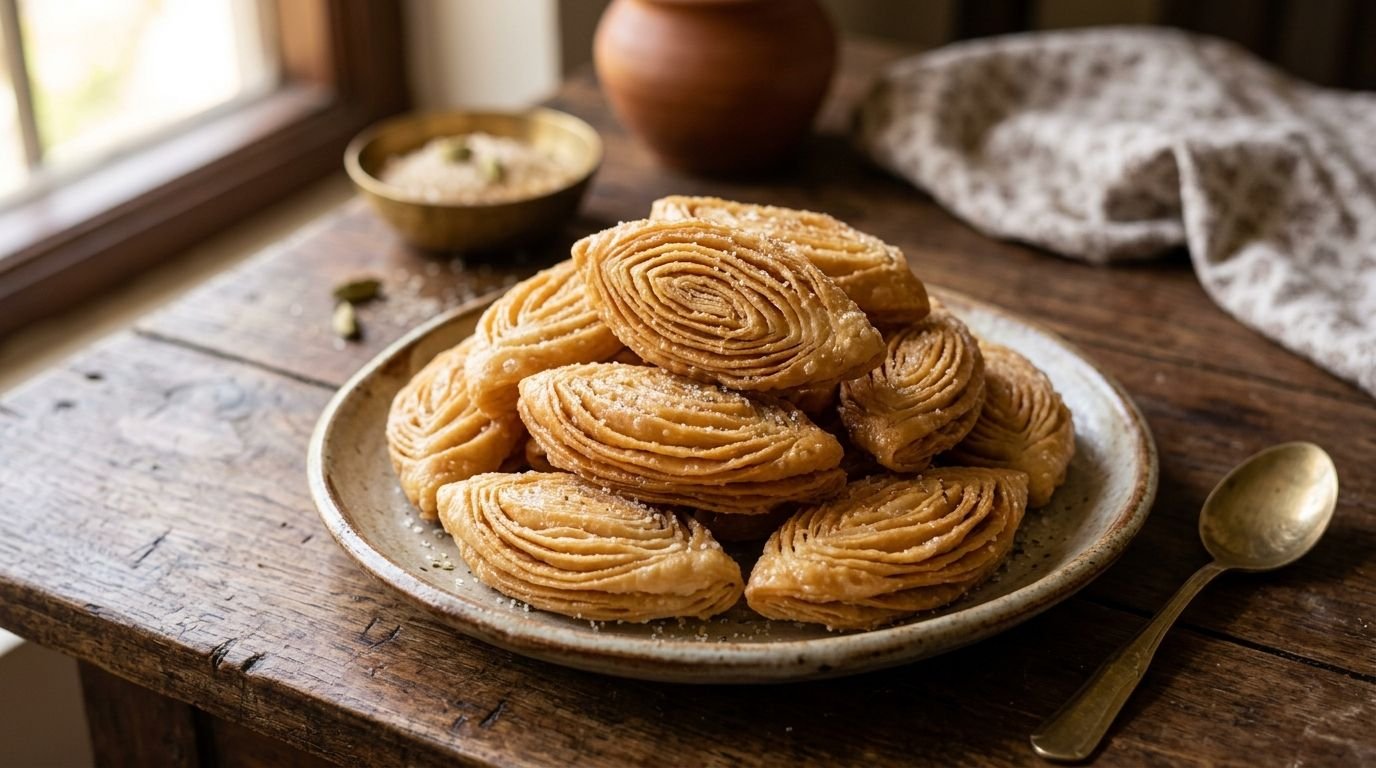
Kaja is a deep-fried, syrup-glazed Andhra sweet built from dozens of paper-thin flour layers, and the entire appeal comes down to one thing: does it shatter when you bite it, or has it gone soft and chewy. This guide breaks down what separates a properly made kaja sweet from a soggy imitation, how it stacks up against bandar laddu and pootharekulu, and how to keep it crisp after it arrives at your door in 2026.
- Kaja sweet gets its crunch from repeated folding, deep-frying, and a light sugar syrup coat, not from extra sugar alone.
- Andhra-style kaja is drier and flakier than the denser Odisha khaja, even though both names get used online interchangeably.
- Bandar Laddu and Pootharekulu are the closest festival-gifting rivals to kaja for Andhra sweet lovers in 2026.
- Kaja softens within days in humid kitchens – an airtight tin, not a plastic bag or fridge, keeps the layers intact longest.
Why kaja sweet matters for crispy layered Andhra sweet lovers
Crispy layered Andhra sweet lovers are pickier than the average dessert buyer. They know the difference between an Andhra-style kaja – thin, crisp, mildly sweet – and the heavier Odisha khaja variant, and they reject a batch the moment the layers have fused into one greasy lump instead of separating cleanly.
Most of this segment already orders pickles, podi and papads from a Hyderabad kitchen they trust, because they already lean on Tulasi Pickles for homemade Andhra flavor sourced from Telangana. The same trust question applies to sweets: was the ghee real, was the frying done in small batches, and does the kaja survive a shipment outside Andhra Pradesh without turning soft.
That last point matters more than most buyers realize. A pickle jar can sit in transit for days with no quality loss. Kaja can't – moisture is the enemy from the moment it leaves the fryer, which is why storage and packing matter as much as the recipe itself.
How to choose and enjoy kaja sweet like an Andhra local
Check the layer count and crunch before you buy
A proper kaja shows visible layering the moment you snap a piece in half. If the seller can't show you that, or the piece bends instead of breaking, walk away.
- Look for clean, visible layering when you snap a piece open
- A good kaja shatters instead of bending – bend resistance means the layers have collapsed
- Syrup should coat the surface, not soak through to the center
- Avoid pieces that feel oily or greasy to the touch
- Check for even golden-brown color, not blotchy dark patches from uneven frying
Match the syrup style to your taste
Not all kaja is finished the same way, and the syrup choice changes the eating experience more than most buyers expect going into 2026.
- Plain sugar syrup with cardamom gives a lighter, cleaner sweetness
- Jaggery-based syrup adds a caramel note and a darker color
- Khova or mawa kaja includes a milk-solid filling and is noticeably richer
- Ask for a lighter syrup dip if you find standard kaja too sweet
- Taste one piece before ordering a bulk box for a wedding or festival
Store kaja correctly to keep it crisp
This is the step most buyers skip, and it's the reason kaja gets blamed for being "not fresh" when the real issue is storage.
- Use an airtight steel or glass container, never a loosely tied plastic bag
- Keep it at room temperature – refrigeration turns the layers limp within hours
- Store away from direct sunlight and humid stove-side counters
- Separate stacked pieces with parchment paper if you're storing more than one layer
- Check the pack for a use-by window and finish it inside that timeframe
Order kaja and other Andhra sweets for a festival
Buyers who don't have a trusted home kitchen nearby often order online instead of driving across Hyderabad to five different shops for Sankranti or Diwali. Andhra sweets for festival celebrations is the faster route when you need a mixed box rather than a single item, and it saves the guesswork of comparing five sellers separately.
- Confirm the seller states a production date, not just a packing date
- Check whether sweets ship separately from spicy pickles and podi to avoid flavor transfer
- Ask about overseas shipping if you're ordering for NRI family members
- Compare piece count per box rather than assuming a bigger box has more sweets
- Check delivery timing around festival dates so the box arrives fresh, not late
Pair kaja with other Andhra snacks and sweets
A single sweet rarely satisfies a full festival table, and kaja pairs better with some items than others.
- Serve with filter coffee – the bitterness cuts the syrup sweetness
- Add murukku or chegodilu for a savory-sweet tea-time platter
- Include a podi-based snack in the same order to balance a sweet-heavy box
- Keep kaja packed apart from garlic or non-veg pickles to avoid smell transfer
- Add a second sweet like bandar laddu for guests who want variety beyond kaja
Test freshness before gifting in bulk
Don't place a large festival order on faith. Buy a small sample pack first, check crunch after 48 hours in your own kitchen conditions, and only then commit to a bulk hamper – Hyderabad's humidity in 2026 hasn't gotten any kinder to fried sweets, and one bad batch ruins a gifting reputation faster than a late delivery.
Kaja sweet vs other Andhra sweets
| Sweet | Best For | Key Limitation | Verdict |
|---|---|---|---|
| Kaja | Crunch-first eaters who want a dry, flaky bite | Softens fast in humid weather without airtight storage | Buy |
| Bandar Laddu | Traditional laddu lovers who want a dense, ghee-rich sweet | Heavier – not ideal for a light tea-time snack | Buy |
| Pootharekulu | Gifting boxes and paper-thin sugar-sheet lovers | Fragile in transit – cracks if not packed flat | Buy |
| Boondi Laddu | Buyers who want a widely recognized, classic shape | Less distinctly Andhra than kaja or pootharekulu | Hold |
| Til Chikki | Winter snacking and sesame-jaggery fans | Not syrup-soaked – a different texture category entirely | Buy |
Kaja sweet wins on crunch, pootharekulu wins on gift presentation, and bandar laddu wins on richness – pick based on what the occasion needs, not just what's most familiar.
Common mistakes crispy layered Andhra sweet lovers make
- Buying weeks ahead of a festival, then bagging it in plastic – the layers absorb moisture and go soft before the event even starts
- Assuming a heavier piece means more layers – extra weight is usually oil absorption, not extra folding
- Refrigerating kaja to keep it fresh – cold air is exactly what collapses crisp layers into a chewy mass
- Ordering only kaja for a mixed festival crowd – pair it with a laddu or chikki for guests who skip fried sweets
- Ignoring the syrup-style label – buyers expecting a light kaja often get a rich khova version and are disappointed
Order kaja and Andhra sweets today
Tulasi Pickles ships homemade Andhra sweets and snacks from Hyderabad across India and overseas.
FAQ
What is kaja sweet made of?
Kaja sweet is made from refined flour dough rolled into thin sheets, layered with ghee or oil, deep-fried, then dipped in sugar syrup. Andhra versions often add cardamom to the syrup for a lighter finish.
Is kaja the same as khaja?
Kaja and khaja are regional names for the same fried, layered pastry, but the texture differs by region. Andhra-style kaja is thinner and crisper, while Odisha khaja tends to be denser and chewier.
How long does kaja sweet stay crisp after opening?
Kaja stays crisp longest in an airtight container at room temperature, away from humidity and direct sunlight. Refrigeration or loose plastic bags soften the layers within hours.
Can kaja sweet be shipped overseas?
Sellers based in Hyderabad who ship pickles, podi and snacks across India and overseas can typically include sweets like kaja in the same order. Ask about moisture-sealed packing before ordering for NRI family.
What is the difference between kaja and pootharekulu?
Kaja is deep-fried and layered with ghee, giving it a fried crunch. Pootharekulu is an unfried, paper-thin rice-sheet sweet rolled with sugar or dry fruit filling, so the two textures are not comparable.
How much does kaja sweet cost in Hyderabad?
Pricing varies by weight, packaging and ingredient costs, which shift through 2026, so check current listings directly rather than relying on a fixed figure.
Can diabetics eat kaja sweet?
Standard kaja is sugar-syrup soaked and not suitable for a diabetic diet. Buyers managing sugar intake are better off looking at sugar-free festive sweet options instead.
One last thing
Most online descriptions of kaja skip the frying detail that actually explains the texture difference between regions: Andhra-style kaja is typically fried at a lower, steadier temperature for a longer stretch, which sets the layers without over-browning them, while the syrup-heavy versions sold as khaja in eastern India often get a hotter, faster fry. That is why two sweets sharing the same name online can taste completely different once they arrive – the frying method, not just the syrup, decides whether you get a flaky bite or a dense chew.
Related guides
- Til Chikki for winter snacking cravings
- Sugar-free sweets for diabetic-friendly festive gifting
- Sweets and snacks combo for festive gifting