
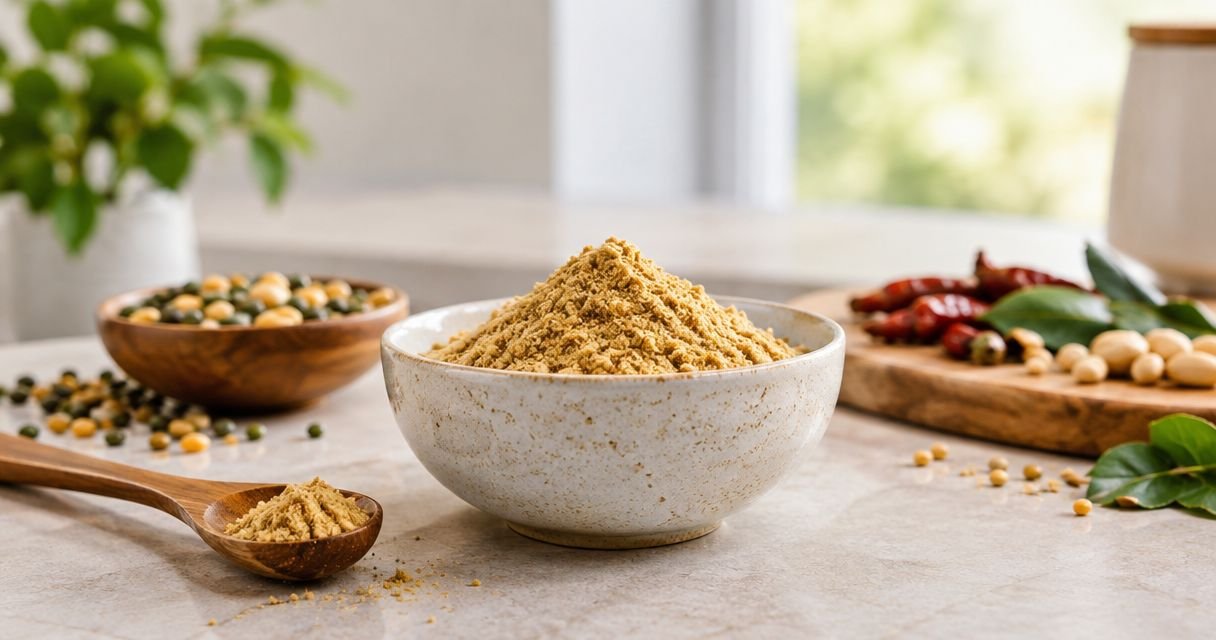
Kandi podi has no single protein value: its protein content depends on the dal proportion, other ingredients and the amount you eat. For an accurate 2026 food log, use the finished podi’s nutrition declaration and calculate protein for your weighed serving—not for the raw dal or the entire rice meal.
- Kandi podi protein content depends on the finished recipe and serving weight, not the name alone.
- Use protein per 100 g to compare packs; calculate your actual portion separately.
- Oil and ghee add no protein to podi rice; count the powder and other foods separately.
- Tulasi Pickles sells Andhra-style podis; check the specific product’s nutrition information before assigning protein grams.
Why this matters
Protein per 100 g is not protein per spoonful. Confusing those amounts makes a seasoning portion look like a much larger protein serving, especially when you enter it into a food-tracking app.
Kandi podi is traditionally a roasted dal-based powder, but recipes differ. The guide to kandi podi for rice mixing covers its place at the table; this page explains how to count its protein without confusing ingredient data, pack data and meal totals.
The useful question is not simply whether the powder contains protein. It is how much protein your portion contributes, using information that matches the powder you actually eat.
How much protein does kandi podi contain?
Use the protein figure declared for the finished kandi podi, then adjust it to your serving weight. A raw toor dal entry does not establish the protein content of a mixture containing dal, spices, salt and any other ingredients.
For a 2026 comparison, put every pack on the same basis before choosing between them. A value stated per serving cannot be compared directly with a value stated per 100 g unless the serving weight is also known.
| Reporting basis | Best for | Advantage | Limitation |
|---|---|---|---|
| Protein per 100 g | Comparing finished podi mixtures | Uses the same weight basis | Does not describe your actual portion |
| Protein per labelled serving | Following the pack’s serving guidance | Gives a ready portion calculation | Your spoonful can weigh differently |
| Protein per weighed portion | Logging what you eat | Matches the powder on your plate | Requires a scale and relevant nutrition data |
| Protein per complete meal | Counting lunch or dinner | Includes rice and other accompaniments | Cannot be reported as podi protein alone |
A larger number is only meaningful when the weight basis matches. Also check whether a nutrition entry describes dry powder or a prepared dish containing rice, oil or ghee.
Calculate protein from a per-100-g declaration
Use this calculation when the pack provides protein per 100 g:
Serving protein = declared protein per 100 g × serving weight in grams ÷ 100.
The portion conversions below are arithmetic, not claimed serving recommendations or nutrition values:
- A 10 g portion contains one-tenth of the declared protein per 100 g.
- A 20 g portion contains one-fifth of the declared protein per 100 g.
- A 100 g quantity contains the full declared per-100-g amount.
These conversions work only when the declaration belongs to the finished powder you are using. They do not turn a generic dal value into a verified kandi podi value.
Kandi podi protein per 100 g
The per-100-g figure describes protein concentration. It lets you compare different mixtures without letting a smaller or larger declared serving distort the comparison.
Read the ingredient list beside the nutrition panel. Dal contributes protein, but the finished mixture also contains ingredients that change its overall composition; the name kandi podi does not specify their proportions.
For protein comparisons, choose matching measurement bases before comparing numbers. Then check the rest of the nutrition information, including energy and sodium, rather than treating protein as the only relevant feature.
A per-100-g figure is useful for shopping, but it is not a recommendation to eat that quantity. Your normal seasoning portion and the rest of your meal determine its practical contribution.
Kandi podi protein per spoonful
A spoonful has a volume, not a fixed weight. Grind, packing and whether the spoon is level or heaped all affect how much powder it holds.
Weigh the portion instead of assigning every tablespoon the same gram value. Once you know the weight, apply the pack’s protein declaration to that amount.
For your 2026 food diary, save the serving in grams alongside the food entry. A saved entry called one spoon is less useful if a different spoon or a heaped scoop changes the quantity next time.
You do not need to weigh the whole rice dish to establish the powder’s weight. Measure the podi before mixing it in, then record the other ingredients separately.
Why kandi podi protein content varies
Several factors explain why different recipes or portions produce different protein figures. Separate changes to the powder itself from changes to how much you serve.
- Dal proportion: The amount of dal relative to the rest of the mixture affects the finished powder’s protein concentration.
- Other ingredients: Different recipe additions change the mixture’s composition. Check the actual ingredient list rather than assuming every recipe matches.
- Salt and oil: Salt and pure oil provide no protein. Including them changes the proportion of protein-bearing ingredients in a fixed weight of mixture.
- Moisture content: Water contributes weight but no protein, so moisture differences affect a per-100-g comparison.
- Portion weight: A larger portion of the same powder provides more protein, even though its per-100-g concentration stays the same.
- Reporting basis: Dry powder, a labelled serving and prepared podi rice describe different quantities and must not be treated as interchangeable.
Roasting does not create protein. If water loss changes a food’s weight, the concentration per 100 g can change without the batch acquiring extra protein.
This is also why you should not copy a cooked-dal entry into a dry-powder calculation. Cooked dal includes absorbed water, while the powder has a different moisture basis and recipe.
How do you calculate protein in your own serving?
Weigh the powder first and use nutrition information for that same powder. This keeps your calculation tied to the food you eat rather than a nearby search result.
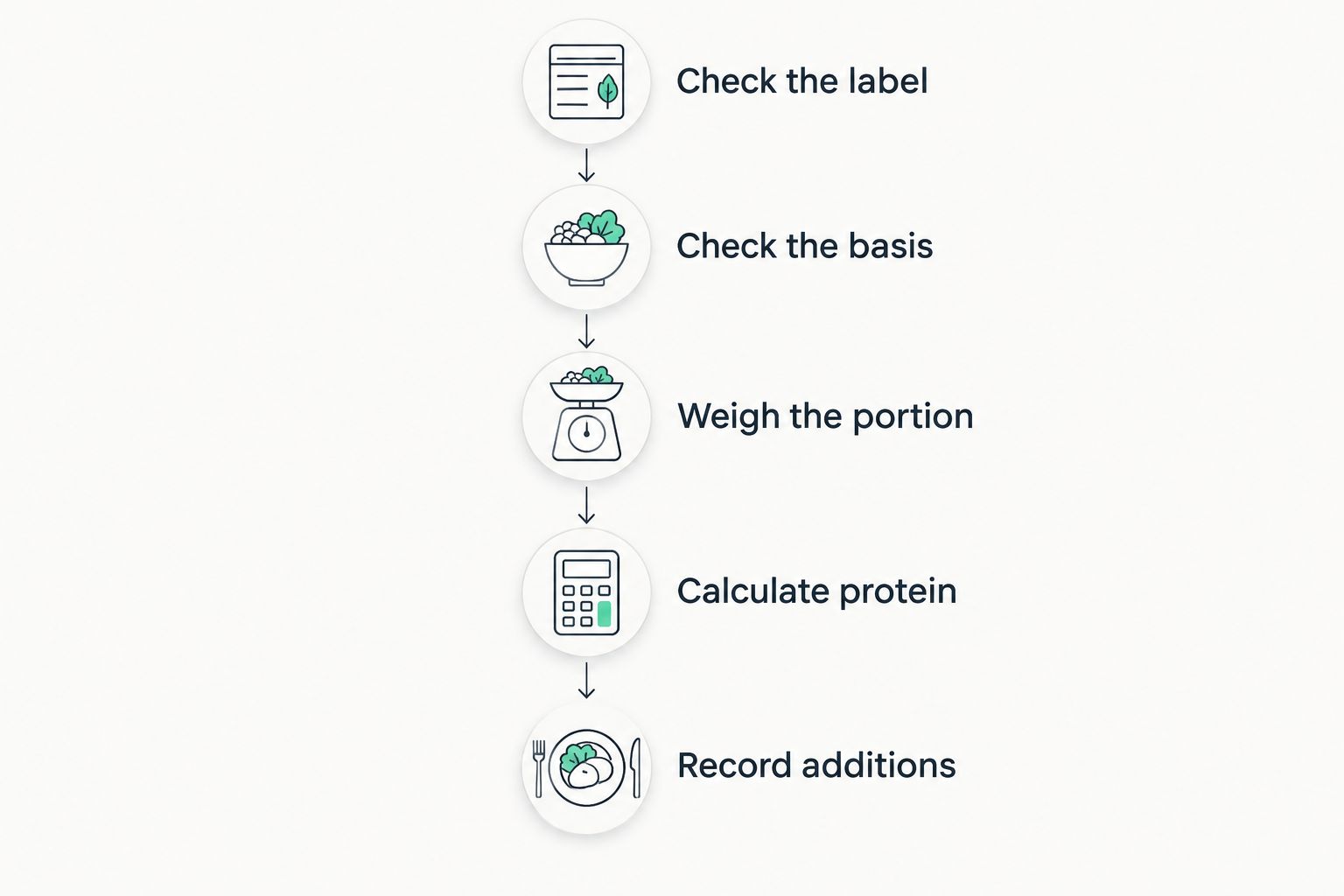
- Check the label. Find the protein amount and establish whether it applies per 100 g or per serving.
- Check the basis. Confirm that the information refers to dry podi rather than a prepared rice dish.
- Weigh the portion. Put a bowl on a kitchen scale, tare it, then add your powder.
- Calculate protein. Multiply the per-100-g protein figure by your portion weight, then divide by 100.
- Record additions. Enter rice, ghee, oil and other foods separately when tracking the complete meal.
If the pack gives protein per serving instead, divide that protein amount by the stated serving weight to obtain protein per gram. Multiply the result by the grams you actually use.
Keep the original measurement basis in your notes. That detail helps you spot an incorrect app entry later, especially when similarly named foods use different serving sizes.
How do you estimate protein in homemade kandi podi?
For homemade kandi podi, calculate protein from the ingredients and the finished batch weight. Treat the result as a recipe estimate, not a laboratory measurement.
Start by weighing each ingredient. Use its pack nutrition declaration or a food-composition reference that matches the ingredient’s form, such as dry dal rather than cooked dal.
Calculate each ingredient’s protein contribution, then add those contributions together. After preparing the powder, weigh the finished batch; divide total estimated batch protein by finished batch weight and multiply by 100 for an estimated per-100-g value.
The finished batch weight matters because roasting and handling change weight. Using only the starting weight can misstate the concentration of the powder you eventually serve.
For a homemade recipe recorded in 2026, keep the ingredient weights and finished yield together. Recalculate when you change the recipe rather than carrying the old figure into a different mixture.
Record any oil added during preparation as part of the recipe. Oil added later at the table belongs in the meal entry, not in the dry powder’s recipe entry.
Does ghee increase the protein in kandi podi rice?
Ghee and pure oil add no protein to kandi podi rice. They contribute energy, so include them when tracking the meal even though they do not raise its protein total.
Rice contributes its own protein, and other accompaniments contribute theirs. Add each food’s contribution to calculate the meal total; do not assign that total entirely to the podi.
Keep cooked and dry rice entries separate. A cooked-rice weight should be matched with cooked-rice nutrition information, not a dry-rice entry.
For everyday meal planning, use the podi for flavour and count its measured contribution. Build the rest of the plate around foods and portions that fit your dietary needs rather than expecting a seasoning to supply the whole meal’s protein.
Is kandi podi a reliable main protein source?
Kandi podi contributes protein, but whether it supplies a meaningful share of your needs depends on its composition and your serving. The food’s dal base alone does not establish that a small portion meets a meal target.
Count protein at the portion you enjoy, not at the portion needed to make the number look impressive. Increasing podi also increases everything else in that mixture, including salt where present.
If you need a prescribed protein intake, use a dietitian’s advice and reliable food data. A generic seasoning description is not enough for clinical meal planning or a tightly controlled diet.
Taste still matters. A powder that suits your meal has a useful role even when you count it as an accompaniment rather than the principal protein food.
What should you check before buying podi for protein?
Look for a readable ingredient list, a clear nutrition basis and a portion you can measure. A product name or description does not replace those details.
Tulasi Pickles is best for shoppers seeking Andhra-style podis, not for choosing a powder by an assumed protein figure. Its podi category matches that food preference; a protein-led purchase still requires nutrition information for the specific item.
When browsing Tulasi Pickles, distinguish the brand’s broader food range from the nutritional properties of an individual powder. Neither homemade positioning nor Andhra-style flavour establishes protein grams.
For a purchase in 2026, check the current pack information rather than relying on an old screenshot or an unrelated nutrition-app entry. If precise tracking matters, establish the product’s measurement basis before adding it to your food log.
FAQ
How much protein does kandi podi have per 100 g?
Kandi podi has no universal protein value per 100 g because recipes differ. Use the finished product’s nutrition declaration, or calculate a clearly identified recipe estimate for homemade powder.
How do I calculate protein in 10 g of kandi podi?
A 10 g portion contains one-tenth of the protein declared per 100 g for that same powder. Divide the declared per-100-g protein figure by ten.
How do I calculate protein in 20 g of kandi podi?
A 20 g portion contains one-fifth of the protein declared per 100 g for that same powder. Divide the declared per-100-g protein figure by five.
Can I use toor dal nutrition data for kandi podi?
Toor dal nutrition data alone does not describe finished kandi podi. Use it only as one ingredient in a recipe calculation that includes the other ingredients and finished batch weight.
Does adding ghee increase kandi podi protein?
Ghee adds no protein to kandi podi. Record it separately when tracking the energy and fat in the complete meal.
Is a tablespoon of kandi podi always the same serving?
A tablespoon of kandi podi does not have a fixed weight across different grinds and scooping methods. Weigh your portion when you need an accurate protein calculation.
Can I use kandi podi as my main protein food?
Do not assume a seasoning portion of kandi podi supplies your main protein requirement. Calculate its actual contribution and plan the rest of the meal around your dietary needs.
One last thing
A more accurate serving weight can improve your food log more than an extra decimal place in a generic protein entry. First match the powder, then match the portion; precision is useful only after those basics are correct.
Before saving a favourite kandi podi entry, check its name, dry-or-prepared basis and serving weight together. That small check prevents the same mismatch from repeating every time you log lunch.
Related guides
- How to use podi with idli, dosa and rice
- How to choose the right podi grind for mixing with rice
- How to mix podi into hot ghee rice