
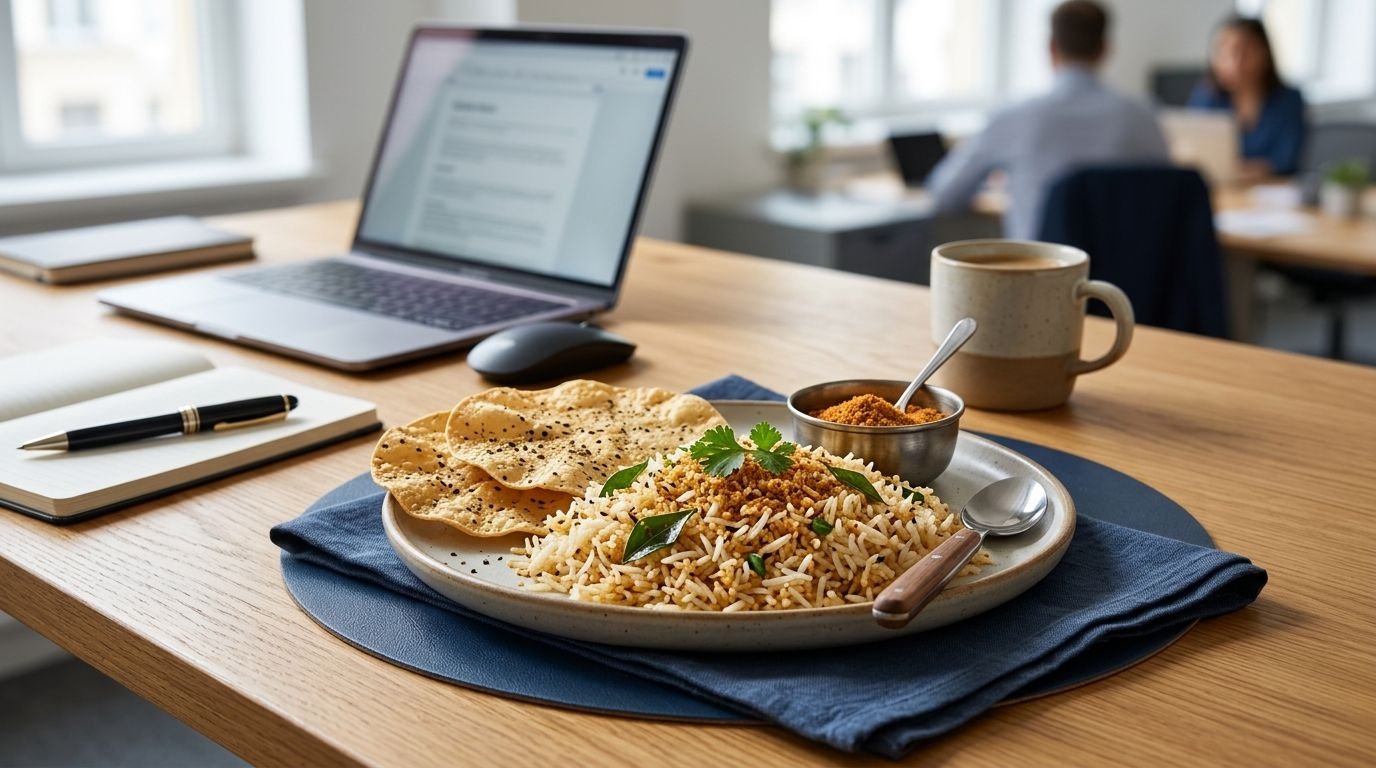
Podi and papad combo for office lunch break is a no-cook meal fix: a spoon of spice powder stirred into rice or curd rice, plus a roasted papad on the side, built for the 30-40 minute window most desk jobs allow in 2026. Office lunches can't handle wet, oily pickle jars leaking into a laptop bag or a stove-top tempering station at 1 PM — this combo skips both.
- Podi papad combo for office lunch works because it needs zero cooking equipment at a desk.
- Kandi podi with rice papad gives protein without the oil stains wet pickles leave on tiffin lids.
- Tulasi Pickles ships podi and papad as separate packs so portions stay in your control.
- Papads left open past a day turn chewy — reseal tightly or use within 24 hours.
- Rotate a mild podi and a spicy karam podi across the week instead of picking by day.
Why podi and papad combo matters for office lunch breaks
Most office canteens serve one fixed menu, and most desks don't have a stove. A tiffin box with rice, a spoon of podi, and a papad solves both problems without a microwave queue or a lunch that smells like a full tempering pan across three cubicles.
The Tulasi Pickles approach to this combo treats podi and papad as two separate decisions, not one bundled habit. Get the podi wrong and lunch is bland; get the papad wrong and it's soggy cardboard by the time the lunch bell rings. Office workers need dry-stable, low-mess food that survives a bag ride and a 45-minute wait before it's opened.
There's a food-safety angle too: cooked rice left at room temperature for more than roughly two hours starts to risk bacterial growth, a standard food-handling guideline, not a brand claim. That's one more reason podi-mixed rice packed fresh in the morning and eaten by early afternoon beats a heavy, oil-based curry sitting in a bag since 8 AM.
Pack your podi and papad the night before
Office mornings don't leave 20 minutes for spice-powder measuring. Doing it the night before is the single habit that keeps this combo from collapsing into a canteen sandwich by Wednesday.
- Measure 1-2 tablespoons of podi into a small dry container, not the main jar
- Keep podi and rice in separate compartments until you're ready to eat
- Pack the papad in its own sealed pouch, away from anything with moisture
- Add a small spoon of ghee or oil separately if your podi needs binding
- Set a reminder to check the papad pack seal before it goes into the bag
Choose a podi that survives a jostled bag
Not every podi travels well. Coarse, dry powders hold their texture through a commute; oily or paste-like ones clump and stain the container lid.
- Pick coarse-ground podi over wet or paste-style spice mixes for bag transport
- Favor sesame (nuvvula) or peanut-based podi for a drier, less oily texture
- Test a new podi at home first — some need more oil to bind than others
- Store the day's portion in a small steel or glass box, not a plastic pouch that tears
- Keep kandi podi as a default when you want a protein-forward mix with plain rice
Keep papads sealed until the moment you eat
A papad that sits open in a bag from 9 AM to 1 PM goes chewy, and a chewy papad defeats the entire point of packing one. This is the step office workers skip most often.
- Reseal the pack with a clip after removing one papad, don't leave it open
- Carry papads in a rigid container, not loose in a cloth bag where they crack
- Keep papads crispy after opening the pack by storing them away from steam or condensation from your water bottle
- Roast or microwave-crisp papads the night before if your office has no roasting option at all
- Choose smaller papad sizes that fit flat in a tiffin lid without snapping
Match podi heat to your meeting schedule
A fiery karam podi before a client call is a bad plan for anyone who talks for a living. Matching spice level to the afternoon ahead is a small habit that saves you mid-meeting discomfort.
- Save high-heat karam podi for days with no back-to-back calls after lunch
- Pick a mild kandi or sesame podi on presentation or interview days
- Keep a small water bottle handy regardless of which podi you pick
- Ask a colleague before sharing a strong podi — office lunch sharing is common in Andhra-style workplaces
- Note that spice tolerance in most people builds over repeated days, not overnight
Rotate two podi flavors instead of picking one for the whole week
A single podi flavor gets boring by day three, and boredom is why people abandon the combo for canteen food. Two flavors on a loose rotation fixes this without extra planning.
- Alternate a nutty podi (peanut or sesame) with a tangy or spicy one across the week
- Buy smaller jars of two flavors rather than one large jar of a single type
- Pair one podi with curd rice and the other with plain hot rice for variety
- Track which combination you reach for twice in a week — that's your default
- Add a pickle spoon on Fridays as a small change from the standard podi routine
Store leftover podi and papad correctly
Office desks are dry and warm most of the day, which actually suits podi storage better than a fridge does — moisture is the real enemy, not heat.
- Keep the main podi jar sealed and away from direct sunlight at your desk
- Use a dry spoon every time — a wet spoon in the jar cuts shelf life fast
- Store papad packs in a drawer, not near a window or an AC vent
- Refill your daily portion box only from the main jar, never leave rice mixed in with dry podi overnight
- Move any leftover fresh podi mix in rice to the fridge if you're not eating it the same day
Podi and papad combo options for office lunch, compared
| Option | Best for | Key limitation | Verdict |
|---|---|---|---|
| Kandi podi + rice papad | Daily protein-rich lunch mixing | Needs ghee or oil to bind, gritty without it | Buy |
| Karam (chilli-garlic) podi + urad papad | Spice lovers wanting heat with crunch | Too strong before afternoon meetings | Try |
| Nuvvula (sesame) podi + jowar papad | Lighter, lower-oil lunches | Nutty taste takes a few tries to like | Try |
| Homemade fresh-ground podi, no papad | Avoiding packaged snacks entirely | Takes 20+ minutes to roast and grind, unrealistic on a workday | Skip |
“If your office lunch needs a spoon for oil stains, it’s already not office-friendly.”
Build your office lunch combo
Browse podi and papad packs sized for daily tiffin use.
Common mistakes office workers make with this combo
- Packing oil-heavy pickle instead of dry podi — it leaks through tiffin lids into laptop bags
- Leaving the papad packet open after the first use — it's chewy, not crisp, by the next lunch
- Mixing podi into rice straight out of a hot microwave — steam kills the aroma and clumps the powder
- Choosing the spiciest karam podi before a client call — heat sensitivity spikes stress in a meeting
- Skipping curd or buttermilk with dry rice — the tiffin turns into a dry, hard-to-swallow block by 1 PM
FAQ
What is the best podi for office lunch in 2026?
Kandi podi paired with plain or curd rice works best for daily office lunch because it’s dry, protein-forward, and doesn’t need refrigeration through a workday. Sesame (nuvvula) podi is the lighter alternative for anyone avoiding a heavier, oilier mix.
Can papad be eaten without frying at a desk?
Yes, papad can be roasted or microwave-crisped the night before and packed ready to eat, since most offices have no stove or open flame. A sealed pouch keeps it crisp until lunch if it isn’t opened until you’re ready to eat.
How long does an opened papad packet stay crisp?
An opened papad packet stays crisp for about a day if resealed tightly and kept away from moisture or steam. Left open in a bag from morning to afternoon, most papads turn chewy well before lunch.
Is a podi and papad combo healthy for daily office use?
A podi and papad combo is a reasonable daily lunch component when portions are measured, since dry spice powders carry less oil per serving than a wet pickle. Pairing it with rice or curd rice rather than eating podi alone balances the meal better.
Can I mix podi directly with curd rice?
Yes, podi mixes well with curd rice, and the acidity in curd actually tones down a hot karam podi if it’s too spicy on its own. Add podi just before eating rather than mixing it in the morning, since curd rice sitting mixed for hours turns watery.
Does podi need refrigeration during a workday?
No, dry podi doesn’t need refrigeration during a single workday since it’s a low-moisture spice powder, not a wet dish. Once mixed into rice, though, any leftover should go into a fridge if it isn’t eaten within a couple of hours.
Which podi has the least oil for a light office lunch?
Sesame (nuvvula) and peanut-based podis generally need less added oil to bind than chilli-garlic karam podi, making them the lighter pick for office lunch. Kandi podi sits in between, needing a small spoon of ghee for the right texture.
How much podi is enough for one lunchbox serving?
One to two tablespoons of podi is enough for a single cup of rice in most office lunchboxes. Measuring it into a small container the night before avoids over-packing the main jar every morning.
One last thing
Rotate podi by your meeting load, not by the day of the week — a mild kandi podi before calls and a stronger karam podi on quiet desk-work days does more for a consistent 2026 office lunch routine than sticking to one flavor out of habit. The papad half of the combo matters just as much: a crisp papad packed sealed until the exact moment you eat it is the difference between a satisfying tiffin and a soggy afterthought.
Related guides