
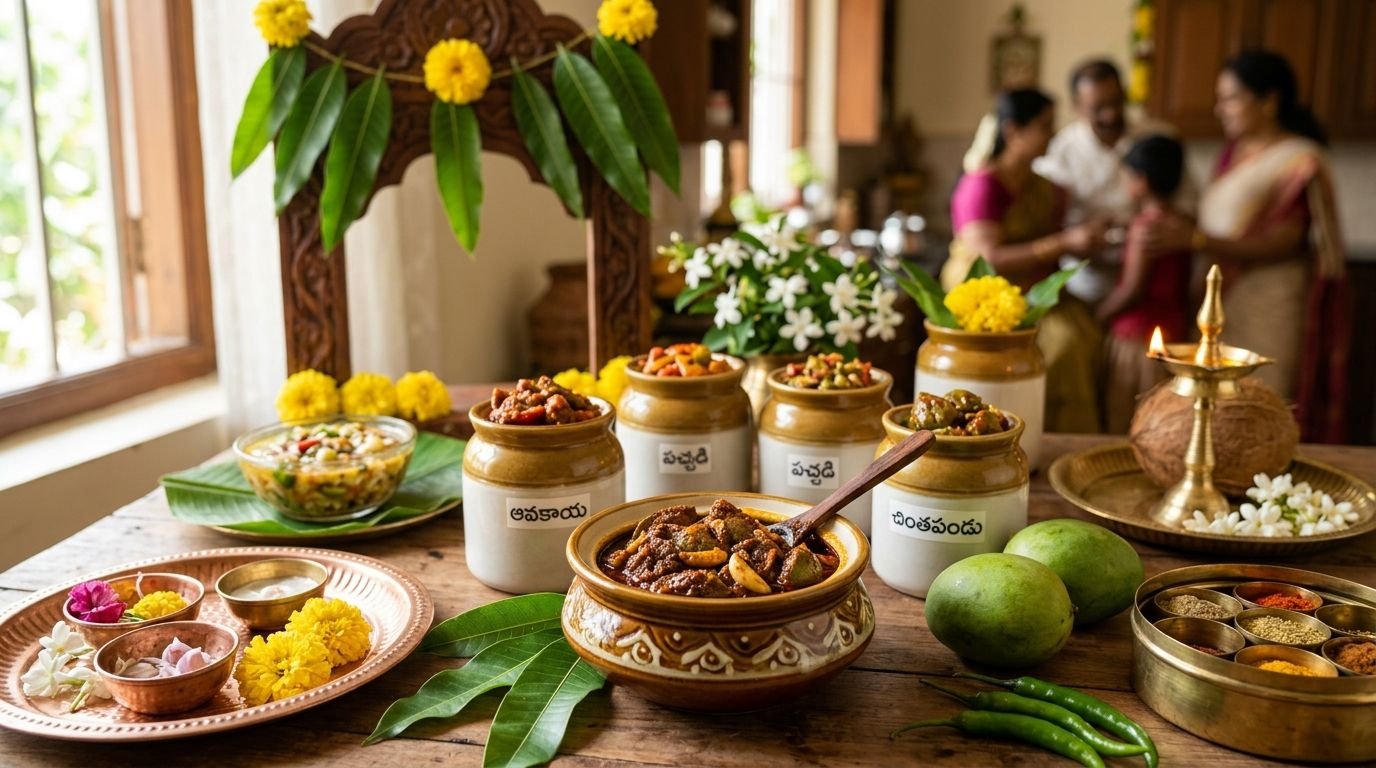
Andhra pickles for Ugadi festival celebrations are the jar-sized version of the six tastes Telugu households stir into Ugadi pachadi every year, meant to round out the festive thali and travel well as gifts for guests. A Ugadi table needs a spread that covers sweet, sour, salty, bitter, pungent and astringent notes at once in 2026, not a single large jar of one flavor.
- Andhra pickles for Ugadi work best as a six-jar spread matching the pachadi’s sweet, sour, bitter and pungent notes.
- Avakaya, gongura, tamarind, sweet mango, bitter gourd and garlic jars each cover one Ugadi pachadi taste.
- Order 10-12 days before Ugadi weekend in 2026 to avoid festival-week courier backlogs across India and overseas.
- Skip single-jar orders for gatherings of 8-10 people; a sampler spread beats one large avakaya jar.
- Confirm veg-only or mixed non-veg pickles before an evening puja, since some households keep the table vegetarian.
Why Andhra pickles matter for an Ugadi table
Ugadi marks the Telugu New Year, and the ritual dish that opens the meal, Ugadi pachadi, is built from six tastes in one bowl: jaggery for sweet, tamarind for sour, salt, raw mango for astringent, neem flower for bitter and green chili for pungent. Most Andhra households extend that same six-taste logic across the rest of the Ugadi meal through a spread of authentic Andhra pickles rather than one large jar of a single flavor.
That's the actual constraint on a Ugadi table: guests expect variety on the pickle tray, not depth in a single jar. A family serving 8-10 people for Ugadi lunch works through more pickle varieties in one sitting than a regular week, and mixed veg-non-veg households need to settle whether non-veg pickles belong on the table before an evening puja.
Match your pickle jars to the six Ugadi tastes
Start by listing what Ugadi pachadi already covers, then pick a pickle for each note instead of duplicating one flavor across six jars. This is the free, manual way to plan the spread before you order anything.
- Sour and pungent — raw mango avakaya, the closest match to the pachadi's mango-and-chili base
- Sweet — a jaggery-based sweet mango pickle, mirroring the bellam in the pachadi bowl
- Tangy — gongura or tamarind pickle for the sharper sour edge
- Bitter — bitter gourd pickle, the note most families skip and the one that completes the tradition
- Pungent (immunity) — garlic pickle, a common Andhra staple through spring
- Heat — red chilli pickle for guests who want more spice than avakaya gives
Check for authentic recipe markers before you order
A mass-market jar can skip the sun-dried mango and cold-pressed oil that make the sour and pungent notes work, so check the label before it lands on your Ugadi table. This step matters more for festival cooking than everyday pickle buying, since guests notice a flat or oily jar faster at a gathering.
- Oil listed is mustard or sesame, not refined vegetable oil
- Mango or vegetable pieces are irregular-cut, not diced factory-style
- No preservative code (E211, E200) on the ingredient list
- Recipe is named after a region — Andhra, Guntur, Vijayawada — not just "mixed pickle"
- Masala visibly clings to the pieces instead of sitting in liquid at the bottom
Tulasi Pickles jars are made in Hyderabad using cold-pressed oil and hand-mixed masala, so checking one brand's ingredient list against these five markers is faster than reading labels across five different sellers.
Decide veg-only or mixed non-veg for the table
Some Ugadi households keep the entire day vegetarian around the morning puja and pachadi ritual, then open up to non-veg pickles at dinner. Others serve both from the start. Settle this before you place an order, since chicken, mutton and prawns pickles need separate serving dishes from the veg spread by most Andhra household customs.
- Veg-only table: avakaya, gongura, tamarind, garlic, bitter gourd, red chilli
- Mixed table: add one non-veg jar (chicken, mutton or prawns) for the evening meal
- Guests with dietary restrictions: check for a plain, low-oil vegetable pickle as a fallback
For a vegetarian Ugadi table, a sweet mango pickle covers the jaggery note on its own, without any meat pickle needed at all.
Add a podi and a festive sweet to complete the thali
Pickles cover the taste spectrum, but a full Ugadi thali also carries a dry spice powder (podi) for rice-mixing and a sweet for dessert. Podis stretch further than pickles across a large gathering, since a small spoon mixed into hot rice goes a long way.
- Peanut or sesame podi for plain rice on the side
- A festive sweet (laddu, pootharekulu-style item) to close the meal
- A crisp snack (murukku, chegodilu-style item) for guests arriving before lunch
- One podi with ghee for children or elders who skip spicy pickles
Order your Ugadi pickle spread
Shop the veg and non-veg pickle range before Ugadi week fills up.
Order early enough to beat festival-week shipping
Couriers slow down in the days right before any major Indian festival, and Ugadi is no exception. Placing an order 10-12 days ahead gives enough buffer for a delayed pickup or a re-route, especially for overseas orders that already carry longer transit times.
- Domestic orders: order at least a week before Ugadi weekend
- Overseas orders (US, UK, Gulf): order 2-3 weeks ahead to clear customs in time
- Bulk or gifting orders: confirm delivery dates in writing before the festival week starts
Store the jars once they arrive and pack extras as return gifts
Homemade pickles without heavy preservatives need the right storage from day one, especially if they sit out on a serving table for a full Ugadi lunch. Getting this wrong is how a jar that should last months turns cloudy or develops a film within weeks.
- Keep jars away from direct sunlight and stove heat during the festival meal
- Use a dry spoon every time, never a wet or previously-used one
- Refrigerate after opening if the household doesn't finish a jar within a few days
- Full guidance is in the pickle storage guide for jars that need to last past the festival week
Extra small jars work well as return gifts for guests who visited for Ugadi lunch, since a single-serving pickle jar travels better than a sweet box in warm March weather.
Comparing pickle order options for an Ugadi table
| Option | Best for | Key limitation |
|---|---|---|
| Single large jar, one flavor | Small households eating one pickle daily anyway | Doesn't cover the six-taste Ugadi tradition |
| Six-jar sampler (avakaya, gongura, tamarind, sweet mango, bitter gourd, garlic) | Families hosting a full Ugadi lunch or puja | Needs more table space and planning than one jar |
| Podi and pickle combo | Households that want rice-mixing options alongside the pickle tray | Podi needs dry rice, doesn't replace the wet thali pickles |
| Sweets and snacks combo | Return gifts for guests after the meal | Doesn't cover the pickle side of the Ugadi table at all |
A six-jar sampler covering avakaya, sweet mango, gongura, bitter gourd, garlic and red chilli is the closest match to what Ugadi pachadi already represents in one bowl.
Common mistakes Ugadi hosts make
- Ordering one 1kg avakaya jar for 8-10 guests and running out of variety halfway through lunch, with nothing else on the table.
- Serving heavy non-veg pickles before an evening puja in a household that keeps the day vegetarian until dark.
- Waiting until Ugadi week to order online, then finding courier slots full during the festival rush.
- Skipping the bitter and pungent notes (bitter gourd, garlic) because they're less popular, which misses the point of the six-taste pachadi tradition.
- Sending overseas relatives a jar without checking transit time, risking a pickle that arrives after Ugadi has already passed.
“Ugadi pachadi already puts six tastes in one bowl; a pickle tray that copies only one of them isn’t really keeping the tradition.”
FAQ
What pickles do Telugu families usually serve on Ugadi?
Most Andhra households serve avakaya, gongura, tamarind and a sweet mango pickle on Ugadi, matching the sour, tangy and sweet notes already in Ugadi pachadi. Bitter gourd and garlic pickles round out the bitter and pungent notes for households that keep the full six-taste tradition.
Is avakaya pickle traditional for Ugadi?
Yes, avakaya is one of the most common pickles on an Ugadi table because raw mango is already central to Ugadi pachadi. It covers the sour and pungent notes that the ritual dish is built around.
How much pickle should I order for an Ugadi family gathering?
For 8-10 guests, a spread of five to six smaller jars covering different tastes works better than one large jar in a single flavor. Guests expect variety on the pickle tray during a festival meal, not depth in one jar.
Can I gift Andhra pickles for Ugadi?
Yes, small pickle jars are a common Ugadi return gift because they travel well in warm March weather and don’t need refrigeration before opening. A single-serving jar per guest works better than a large shared jar for gifting.
How early should I order pickles before Ugadi?
Order at least 10-12 days before Ugadi weekend for domestic delivery in 2026, and 2-3 weeks ahead for overseas orders to clear customs in time. Festival-week courier delays are common right before major Indian holidays.
Are non-veg pickles served during Ugadi?
Some households add chicken, mutton or prawns pickle to the evening meal after keeping the day vegetarian through the morning puja. Others serve non-veg pickles from the start; the choice depends on the household’s own puja customs.
Do Andhra pickles ship overseas in time for Ugadi?
Overseas shipping for homemade pickles takes longer than domestic delivery, so orders placed 2-3 weeks before Ugadi have the best chance of arriving on time. Checking a shipping guide before ordering avoids spoilage risk on longer routes.
How long do homemade Andhra pickles stay fresh after Ugadi?
Properly stored homemade pickles kept away from sunlight and served with a dry spoon last for months past the festival. Refrigerating after opening extends shelf life further once a jar is partially used.
One last thing
Ugadi pachadi already solves the hard part of festival cooking by putting six tastes in a single bowl instead of six separate dishes. A pickle tray built the same way, one jar per taste, isn't a marketing bundle; it's the same logic the festival already uses, just spread across avakaya, sweet mango, gongura, bitter gourd, garlic and red chilli instead of one bowl.
Related guides