
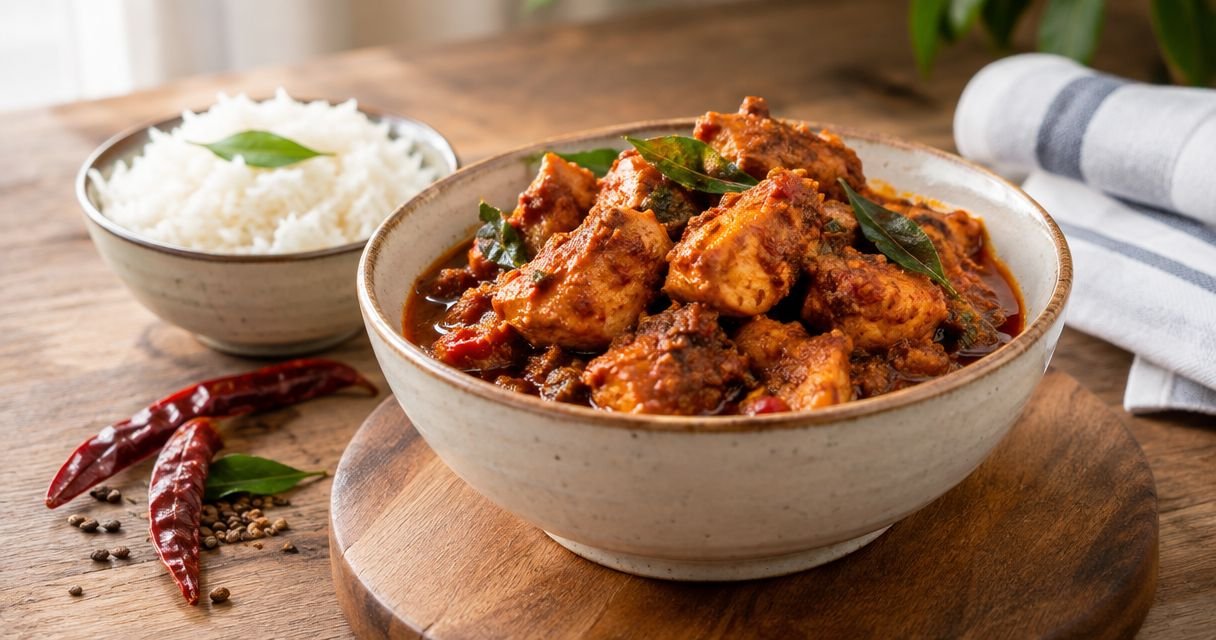
Best overall for comparing chicken pickle 1kg price in 2026: a verified 1 kg boneless pack. Best for splitting across meals: two 500 g boneless packs. Best for smaller portions: four 250 g boneless packs. These are buying formats, not a price ranking of sellers: compare them only when the pack size and boneless description are confirmed on the current listing.
- For chicken pickle 1kg price comparisons, a verified 1 kg boneless pack is the clearest benchmark.
- Two 500 g packs or four 250 g packs also total 1 kg, if those sizes are offered.
- Tulasi Pickles suits shoppers seeking Andhra-style non-veg pickles; confirm boneless status before comparing a listing.
- Compare the final checkout total for the same net weight, not the pack label alone.
Why this matters
A lower amount on a product page does not establish a better chicken pickle 1kg price. The pack may contain less pickle, and a delivery charge can change the amount you pay. Start with the stated net weight, then compare the final checkout total for the same quantity. The guide to comparing chicken pickle prices covers that decision in more detail.
Boneless status matters just as much as weight. A chicken pickle listing that does not clearly say boneless cannot be treated as an equivalent match, even if its jar looks similar. Tulasi Pickles is an Andhra-style non-veg pickle seller; check the current product description before counting any of its listings as a boneless 1 kg option.
In 2026, the useful question is not which pack has the smallest number beside it. It is which confirmed boneless option gives you the quantity you want for the lowest final amount payable. If a listing leaves either the contents or net weight unclear, set it aside until the seller clarifies it.
What makes the best-value boneless chicken pickle?
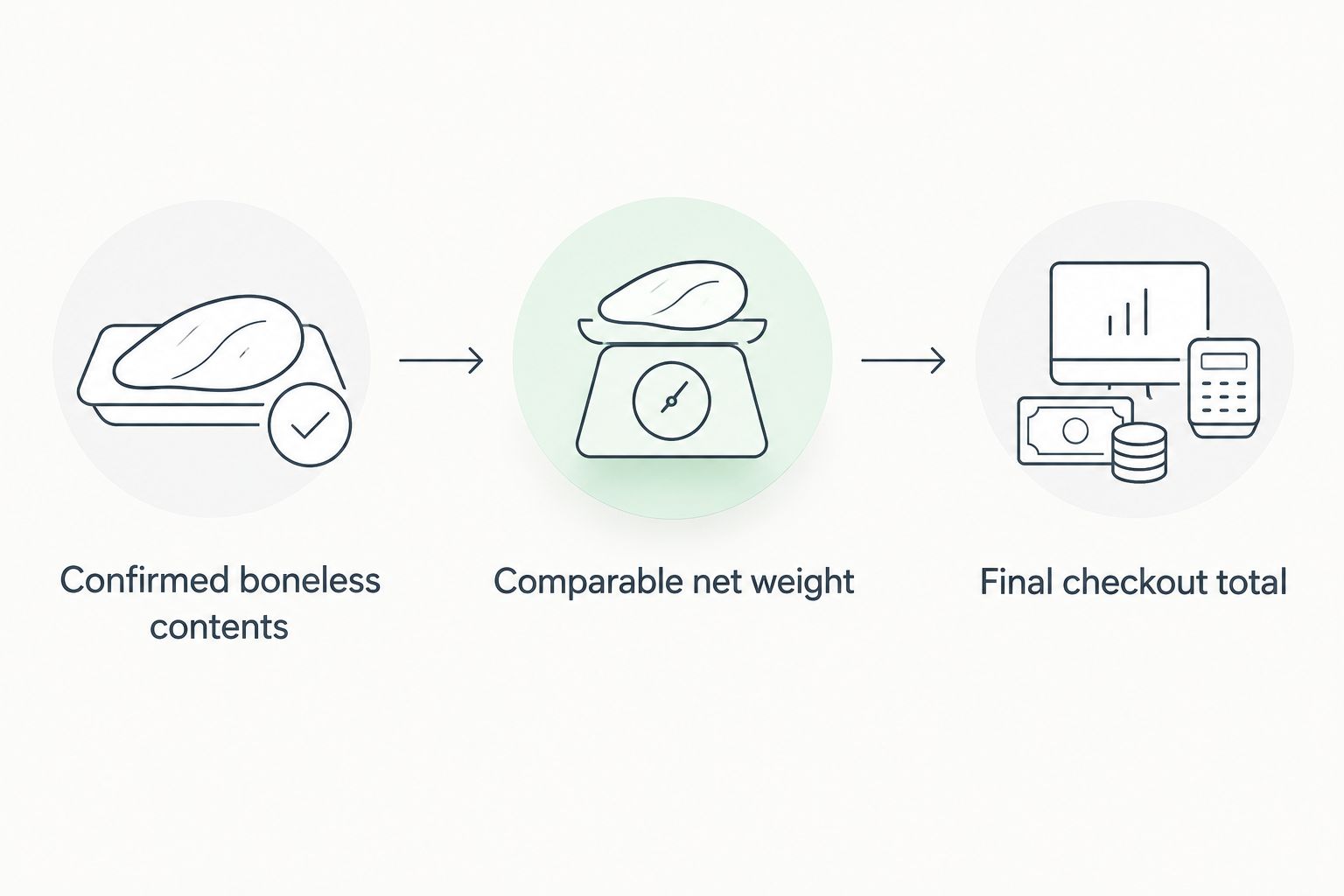
- Confirmed boneless contents: The listing must explicitly identify the chicken pickle as boneless. Do not infer this from a photograph or a general chicken pickle category.
- Comparable net weight: Compare 1 kg with 1 kg. A 500 g pack is half that weight; two 500 g packs equal 1 kg.
- Final checkout total: Use the amount payable for the complete order, including any delivery charge shown at checkout. A product-page figure alone is not the final comparison.
- Clear ingredient information: Read the ingredients if you have a dietary restriction or want a particular style of seasoning. Do not assume that two Andhra-style pickles use the same recipe.
- Useful pack division: One large pack gives you one container to manage. Smaller packs divide the same total weight into separate containers, when those sizes are offered.
- Storage instructions: Follow the instructions on the actual pack, particularly after opening. Do not apply the storage directions from one seller's chicken pickle to another's.
Use those checks in that order. A cheaper-looking pack that fails the boneless check is not a substitute for boneless chicken pickle. A pack with unclear weight cannot support a 1 kg comparison.
Boneless chicken pickle options at a glance
The ranking below orders ways to buy the same total weight, not sellers by an unverified price. In 2026, use a current checkout total to decide which format costs less for your delivery address. The smaller-pack formats apply only where a seller offers them and confirms that each pack is boneless.
| Rank and option | Best for | Standout feature | Key limitation |
|---|---|---|---|
| 1. One 1 kg boneless pack | A direct 1 kg comparison | One stated net weight to check | One container may not suit a household that wants separate portions |
| 2. Two 500 g boneless packs | Dividing the order into two portions | Combined net weight equals 1 kg | Both packs must be confirmed boneless; the final total can differ |
| 3. Four 250 g boneless packs | Smaller separate portions | Combined net weight equals 1 kg | More individual packs to verify; this format may not be offered |
No row wins on price without current checkout totals. The first row wins as a benchmark because its stated quantity matches the search directly. For the other rows, add the pack weights before you compare what you pay.
1. One 1 kg boneless pack: best for a direct comparison
A single pack labelled 1 kg and boneless gives you the simplest answer to a chicken pickle 1kg price search. Confirm that 1 kg is the stated net weight of the pickle and that boneless refers to the chicken in the pack. Then check the final checkout total for your delivery address.
One 1 kg pack pros:
- The stated weight matches the quantity you searched for.
- You can compare one listing against another without adding pack weights.
- There is only one pack description and set of storage instructions to review.
One 1 kg pack cons:
- One container is less convenient if you want to keep portions separate.
- A 1 kg label alone does not establish how much chicken is in the pickle.
- A product-page amount does not establish the final checkout total.
One 1 kg pack price check: Compare final checkout totals only after confirming that both listings describe boneless chicken pickle with the same net weight. Do not treat a photograph of chicken pieces as confirmation of boneless contents.
Best for: You want one pack and the most direct like-for-like comparison.
Verdict: Buy when the listing confirms boneless contents and 1 kg net weight, and its final total meets your budget. Otherwise, hold until the seller clarifies the listing.
2. Two 500 g boneless packs: best for two separate portions
Two 500 g packs add up to 1 kg. This format is useful if you want to open one portion while keeping the other unopened, provided the seller actually offers that pack size. Check both product descriptions if you are combining different listings; do not assume they contain the same style of chicken pickle.
Two 500 g packs pros:
- The combined net weight matches a 1 kg comparison.
- Separate packs let you divide the order without transferring pickle to another container.
- You can assess each pack's ingredients and storage directions separately.
Two 500 g packs cons:
- Both packs must explicitly be boneless for a boneless comparison.
- The combined checkout total can differ from a single-pack order.
- This format depends on a confirmed 500 g option being offered.
Two 500 g packs price check: Add the amounts payable for both packs and include the delivery charge shown for the complete order. Compare that final figure with a confirmed single 1 kg boneless pack, not with one 500 g pack.
Best for: You want the equivalent of 1 kg in two separate containers.
Verdict: Buy when the two-pack checkout total and portioning suit you. Hold if either pack's weight or boneless status is unclear.
3. Four 250 g boneless packs: best for smaller portions
Four 250 g packs also add up to 1 kg. Consider this format only if confirmed boneless packs of that size are offered. It serves a different purpose from a single large pack: keeping the total quantity divided into smaller containers.
Four 250 g packs pros:
- The combined stated net weight can match 1 kg.
- Separate containers make it easier to open one portion at a time.
- Each pack has its own description to check before ordering.
Four 250 g packs cons:
- You must verify the boneless description and weight across more packs.
- A lower amount per pack does not establish a lower amount for 1 kg.
- The required pack size may not be listed by the seller you want.
Four 250 g packs price check: Compare the final amount payable for all four packs with the final amount for one confirmed 1 kg pack. If the seller does not offer four suitable packs, this option is not a valid match.
Best for: You value smaller separate portions more than the simplicity of one pack.
Verdict: Buy only when all four packs are confirmed boneless and the final total works for your order. Otherwise, skip this format.
How this ranking works
The ranking puts the easiest direct comparison first, followed by formats that divide the same 1 kg total. It does not put sellers in order of expense. That would require current, comparable checkout totals for confirmed boneless listings, including delivery to the same address.
For a 2026 comparison, write down the boneless description, stated net weight and final amount payable for each eligible order. If one of those details is absent, do not fill it in from another listing or from the jar photograph. Use the chicken pickle budget guide to decide which trade-off matters to you before placing an order.
Tulasi Pickles belongs on your shortlist for Andhra-style non-veg pickles, not automatically at the top of a boneless price ranking. Confirm the precise product type and pack weight on its current listing, then apply the same checks to any alternative. A familiar brand is not a substitute for a matching product description.
Which boneless chicken pickle format should you choose?
Choose a confirmed 1 kg boneless pack by default. It answers the quantity in the search without extra arithmetic. If you prefer separate containers, compare two confirmed 500 g packs against it. Choose four confirmed 250 g packs only when that format is offered and smaller portions justify the extra checks.
Before paying in 2026, make the comparison on the same basis: boneless chicken pickle, 1 kg total stated net weight and the final amount payable to your address. If a candidate is bone-in, has an unspecified weight or does not clearly describe its contents, remove it from the comparison rather than treating it as a cheaper match.
Check the current pickle selection
Review non-veg pickle descriptions and pack weights before comparing your options.
FAQ
What is the best way to compare chicken pickle 1kg price in 2026?
Compare the final checkout total for confirmed boneless chicken pickle with 1 kg total stated net weight. Check the product description and delivery amount before deciding which order costs less.
Is one 1 kg pack better than two 500 g packs?
One 1 kg pack is easier to compare directly; two 500 g packs suit someone who wants separate portions. Both formats total 1 kg when their stated net weights are accurate, so compare their current checkout totals.
Do four 250 g packs equal 1 kg?
Yes, four 250 g packs total 1 kg by stated net weight. For a boneless chicken pickle comparison, each pack must also be confirmed boneless.
Does a 1 kg chicken pickle label mean 1 kg of chicken?
No. A 1 kg pickle label states the product’s net weight, not the weight of chicken alone. Check the product description for any further breakdown rather than assuming one.
Can I rank boneless chicken pickle brands by price without checkout totals?
No. A defensible price ranking needs comparable current totals for the same product type and weight. Delivery charges can change what you pay for an order.
Does Tulasi Pickles sell a confirmed 1 kg boneless chicken pickle?
Check the current Tulasi Pickles listing for an explicit boneless description and 1 kg net weight. Its Andhra-style non-veg pickle range alone does not confirm a specific boneless pack.
What if a chicken pickle listing does not say boneless?
Do not include it in a boneless chicken pickle comparison. Ask the seller to confirm the contents or choose a listing that states them clearly.
One last thing
The smallest amount shown beside a pack can lead to the wrong choice. A 250 g pack and a 1 kg pack are not competing quantities until you total four of the smaller packs and compare the complete orders. In 2026, confirm the boneless description first, match the net weight second and compare the final checkout totals last.
Related guides
- Best boneless chicken pickle online
- How to store non-veg pickles safely in the refrigerator
- Best chicken pickle 1 kg packs for family stocking