
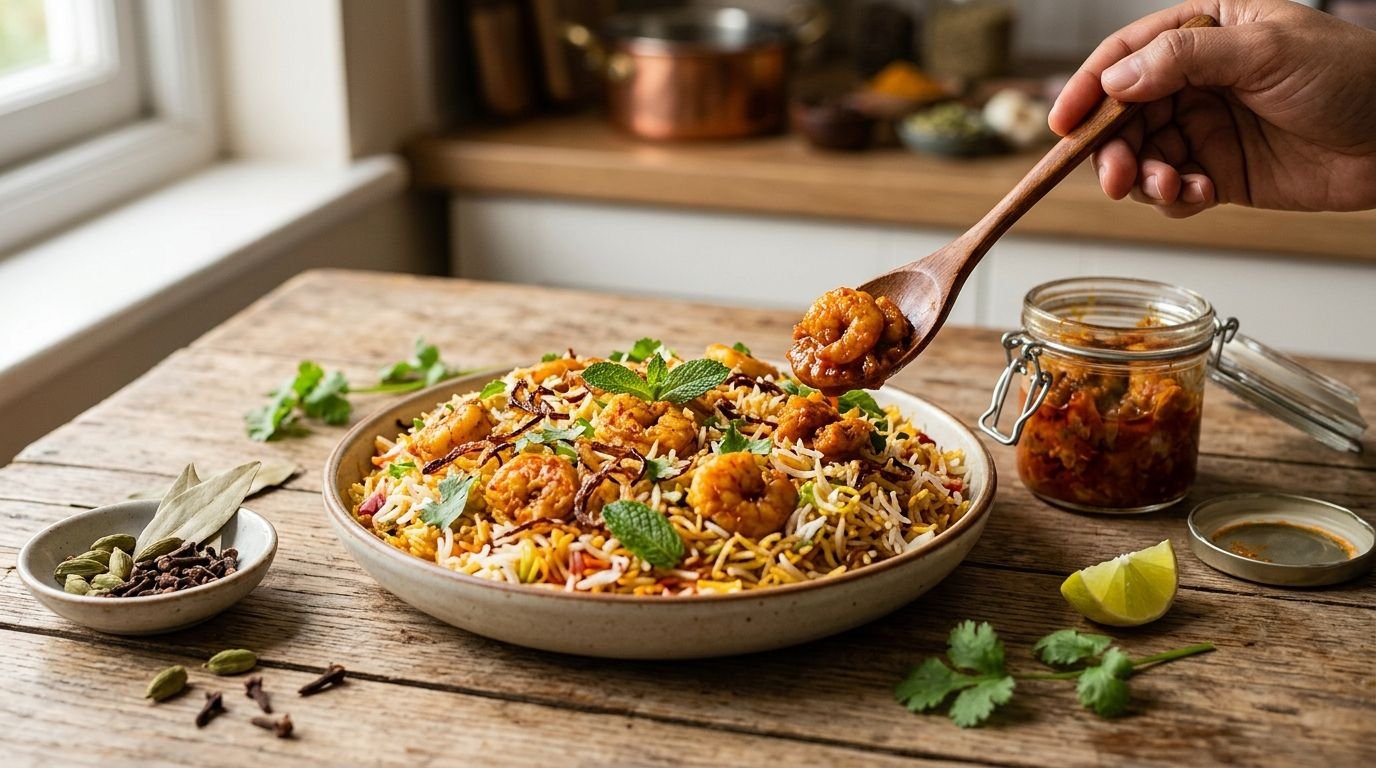
Prawns pickle turns a pot of leftover rice into a 20-minute biryani by replacing the entire masala-and-marinade step with two to three tablespoons of ready-made pickle. Stir it through hot rice with fried onions and a splash of the pickle's own oil, and you skip the 45-minute prawn-cleaning-and-marinating stage that a from-scratch biryani demands — the trade-off is that you're working with pre-cooked, already-salted prawns, so you add no extra salt until you've tasted the dish.
How to make prawns pickle biryani
The fastest version uses cooked rice, fried onions, and jarred prawns pickle from Tulasi Pickles as the flavor base. Here's the sequence that works every time in 2026 test batches at home:
- Heat 1 tablespoon of ghee or oil in a pan and fry one thinly sliced onion until golden, about 6-8 minutes.
- Add 2-3 tablespoons of prawns pickle along with 1 tablespoon of its oil — this oil carries most of the red chili and mustard flavor, so don't skip it.
- Toss in 3 cups of cooked, cooled basmati rice and mix on low heat for 3-4 minutes so the rice picks up color evenly.
- Finish with chopped coriander and a squeeze of lemon; rest the pan off heat for 5 minutes before serving so the rice absorbs the oil.
Total active cooking time runs 12-15 minutes once the rice is already cooked, which is why this counts as a quick biryani rather than a full dum biryani.
- Prawns pickle biryani recipe takes 12-15 minutes of active cooking once rice is ready — no marination needed.
- 2-3 tablespoons of prawns pickle plus 1 tablespoon of its oil replaces the entire masala base.
- Tulasi Pickles’ prawns pickle works because the prawns are already cooked and spiced, unlike raw biryani prawns.
- Use day-old rice, not fresh-cooked rice, or the biryani turns mushy.
Why this matters
Most home cooks in Hyderabad already keep a jar of non-veg pickle in the fridge, but almost nobody thinks to use it as a biryani shortcut — it gets treated purely as a side dish. That's a missed use case: a well-made prawns pickle carries the same tamarind, red chili, and mustard oil base that goes into a traditional prawn biryani masala, just concentrated and shelf-stable. Once you know the ratio, a jar that normally lasts weeks as a condiment becomes a standing biryani ingredient too.
Prawns pickle biryani: step-by-step for beginners
| Step | Action | Time |
|---|---|---|
| 1 | Fry sliced onion in ghee | 6-8 min |
| 2 | Stir in pickle + pickle oil | 1 min |
| 3 | Fold in cooked rice | 3-4 min |
| 4 | Rest off heat, garnish | 5 min |
This table is the entire recipe — there's no marinating, no separate masala grinding, and no pressure cooking. If you're using Tulasi Pickles prawns pickle straight from the jar, the prawns are already tender enough that they don't need further cooking; you're just reheating them through the rice.
Dum-style version: 35 minutes
For a layered version closer to a restaurant biryani, cook basmati rice to 70% doneness, layer it with fried onions and 4-5 tablespoons of prawns pickle, cover tightly, and cook on low heat (dum) for 15-18 minutes. This version costs you an extra 20 minutes over the quick method but produces a more traditional texture with distinct rice layers instead of a uniform stir-fried finish. Best for: weekend cooking when you have time to spare. Skip this if you need dinner on the table in under 20 minutes.
Why the quick method works better on weeknights
- No raw seafood handling — the prawns arrive pre-cooked and pickled, cutting out cleaning and deveining time entirely.
- Fixed spice level — the pickle's chili content is consistent jar to jar, so you're not guessing masala quantities.
- Long shelf life of the base ingredient — a jar of pickle keeps for weeks refrigerated, unlike fresh prawns that need same-day use.
- Works with leftover rice — day-old rice absorbs the pickle oil better than freshly steamed rice, which stays too moist.
- Portion control — you scale the recipe up or down just by adjusting tablespoons of pickle, no separate masala batch needed.
Related questions
Can I use any non-veg pickle instead of prawns pickle for this biryani?
Prawns pickle works best for seafood biryani, but the same 2-3 tablespoon method applies to other jarred pickles if you're building a different biryani. A boneless mutton or chicken pickle from the same base recipe gives a heavier, richer biryani, while prawns pickle keeps the dish lighter and finishes faster since the prawns are smaller.
How much prawns pickle do I need for 4 servings?
4 servings of prawns pickle biryani need about 6 cups of cooked rice and 5-6 tablespoons of pickle, roughly double the single-batch ratio. Taste before adding more — pickle salt levels vary by jar, and Tulasi Pickles' prawns pickle runs on the spicier side compared to mild store-bought versions.
Does prawns pickle biryani taste different from fresh prawn biryani?
Yes — prawns pickle biryani has a tangier, more concentrated flavor than fresh prawn biryani because the prawns have already absorbed tamarind, mustard, and chili over days of pickling rather than a single cooking session. Fresh prawn biryani tastes brighter and less intense; pickle-based biryani tastes deeper and holds its flavor longer when reheated the next day.
Can leftover pickle oil be used for biryani if I run out of pickle?
Leftover pickle oil alone won't replace the prawns, but it does carry enough chili and mustard flavor to season plain rice in a pinch. Check how to reuse leftover pickle oil in everyday cooking for other ways to use it before it goes to waste.
How do I store leftover prawns pickle biryani?
Refrigerate leftover biryani within 2 hours of cooking and eat it within 2 days — the pickle's oil and chili content act as a mild preservative, but the rice itself still spoils at normal rates. Reheat with a splash of water to loosen the rice before serving.
One genuinely useful trick: if your biryani tastes flat after mixing in the pickle, it's almost never a salt problem — it's usually a tamarind problem, since jarred pickle mellows over time in the fridge. A fresh squeeze of lemon at the end fixes it faster than adding more pickle.
Order prawns pickle for your next biryani
Homemade Andhra-style prawns pickle, shipped fresh from Hyderabad.
FAQ
How much prawns pickle do I need for a quick biryani?
You need 2-3 tablespoons of prawns pickle plus 1 tablespoon of its oil for every 3 cups of cooked rice. Double the quantity for 4 servings and taste before adding salt since pickle is already salted.
Is prawns pickle biryani spicier than regular biryani?
Prawns pickle biryani is usually spicier than a home-style biryani because the pickle’s chili and mustard oil are concentrated over days of pickling. Reduce the pickle quantity to 1.5 tablespoons per 3 cups of rice if you want a milder result.
Can I make this biryani with day-old rice?
Day-old rice actually works better than freshly cooked rice for prawns pickle biryani because it’s drier and absorbs the pickle oil without turning mushy. Fresh rice holds too much moisture and can clump when mixed with the pickle.
What’s the difference between quick prawns pickle biryani and dum-style biryani?
The quick method stir-fries pickle through already-cooked rice in 12-15 minutes, while the dum-style version layers partially cooked rice with pickle and steams it for 15-18 minutes under a sealed lid. Dum-style gives distinct rice layers; the quick method gives a uniform, faster result.
Does prawns pickle need refrigeration before using it in biryani?
Yes, prawns pickle should be refrigerated after opening and used within the timeframe noted on the jar. Check how to store non-veg pickles safely in the refrigerator for handling guidance before you cook with an opened jar.
Can I add vegetables to prawns pickle biryani?
Yes, sliced onions, green peas, or capsicum can be fried alongside the base onion before you add the pickle and rice. Keep vegetable additions light since the pickle already carries a strong flavor profile that can get lost under too many extra ingredients.
Why does my prawns pickle biryani taste too oily?
Too much pickle oil is the usual cause — stick to 1 tablespoon of oil per 3 cups of rice and drain excess oil off the pickle before measuring. Andhra-style pickles are packed in oil for preservation, so a full tablespoon on top of what clings to the pickle itself is often enough.
One last thing
The single biggest mistake in prawns pickle biryani isn't the pickle quantity — it's using freshly steamed rice instead of rice that's rested for at least 2 hours. Rice that's still warm and moist breaks down when you stir in the pickle's oil and turns the whole dish sticky instead of grain-separated, which is the one texture problem no amount of extra pickle can fix.
Related guides
- How to make avakaya pulihora at home
- How to store non-veg pickles safely in the refrigerator
- How to reuse leftover pickle oil in everyday cooking
- Best non-veg pickles in Hyderabad for meat lovers