
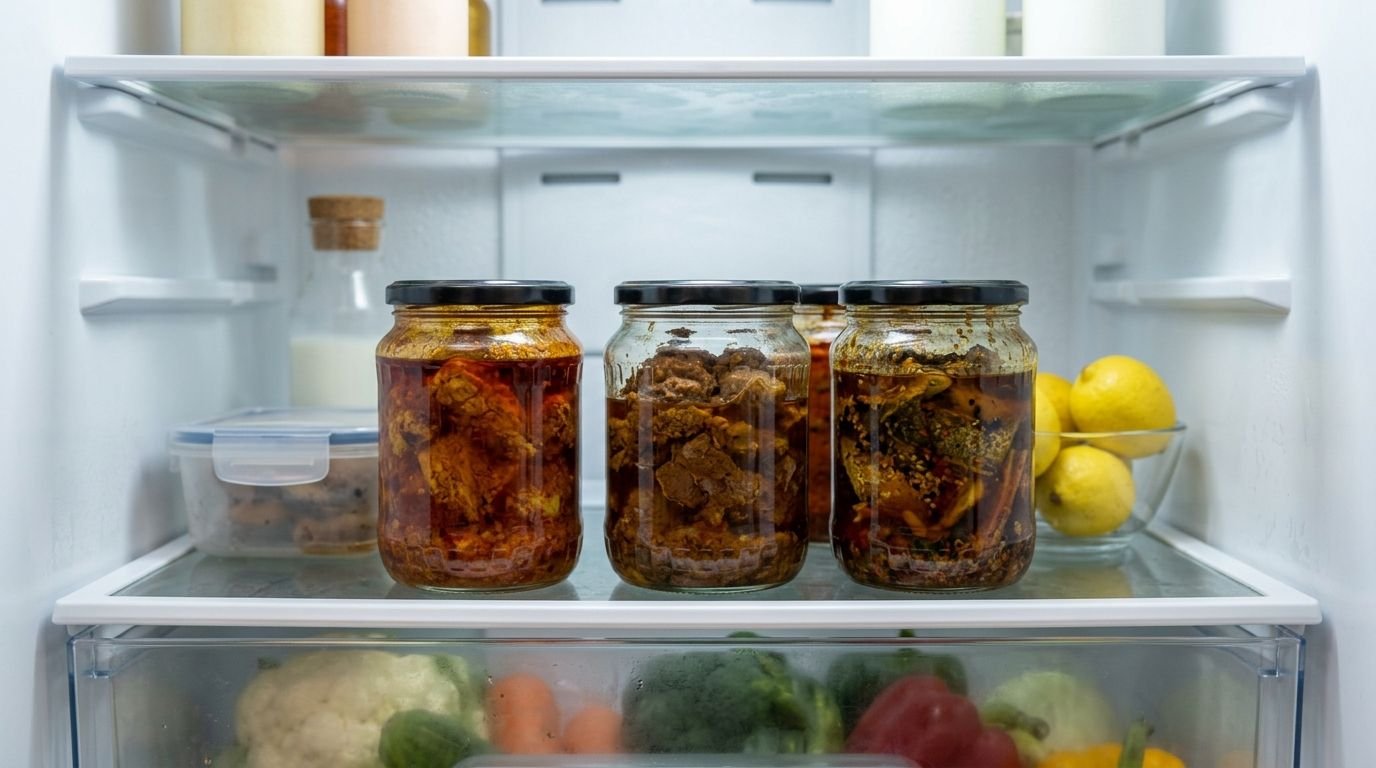
Non-veg pickles like chicken, mutton, prawn, and fish stay safe in the refrigerator when the meat is fully submerged under an oil layer, kept in an airtight glass or food-grade jar, and served with a dry spoon every single time. The oil layer is doing the actual preservation work — the moment a piece pokes above the surface or the spoon carries in moisture, spoilage risk climbs even inside a cold fridge in 2026.
- Non-veg pickle stays safe in the fridge only when meat sits fully under the oil line — exposed pieces spoil fastest.
- A dry spoon every time is non-negotiable; one wet scoop introduces bacteria that oil and salt cannot stop.
- Store the jar at the back of the fridge, not the door, to avoid temperature swings every time it opens.
- Chicken and mutton pickle hold up longer refrigerated than prawn or fish pickle, which are more perishable.
- Tulasi Pickles ships its non-veg range with a heavy oil seal built for cold storage and long transit in 2026.
Why this matters
Most non-veg pickle spoilage isn't a fridge temperature problem — it's a handling problem. People scoop with a wet spoon, leave the jar open on the counter while cooking, or let a piece of chicken sit half-exposed above the oil for days. In 2026, with more non-veg pickle bought online and shipped across India and overseas, the gap between "refrigerated" and "stored correctly" matters more than ever.
A jar that looks fine can already be compromised if the oil seal is broken. This guide covers exactly how to store it so the batch you paid for actually lasts, plus how storage needs shift depending on whether you're dealing with chicken, mutton, prawn, or fish pickle. For a broader look at shelf-stable storage across pickle types, the long shelf life storage guide covers the basics that apply to veg pickles too.
How to store non-veg pickles safely in the refrigerator
Follow these steps in order every time you open a fresh jar or transfer pickle into a smaller container for daily use.
- Use a clean, completely dry jar. Glass or food-grade plastic both work; any trace of water inside the jar shortens shelf life fast.
- Press every piece of meat below the oil line. If a piece sticks out, push it down with a dry spoon or top up with a little extra oil until it's covered.
- Top up the oil if the level looks low. The oil layer is the barrier between the meat and air — a thin or cracked layer is the single biggest cause of early spoilage.
- Seal the lid tightly and place the jar at the back of the fridge. The door shelf swings in temperature every time it opens; the back of a shelf stays closer to a steady 4°C (40°F).
- Use a dry spoon for every serving, no exceptions. Wet or previously used spoons carry bacteria straight past the oil seal.
- Let solidified oil come back to room temperature before serving. Refrigerated oil thickens and turns cloudy — this is normal, not spoilage, and it clears once the jar sits out for a few minutes.
| Step | What it protects against |
|---|---|
| Dry jar | Bacterial growth from residual moisture |
| Meat under oil | Oxidation and surface spoilage |
| Dry spoon only | Cross-contamination from saliva or food residue |
| Back-of-fridge placement | Temperature swings from door use |
The rule that matters most: if the meat is visible above the oil, the jar is not properly stored — fix it before it goes back in the fridge.
Why non-veg pickle storage needs vary
Not every non-veg pickle behaves the same way in the fridge. A few factors change how careful you need to be:
- Meat type: Chicken and mutton pickle, denser and typically cooked longer in oil and spice before bottling, tend to hold up better under refrigeration than prawn or fish pickle, which are more delicate proteins.
- Oil quantity: A jar with a generous oil layer protects the meat longer than one with a thin, barely-there coating.
- Boneless vs. bone-in cuts: Boneless pieces expose more surface area to air once the jar is opened, so they need a tighter oil seal than bone-in cuts of the same meat.
- How often the jar is opened: Every opening lets warm, humid air in briefly — a jar opened daily needs stricter spoon discipline than one opened weekly.
- Spice and salt level: Higher salt and chilli content act as natural preservatives, so milder or low-spice non-veg pickle needs colder, more consistent storage.
- Homemade vs. commercially sealed: A freshly opened factory-sealed jar starts its fridge life differently than pickle transferred from a larger batch at home.
Tulasi Pickles makes its non-veg pickles with an oil-to-meat ratio built for exactly this kind of cold storage, since the same jars travel by courier across India and overseas before they ever reach a fridge.
Craving fresh non-veg pickle in Hyderabad?
Homemade chicken, mutton, and prawn pickle delivered across Hyderabad and beyond.
How long do non-veg pickles last in the refrigerator?
Refrigerated non-veg pickle lasts considerably longer than the same jar left at room temperature, as long as the oil seal stays unbroken and every scoop uses a dry spoon. The moment the oil layer cracks or a piece of meat is repeatedly exposed to air, the safe window shrinks fast regardless of fridge temperature.
Can you freeze non-veg pickle for longer storage?
Freezing works for non-veg pickle and is standard practice for jars shipped over long distances, including frozen international shipments. Thaw it in the fridge rather than on the counter, and expect the oil to separate slightly — stir gently once it's back to room temperature and the texture returns to normal. The frozen overseas shipping guide covers what happens to the jar in transit before it reaches your freezer in 2026.
Why does the oil turn solid or cloudy in the fridge?
Oil solidifying or turning cloudy in the fridge is a normal reaction to cold, not a sign of spoilage. Most cooking oils used in Andhra-style pickles thicken below room temperature and clear up again within minutes once the jar sits out.
Should chicken pickle be refrigerated immediately after opening?
Yes — chicken pickle goes back into the fridge as soon as you're done serving, not after the meal ends. Warm kitchen air accelerates spoilage far faster in meat-based pickle than in vegetable pickle, because the meat itself is the higher-risk ingredient.
Is it safe to leave non-veg pickle outside the fridge overnight?
Leaving non-veg pickle outside the fridge overnight is not safe, even with the oil layer intact. Room-temperature storage through the night gives bacteria in the meat time to multiply, and the oil seal alone doesn't offset that risk.
“A single wet spoon does more damage to a jar of non-veg pickle than a few hours on the counter.”
FAQ
How do I store non-veg pickle after opening the jar?
Keep the meat fully submerged under the oil line, seal the jar tightly, and refrigerate it at the back of the shelf rather than the door. Always serve with a dry spoon to avoid introducing moisture or bacteria.
Does refrigerating non-veg pickle change its taste?
Refrigeration doesn’t change the taste, though the oil thickens and needs a few minutes at room temperature before serving. The spice and salt flavour returns fully once the jar warms slightly.
Can prawn or fish pickle be stored the same way as chicken pickle?
Prawn and fish pickle follow the same oil-seal and dry-spoon rules as chicken pickle, but they are more perishable proteins. Use stricter spoon discipline and finish the jar sooner after opening.
What container is best for storing non-veg pickle in the fridge?
A clean, completely dry glass jar with an airtight lid is the safest choice for non-veg pickle. Food-grade plastic works too, as long as it is odour-free and fully dry before the pickle goes in.
Is it normal for the oil layer to shrink over time?
Yes, the oil level drops a little each time you scoop pickle out, because some oil clings to the meat you remove. Top it up with fresh oil whenever the meat starts to show above the surface.
Can non-veg pickle be stored outside the fridge before opening?
An unopened, factory-sealed jar can usually sit at room temperature until opened, but once opened, non-veg pickle needs refrigeration to stay safe in 2026. Check the guidance printed on the specific jar.
How do I know if refrigerated non-veg pickle has gone bad?
A sour or off smell, visible mould on the surface, or a discoloured separated oil layer all mean the jar has spoiled. With meat-based pickle, discard it rather than taste-testing it.
What is the best way to store non-veg pickle for daily use?
Transfer a week’s worth into a smaller dry jar and keep the main jar sealed and undisturbed at the back of the fridge. Fewer openings on the main jar means fewer chances for warm humid air to get in.
One last thing
The detail most people miss isn't fridge temperature — it's spoon discipline. A single wet or previously used spoon does more damage than a few hours on the counter, because it pushes bacteria under the oil seal where you can't see anything happening until the smell gives it away. Keep one dedicated dry spoon per jar in 2026 and the guesswork disappears.
Related guides
- Best boneless chicken pickle online for effortless snacking
- How to serve non-veg pickle as a side dish
- Best non-veg pickles in Hyderabad for meat lovers