
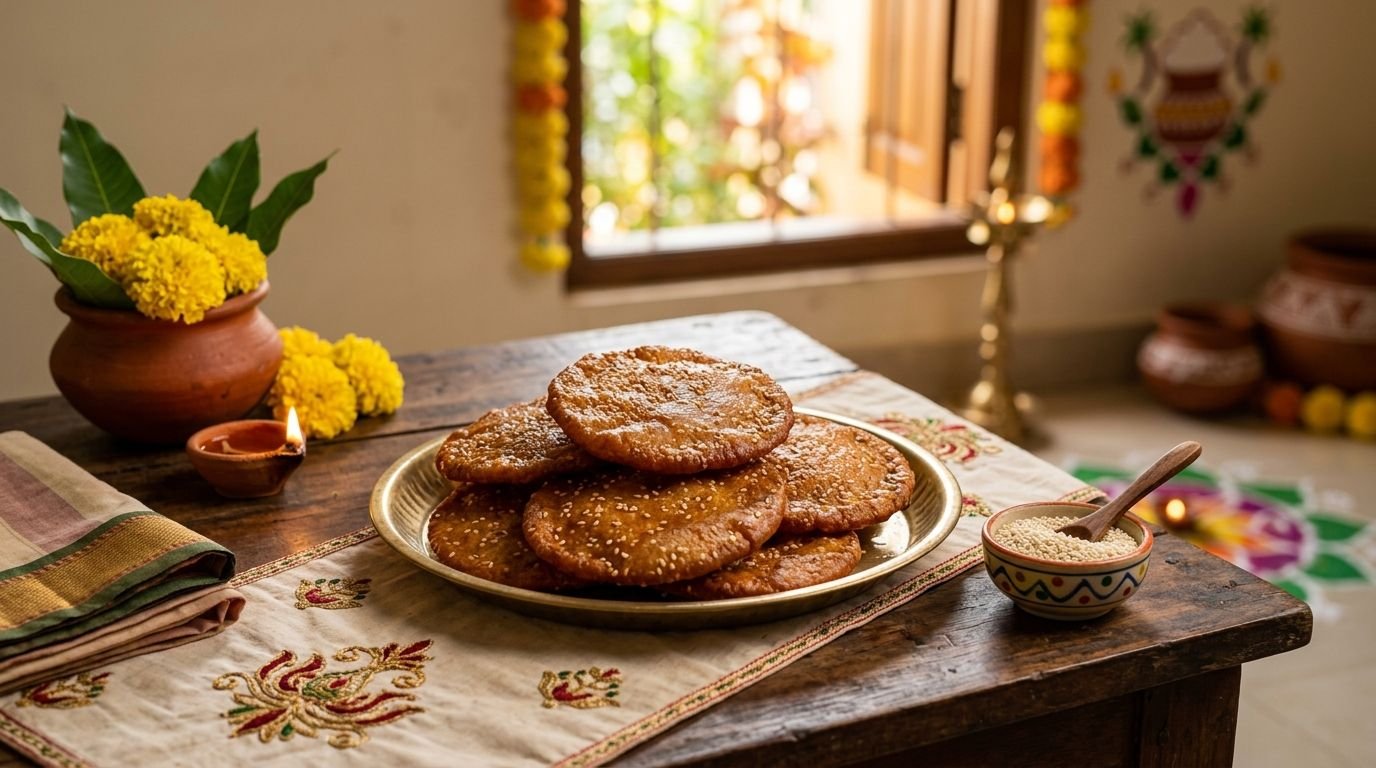
Ariselu for Sankranti gifting is a deep-fried rice-and-jaggery sweet, and for buyers outside Andhra Pradesh the real question isn't the recipe — it's whether a batch made 500 km or 5,000 miles away still tastes right after transit. Home cooks in Hyderabad have decades of practice getting the jaggery syrup and rice flour ratio right; NRIs and diaspora families craving ariselu for Sankranti 2026 usually don't have that muscle memory, and the internet is full of recipes that skip the parts that actually go wrong.
- Ariselu needs sun-dried rice flour and one-string jaggery syrup (108-110°C) — shortcuts here cause the cracking most first-timers complain about.
- Sankranti 2026 falls on January 14, and festival-week ariselu orders should be placed at least 5-7 days ahead for shipped batches.
- Store-bought rice flour mixes save time but flatten the flavor compared to fresh-ground, sun-dried flour.
- Andhra sweets shipped for Sankranti hold up better when packed airtight and shipped within 24-48 hours of frying.
- Deep-fry temperature matters more than syrup temperature for texture — 160-170°C oil keeps ariselu crisp instead of oily.
Why ariselu matters for Sankranti gift buyers
Ariselu isn't a casual snack — it's the sweet Andhra households associate with Sankranti specifically, alongside sesame and jaggery dishes tied to the harvest festival. For buyers who grew up with it, a version that tastes "close but not quite" during Sankranti 2026 reads as a miss, not a minor variation.
The segment searching for ariselu online splits into two groups: home cooks who want a reliable recipe to make it themselves, and gift buyers (often NRIs) who want it shipped ready-to-eat. Both groups run into the same failure points — cracked disks, gummy centers, syrup that seizes before it coats the rice flour. The steps below cover both paths.
Make authentic ariselu step by step
Soak and dry the rice properly
The base flour determines texture more than any other single step.
- Soak raw rice (not parboiled) for 3-4 hours, no longer, or it turns starchy
- Drain fully and spread on a cloth to air-dry until surface-dry but not bone-dry
- Grind in small batches so the flour stays fine and even
- Sieve twice to remove coarse bits that cause uneven frying
- Sun-dry the ground flour for a few hours if humidity is high — wet flour is the top cause of soggy ariselu
Get the jaggery syrup to one-string consistency
This is where most first attempts fail, and it's a temperature problem, not a taste problem.
- Melt jaggery with a small amount of water over low heat, never high
- Strain the melted jaggery to remove grit before it hits the pan again
- Cook to one-string consistency, roughly 108-110°C — test by pulling a drop between two fingers
- Undercooked syrup won't bind the flour; overcooked syrup makes the dough brittle and prone to cracking
- Work fast once you hit temperature — jaggery syrup sets within minutes of cooling
Mix the dough while the syrup is still warm
- Add rice flour gradually to warm (not hot) syrup, kneading as you go
- Add a small amount of ghee to keep the dough pliable
- Rest the dough for at least 30 minutes before shaping
- Check consistency — it should hold a ball shape without cracking at the edges
Shape and press the disks evenly
Thickness inconsistency is the second-most common complaint after cracking.
- Grease your palms or the pressing sheet with oil to prevent sticking
- Press to a uniform thickness — thick centers stay raw, thin edges burn
- Keep disk size consistent across a batch so frying time doesn't vary piece to piece
- Let shaped disks rest a few minutes before frying so they hold shape in hot oil
Fry at the right oil temperature
- Heat oil to 160-170°C before the first batch goes in — cooler oil makes ariselu absorb excess oil
- Fry in small batches so oil temperature doesn't drop
- Press disks gently with a slotted spoon while frying so they puff evenly
- Drain on a rack, not paper towels stacked flat, so trapped steam doesn't soften the base
Order from a kitchen that ships festival sweets, if time is the constraint
Not every household has a free weekend before Sankranti 2026 to run four batches through the steps above. For NRIs and buyers outside Andhra Pradesh, sourcing ariselu and other festival sweets from an Andhra kitchen that already handles shipping logistics solves the time problem — the trade-off is you're trusting someone else's syrup ratio and packing method instead of controlling it yourself. Tulasi Pickles ships Andhra sweets for festival celebrations alongside its pickle and podi range, which matters if you're building a full Sankranti spread rather than a single sweet.
- Confirm the seller ships sweets specifically for festival timing, not just pickles year-round
- Ask how the sweets are packed for transit — airtight sealing matters more for fried items than for pickles
- Check if the seller offers a combined Sankranti festival feasts spread so you're not placing five separate orders
Store and reheat without losing crispness
- Cool completely before sealing in an airtight container — trapped steam is what turns ariselu chewy
- Keep away from direct humidity; a dry steel or glass container beats plastic
- Re-crisp briefly in a low oven if disks soften after a few days, rather than microwaving
Comparing your options for Sankranti 2026
| Option | Best for | Key limitation |
|---|---|---|
| Homemade from scratch | Cooks with a free day and traditional equipment | Syrup consistency takes practice; early batches often crack |
| Store-bought rice flour mix | Quick weeknight batches, low effort | Flavor is flatter than fresh-ground, sun-dried flour |
| Local Andhra sweet shop pickup | Last-minute Hyderabad buyers | Quality varies shop to shop; no shipping option |
| Andhra sweets ordered online, like Tulasi Pickles' festival range | NRIs and buyers outside Andhra Pradesh who want it shipped | Batch availability shifts with festival demand |
Verdict: if you have a free afternoon and raw rice on hand, make it yourself — the syrup step is the only real skill barrier. If you're shipping to family abroad for Sankranti 2026, order from a kitchen that already handles festival sweets logistics rather than mailing a homemade batch that wasn't packed for transit.
Common mistakes Sankranti sweet buyers make
- Ordering too close to Sankranti. January 14 is a fixed date every year, but demand for Andhra sweets spikes the week before — orders placed with only 2-3 days of lead time often ship later than expected.
- Ignoring the muhurat and puja schedule when planning kitchen time. Many families also consult an astrologer for the exact Sankranti puja timing before deciding when to fry the first batch; if that's you, you can talk to an astrologer online for free to lock the schedule instead of guessing and rushing the jaggery stage at the last minute.
- Assuming all rice flour mixes are equal. Coarse or old flour causes cracking regardless of how well you manage the syrup.
- Storing ariselu in plastic bags instead of airtight containers. This is the single biggest cause of sweets going soft within 48 hours.
- Buying a single sweet instead of a festival combo. Sankranti spreads usually pair ariselu with sesame-jaggery items and savory sides — ordering piecemeal means juggling multiple sellers and shipping windows.
Plan your Sankranti 2026 sweets order
Browse the Andhra sweets and festival range before demand peaks in January.
FAQ
What is ariselu made of?
Ariselu is made from sun-dried rice flour bound with jaggery syrup cooked to one-string consistency, shaped into disks and deep-fried. The two failure points are undercooked jaggery syrup and low frying oil temperature.
Why does my ariselu crack while frying?
Cracking usually comes from jaggery syrup that’s overcooked past one-string stage, making the dough too brittle. Coarse or poorly sieved rice flour causes the same problem.
How long does ariselu stay fresh after shipping?
Properly fried and airtight-sealed ariselu holds its texture for about a week if kept dry; humidity and loose packaging are what cause it to soften faster.
Is ariselu the same as Bandar laddu?
No. Ariselu is a fried rice-and-jaggery disk, while Bandar laddu is a roasted gram flour and ghee sweet from Machilipatnam. Both are common Andhra festival sweets but use different bases and techniques — see the [Bandar laddu](https://tulasipickles.com/blog/bandar-laddu-for-authentic-andhra-sweet-cravings/) guide for the difference.
When is Sankranti in 2026?
Makar Sankranti falls on January 14, 2026. Festival sweet orders for shipping should go in 5-7 days ahead of that date to account for transit time.
Can I make ariselu without a deep fryer?
Yes, a heavy-bottomed kadai with enough oil to fully submerge the disks works fine. Maintaining 160-170°C oil temperature matters more than the equipment used.
What goes well with ariselu on a Sankranti plate?
Ariselu is typically served alongside sesame-jaggery sweets like [boondi laddu](https://tulasipickles.com/blog/boondi-laddu-for-festive-andhra-sweet-cravings/) or layered sweets like [pootharekulu](https://tulasipickles.com/blog/pootharekulu-for-authentic-andhra-sweet-gifting/), plus a savory pickle or podi to balance the sweetness.
Is ariselu gluten-free?
Yes, traditional ariselu uses only rice flour and jaggery, with no wheat flour in the base recipe.
One last thing
The detail most recipes skip: ariselu dough needs to rest warm, not cold. Refrigerating the dough between mixing and shaping — which some recipes suggest to make it "easier to handle" — actually stiffens the jaggery syrup and causes the exact cracking problem most first-timers are trying to avoid. Shape it while the dough is still workable and warm, not after it's cooled down.
Related guides
- Andhra sweets for festival celebrations
- Dry fruit laddus for healthy festive sweet gifting
- Sweets and snacks combo for festive gifting
- Til chikki for winter snacking cravings
- Sugar-free sweets for diabetic-friendly festive gifting