
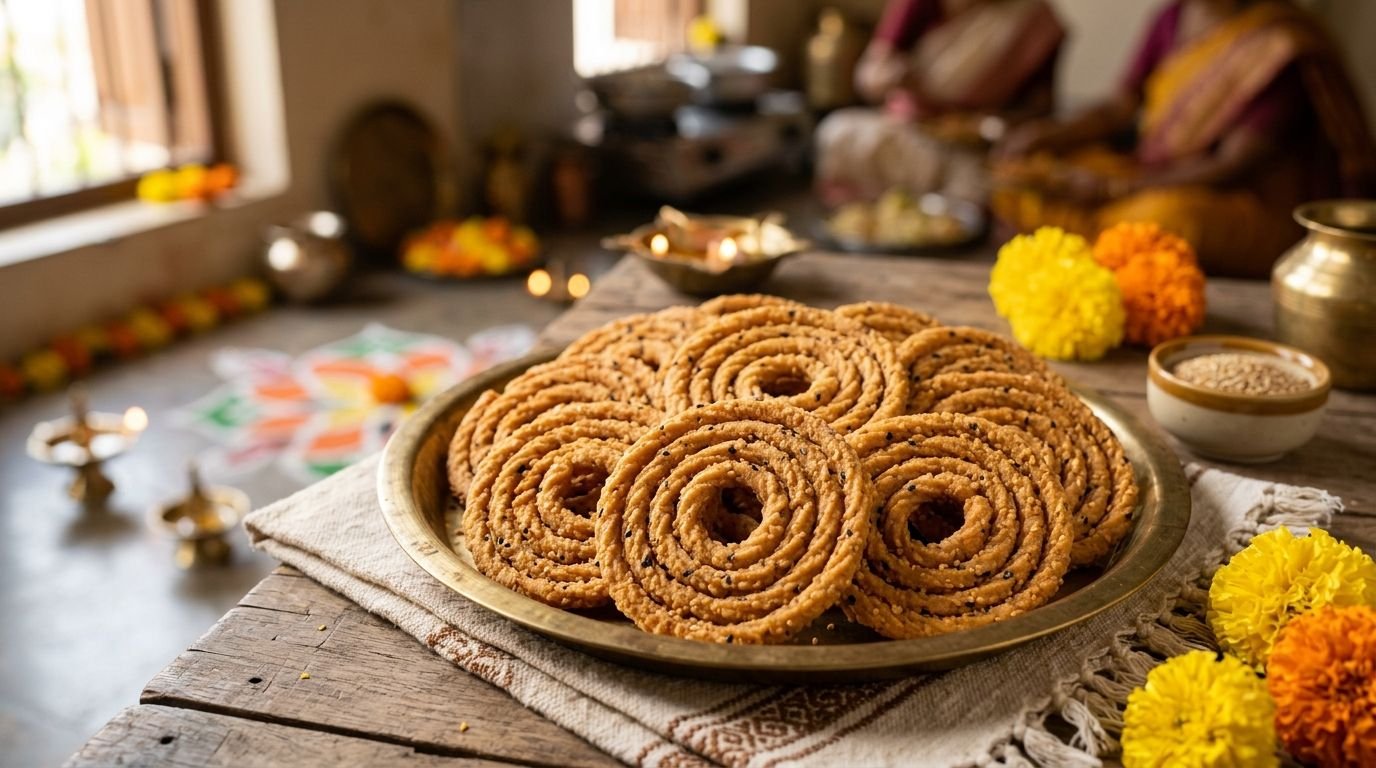
Sakinalu is the deep-fried rice-and-sesame spiral that Telugu households across Andhra Pradesh and Telangana make every Sankranti, with the aim of stocking a crunchy, weeks-long snack that survives three to four days of guests, poojas and travel. For Hyderabad hosts running a full Bhogi-to-Kanuma spread in 2026, the segment's real problem isn't the recipe — it's timing the frying, storage and gifting so sakinalu stays crisp through the whole festival window instead of going soggy or stale by day two.
- Sakinalu is a deep-fried rice-sesame spiral snack made fresh for Sankranti and stored for 2-3 weeks in an airtight tin.
- Fry at 160-170°C in small batches; higher heat browns the outside before the inside cooks through.
- A festival combo pack that pairs sakinalu-style snacks with pickles and podi cuts prep time without cutting flavor.
- Sankranti 2026 runs roughly January 14-17 (Bhogi to Kanuma), so batches made a week early hold up fine.
- Buy vs make comes down to time: homemade wins on cost, a ready combo wins on the three days before the festival.
Why sakinalu matters for Sankranti hosts
Sankranti is a harvest festival built around sharing food across four days — Bhogi, Makar Sankranti, Kanuma and Mukkanuma — and sakinalu is one of the few snacks specifically tied to the occasion rather than everyday eating. Families fry it once, in bulk, then serve it across the whole festival plus send tins home with visiting relatives.
That single-batch, multi-day use case is what makes this segment different from someone snacking on murukku on a random Tuesday. Hosts need a recipe that holds crunch for at least two weeks, a fry method that doesn't burn out by the fourth batch, and a backup plan when there's no time to fry at all. A Sankranti festival feast combo that bundles traditional accompaniments solves the backup-plan half of that equation.
Get the rice-sesame ratio right
Sakinalu dough is rice flour, black or white sesame, and a small amount of fried gram or butter worked into a soft, pliable mass. Get the ratio wrong and the spiral either cracks when piped or turns dense instead of flaky.
- Use fine, freshly ground rice flour — coarse flour makes the shell gritty
- Add sesame at roughly 2-3 tablespoons per cup of rice flour for visible crunch without bitterness
- Work in a spoon of hot oil or melted butter before kneading, not after
- Keep the dough soft enough to pipe but firm enough to hold a spiral shape
- Rest the dough 15-20 minutes before shaping the first batch
Shape the spiral without breakage
Most first-time hosts lose sakinalu at the shaping stage, not the frying stage. A cracked spiral falls apart in hot oil and wastes the batch.
- Pipe onto greased paper or a plastic sheet, never a dry surface
- Keep spiral thickness even — thick centers stay raw while thin edges burn
- Slide the shaped spiral into oil using the paper as a guide, don't lift by hand
- Shape in batches of 4-6 so the dough doesn't dry out while you wait
Fry in small batches at the right temperature
Oil temperature decides whether sakinalu turns out crisp golden or dark and bitter. Most home fryers run the oil too hot because they're rushing through a large batch before a festival deadline.
- Keep oil between 160-170°C — a small dough drop should rise steadily, not spatter violently
- Fry no more than 3-4 spirals at a time so the oil temperature doesn't crash
- Flip once the underside turns light gold, not deep brown
- Drain on a wire rack, not paper towels, so steam escapes instead of softening the base
- Let each batch cool fully before stacking — stacked hot sakinalu sweats and turns chewy
Store sakinalu for two to three weeks of crunch
Sankranti runs across multiple days in 2026, and most families fry once and serve for the full window. Storage is where homemade sakinalu succeeds or fails.
- Cool completely — at least an hour — before sealing any container
- Store in an airtight steel or glass tin, not a plastic bag that traps moisture
- Keep away from direct sunlight and stove-side humidity
- Add a small silica packet or a few curry leaves as natural moisture absorbers
- Re-crisp softened batches with a 2-3 minute dry roast on low heat before serving
Choose the faster path when frying isn't practical
Not every household has a full day to spare for dough-making, piping and frying three or four batches before guests arrive. This is where a ready festival spread earns its place on the table instead of a homemade one.
Tulasi Pickles ships a Sankranti festival feast combo built around the same festival timeline — traditional pickles, podi and snack pairings that arrive ready to serve alongside whatever sakinalu you do manage to fry. Pair it with chegodilu, the ring-shaped rice-and-sesame cousin of sakinalu, if you want two crunchy textures on the tray without doubling your frying time.
Skip a day of frying this Sankranti
Order a ready festival combo pack instead of starting from scratch.
Pair sakinalu with the rest of the Sankranti spread
Sakinalu rarely sits alone on the plate. Andhra households round out the tray with sweets and other fried snacks so guests get texture variety across a single sitting.
- Add Andhra festival sweets like laddu or ariselu for a sweet contrast to sakinalu's savory crunch
- Serve alongside a tangy pickle to cut the fried richness
- Keep a jar of spice podi on the table for guests who want a mix-with-rice option after snacking
- Offer a lighter, low-oil option for elderly guests who avoid heavy fried food
Common mistakes Sankranti hosts make with sakinalu
- Frying too early with the wrong oil temperature. Cold oil under 150°C soaks the dough instead of crisping it, leaving sakinalu greasy by day two.
- Skipping the cooling step before storage. Sealing warm sakinalu traps steam inside the tin and softens the whole batch within 24 hours.
- Making one giant batch on the last day. Rushed dough is uneven, and there's no buffer time to re-fry a failed spiral before guests arrive.
- Ignoring the festival timeline. Sankranti 2026 spans Bhogi through Kanuma across four days — frying only enough for day one leaves nothing for the rest of the visits.
- Storing sakinalu with other snacks in the same tin. Sweets and papads release different moisture levels; mixed storage speeds up staling for everything.
Homemade vs store-bought vs combo pack
| Option | Best for | Key limitation |
|---|---|---|
| Homemade sakinalu | Hosts with a full day free before the festival | Needs practice to get the fry temperature and spiral shape right |
| Store-bought fresh from a local sweet shop | Last-minute buyers near Hyderabad | Quality and crunch vary by shop and batch age |
| Festival combo pack (pickles, podi, snacks) | Hosts who want the rest of the spread sorted while they fry sakinalu themselves | Doesn't include sakinalu itself — it's a companion, not a replacement |
| Ready-to-fry frozen dough | Hosts short on prep time but comfortable frying | Texture depends on how well the dough was frozen and thawed |
Verdict: if you're frying sakinalu yourself, get the oil temperature and storage right before worrying about anything else — a Sankranti festival feast combo covers the rest of the table so your effort goes into the one snack that actually needs it.
FAQ
What is sakinalu made of?
Sakinalu is a deep-fried snack made from rice flour, sesame seeds and a small amount of fried gram or butter, shaped into a spiral and fried until golden. It’s a traditional Sankranti snack across Andhra Pradesh and Telangana.
How long does sakinalu stay crunchy?
Properly cooled and sealed in an airtight tin, sakinalu stays crunchy for 2-3 weeks. Humidity and warm storage are the two things that soften it fastest.
Is sakinalu the same as murukku?
No — sakinalu uses rice flour and sesame in a spiral shape, while murukku typically uses a urad dal and rice flour blend pressed through a mold into a coiled shape. The texture and flavor differ even though both are fried rice-based snacks.
What temperature should oil be for frying sakinalu?
Keep the oil between 160-170°C. Oil that’s too hot browns the outside before the inside cooks, and oil that’s too cool leaves the snack greasy instead of crisp.
When is Sankranti in 2026?
Sankranti 2026 falls in mid-January, with the four-day observance running from Bhogi through Kanuma. Most households fry sakinalu a few days ahead so it’s ready for the full festival window.
Can sakinalu be made without sesame?
Sesame is traditional for both flavor and crunch, but some households reduce or swap it for those with allergies. Skipping it entirely changes the characteristic nutty taste most Sankranti sakinalu is known for.
What goes well with sakinalu on a Sankranti platter?
Andhra sweets like laddu, a tangy pickle, and a spice podi round out the flavor contrast on a typical Sankranti tray. The combination balances sakinalu’s fried, savory crunch with sweet and tangy notes.
Is homemade or store-bought sakinalu better?
Homemade sakinalu wins on cost and control over crunch and oil quality if you have a free day before the festival. Store-bought works better for last-minute hosts, though quality varies by shop and batch freshness.
One last thing
The detail most first-time hosts miss: sakinalu shaped too thin burns before the center cooks, but shaped too thick, it stays doughy no matter how long it fries. Aim for a spiral roughly the thickness of a pencil — thin enough to cook through in the same window it turns gold, thick enough to survive two weeks in a tin without crumbling.
Related guides
- Chegodilu for a crunchy tea-time pairing
- Andhra sweets for festival celebrations
- Best papads to pair with Andhra meals
- Tulasi Pickles homepage